
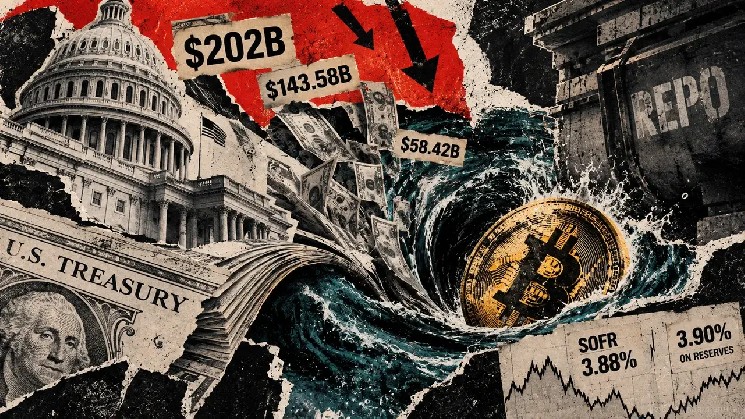

The New York Fed’s current schedule calls for roughly $15.6 billion of reinvestment purchases over Sept. 15 to Oct. 14 but no reserve-management purchases. Those are different operations: the Fed continues replacing principal from maturing mortgage securities with Treasury bills, while its separate program for adding reserves is paused. New York Fed official Roberto Perli said Sept. 22 that reserves appeared ample and funding markets had remained orderly.
Two markets to watch
SOFR, a broad measure of overnight Treasury-backed borrowing costs, was 3.88% for Sept. 24, the latest available pre-event reading as of Sunday. It had been 3.85% on Sept. 18 and 21 and remained below the 3.90% rate the Fed pays on bank reserves, according to FHLBNY. SOFR had already edged up, though FHLBNY still described financing as calm.
A quarter-end SOFR jump that promptly fades would be a weaker signal than pressure that persists relative to the Fed’s reserve rate and other repo measures. For a Bitcoin spillover, traders would also look for weakening perpetual-futures funding or a narrowing futures premium, with falling market depth, reduced leverage or weaker spot flows as corroboration. Recent CryptoSlate coverage described falling derivatives exposure amid a Treasury-yield shock before this settlement, which cannot be attributed to its repo outcome.
If repo rates and Bitcoin funding remain steady after settlement, the anticipated spillover would lack evidence. Even if Bitcoin falls while SOFR rises, timing alone would not show that Treasury financing caused the move.
