


This clash is much more than a corporate dispute over index weighting. It raises a profound structural question for contemporary capital markets: What happens when a private, for-profit index provider acquires the power to penalize corporate balance-sheet innovation, and by extension, exercise private market governance without regulatory accountability?
From Direct Exclusion to Structural Filters
To understand the current crisis, one must trace MSCI’s regulatory maneuvers over the past twelve months. In late 2025, MSCI opened a consultation specifically addressing “Digital Asset Treasury Companies,” proposing to strip index eligibility from any corporate issuer whose digital asset holdings represented 50 percent or more of its total assets. Market participants quickly recognized the measure as an explicit screen against companies that had pivoted their corporate treasuries into Bitcoin.
Facing intense pushback from issuers and institutional investors who pointed out the arbitrary nature of singling out a specific asset class, MSCI shelved that direct approach on January 6, 2026. Rather than dropping the inquiry, however, the index provider retreated to draft a more sophisticated mechanism.
On August 3, 2026, MSCI announced a broader, ostensibly asset-agnostic consultation regarding the eligibility of “non-operating companies” for the GIMI framework. Rather than naming Bitcoin directly, the new proposal establishes a two-step quantitative sieve designed to catch companies deemed to be operating primarily as holding vehicles or investment funds rather than traditional operating businesses.
The methodology proceeds in two distinct stages:
- The Core Screen: MSCI applies a primary balance-sheet test to determine whether an issuer maintains substantial operating assets. A company clears this initial hurdle if its operating assets exceed 50 percent of its total assets.
- The Exclusion Screen: For any issuer failing the core screen, MSCI applies five non-industry-specific financial ratios: operating asset intensity, expense intensity, operating cash flow, fair value intensity, and capital dependence. If a company triggers failing thresholds on at least four of these five metrics, it is classified as a non-operating company and rendered ineligible for index inclusion.
While existing constituents receive modest procedural protections—such as a more lenient 10 percent operating asset floor rather than 20 percent and a requirement to fail the screen in two consecutive annual filings before removal—the structural intent is clear. The simulation accompanying the August 2026 consultation revealed that applying the screen to the MSCI ACWI IMI universe using mid-2026 data would immediately flag and delete major public Bitcoin treasuries, including Strategy and Japan’s Metaplanet, alongside UK-based uranium holding vehicle Yellow Cake plc, while placing firms like SharpLink, Center Laboratories, and Lydia Holding onto a public watchlist.
The Targets and the Quantitative Realities
The primary focal point of this methodology is Strategy. Following its multi-year pivot into accumulating Bitcoin as its primary treasury reserve asset, Strategy has amassed over 845,050 bitcoin, making it the largest corporate holder of the asset globally. In the simulation data released by MSCI, Strategy—boasting a float-adjusted market capitalization exceeding $23.9 billion among the flagged entities—accounts for the vast majority of the affected market value.

The financial stakes of index inclusion for a company of this scale are frequently misunderstood. Critics of corporate Bitcoin strategies often assume that index exclusion triggers a terminal liquidity catastrophe. Yet empirical analysis of trading volumes reveals a more nuanced picture. Industry estimates indicate that passive funds tracking MSCI GIMI indexes hold roughly 3.1 percent of Strategy’s basic shares outstanding, amounting to approximately 13 million shares. When measured against Strategy’s robust trading velocity—where daily volume regularly absorbs hundreds of millions of dollars—that passive exposure represents less than a single average trading day.
Consequently, the true threat of MSCI’s proposal is not a mechanical liquidity shock, but rather a structural and narrative penalty. Index exclusion closes doors to specific institutional mandates, benchmark-restricted pension pools, and broad-market ETFs that are legally or contractually bound to replicate MSCI indexes. It penalizes a company not for operational failure, but for balance-sheet structure.
The Accounting and Legal Clash: GAAP versus Index Discretion
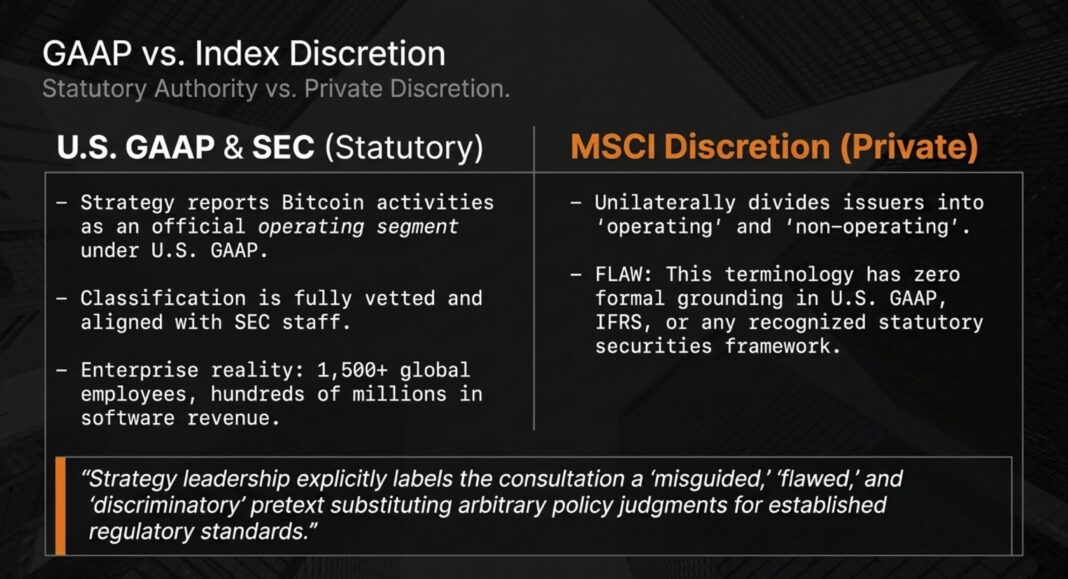
Strategy launched an aggressive counter-offensive in late August 2026, led by founder Michael Saylor and CEO Phong Le. In formal communications to MSCI and public filings, the company blasted the consultation as a “misguided,” “flawed,” and “discriminatory” pretext designed to achieve through backdoor ratio screens what MSCI failed to accomplish with its direct digital asset proposal in 2025.
The core of Strategy’s legal and accounting argument hinges on the definition of an operating business. Strategy noted that its terminology—dividing issuers into “operating” and “non-operating”—has no formal grounding in U.S. Generally Accepted Accounting Principles (GAAP), International Financial Reporting Standards (IFRS), or any recognized statutory securities framework.
Furthermore, Strategy underscored that it reports its Bitcoin activities as an official operating segment under U.S. GAAP, a classification arrived at through extensive engagement and alignment with staff at the U.S. Securities and Exchange Commission (SEC). By treating Bitcoin treasury operations, capital markets issuance, and asset management as core segments of an enterprise that employs over 1,500 people globally and generates hundreds of millions in software revenue, Strategy argues that MSCI is substituting its own arbitrary policy judgments for established regulatory and accounting standards.
In a particularly sharp rhetorical turn, Strategy’s pushback weaponized MSCI’s own historical regulatory positions. The company highlighted a 2022 SEC concept release examining whether information providers and index administrators exercise sufficient market power to bring them within the purview of the Investment Advisers Act. By forcing index providers to judge whether an asset class like Bitcoin belongs inside an operating business, MSCI risks undermining its foundational claim to absolute neutrality—the bedrock principle that index providers merely reflect market reality rather than passing moral or strategic judgment on corporate balance sheets.
The Double Standard of Asset Concentration
Beyond technical accounting definitions, the institutional debate centers on consistency. Critics of MSCI’s methodology argue that the proposed financial ratios are applied unevenly across asset classes.
Consider the treatment of real estate investment trusts (REITs) and mortgage REITs (mREITs). MSCI benchmarks routinely include entities whose balance sheets are overwhelmingly concentrated in a single asset class—commercial real estate, residential mortgages, or physical property portfolios—and whose revenues and valuations are driven entirely by external market cycles, rental yields, and continuous capital raises via debt and equity markets. These entities rely heavily on external capital dependence to scale their portfolios, mirroring the capital-raising mechanics utilized by Bitcoin treasury companies.
Yet under MSCI’s proposed framework, asset concentration and capital dependence in real estate are deemed fully compatible with index inclusion, whereas identical structural strategies executed in digital assets are classified as disqualifying non-operating traits. This disparity exposes the fundamental vulnerability of MSCI’s criteria: they rely on subjective definitions of “operations” that can easily be tailored to exclude disfavored asset classes while sheltering traditional ones.
The Structural Crisis of Private Governance
The confrontation between MSCI and Bitcoin treasury companies transcends the crypto asset ecosystem. It illuminates a broader institutional crisis concerning the unaccountable power of private index providers.
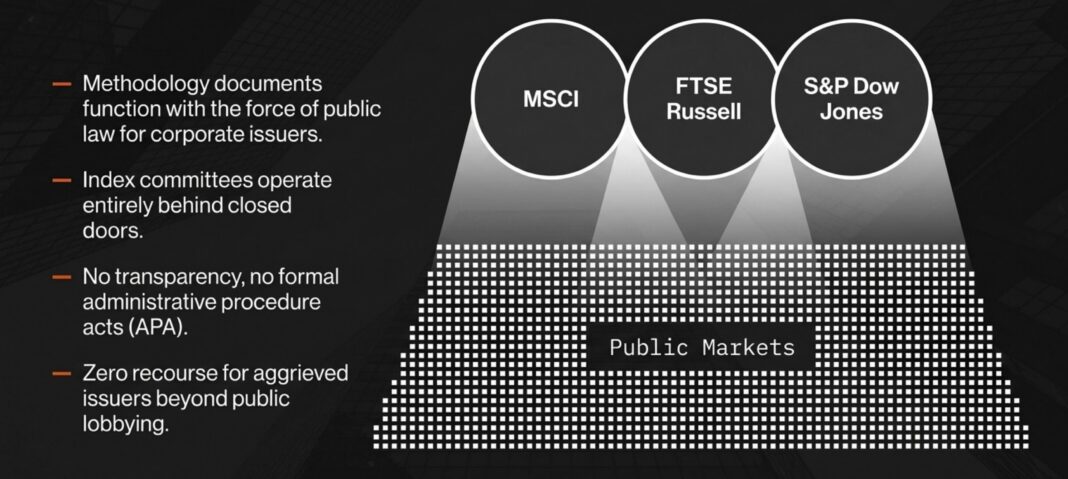
Over the past two decades, the migration of capital from active management to passive index-tracking funds has concentrated immense economic leverage in the hands of a small oligopoly of index administrators, dominated by MSCI, FTSE Russell, and S&P Dow Jones. These firms operate as private, for-profit entities, yet their methodology documents function with the force of public law for corporate issuers.
When an index provider unilaterally alters its inclusion rules to penalize specific corporate treasury models, it engages in private market governance. Unlike regulated public exchanges or statutory securities regulators, index committees operate behind closed doors, subject to limited public transparency, no formal administrative procedure acts, and virtually no recourse for aggrieved issuers other than public lobbying.
If MSCI succeeds in establishing the precedent that holding non-traditional reserve assets on a corporate balance sheet strips a public company of its operating status, it creates a dangerous chilling effect. Today, the target is Bitcoin; tomorrow, it could be corporate holdings of physical commodities, strategic technology stakes, gold, real estate, data centers or alternative monetary reserves that conflict with the prevailing preferences of institutional ESG or benchmark committees. Corporate directors lose the sovereign right to optimize their balance sheets for shareholder value if doing so risks excommunication from the passive capital ecosystem.
The Timeline, the Stakes, and the Regulatory Reckoning
The immediate resolution of this conflict is rapidly approaching. The public consultation period for MSCI’s non-operating company proposal closes on September 30, 2026, with a final determination expected by October 16, 2026. If adopted in its current form, constituent reclassifications will be published on November 11, 2026, and implemented on December 1, 2026.

Yet for institutional investors, asset managers, and corporate executives, the stakes extend far beyond the ticker symbol MSTR. The outcome will test whether public companies retain the autonomy to innovate their balance sheets in an era dominated by passive gatekeepers, or whether benchmark administrators have officially crossed the line from measuring markets to regulating them.
The solution does not lie in government micromanagement of index design, but in statutory accountability. The U.S. Securities and Exchange Commission and global securities regulators must stop treating index providers as invisible software plumbing. When an index committee’s discretionary classifications can dictate corporate access to capital, distort price discovery, and bypass standard administrative notice-and-comment safeguards, that committee is acting as a de facto market regulator.
Regulators must revisit the framework governing dominant index providers under the Investment Advisers Act, demanding transparent due process, strict standards against arbitrary discrimination, and formal accountability for decisions that alter capital formation.
Until market authorities recognize that index providers have become systemic gatekeepers, the free market for corporate control will no longer be governed by shareholders, boards, and public statutes—it will remain at the mercy of unelected private arbiters in New York and London.
Take Action to Protect Index Neutrality
The boundary between measuring market value and regulating corporate behavior is being erased. MSCI’s proposed “non-operating company” screen threatens to penalize balance-sheet innovation, misclassify legitimate operating businesses, and set a dangerous precedent for private governance in capital markets.
Don’t let private index administrators dictate corporate treasury strategy behind closed doors. The public consultation window closes on September 30, 2026.
Disclaimer: This content was prepared on behalf of Bitcoin For Corporations for informational purposes only. It reflects the author’s own analysis and opinion and should not be relied upon as investment advice. Nothing in this article constitutes an offer, invitation, or solicitation to purchase, sell, or subscribe for any security or financial product.
This post How MSCI Shifted from Objective Benchmark to Defacto Market Regulator first appeared on Bitcoin Magazine and is written by Nick Ward.
