

Bitcoin has always been about money. That was the whole point: a peer-to-peer electronic cash system, nothing more. So when people started inscribing JPEGs, text files, and even small video clips directly onto the Bitcoin blockchain in early 2023, it felt like someone had spray-painted graffiti on a cathedral. Some Bitcoiners loved it. Others were furious. But regardless of where you stand, Bitcoin Ordinals represent one of the most significant shifts in how people think about and use the oldest blockchain. Understanding what Bitcoin Ordinals actually are, how they function at a technical level, and why they’ve sparked such intense debate requires looking at several layers of innovation that made them possible. The concept is simpler than most explanations make it seem, but the implications run deep, touching everything from miner economics to the philosophical identity of Bitcoin itself. Here’s the full picture.
Defining Bitcoin Ordinals and Inscriptions
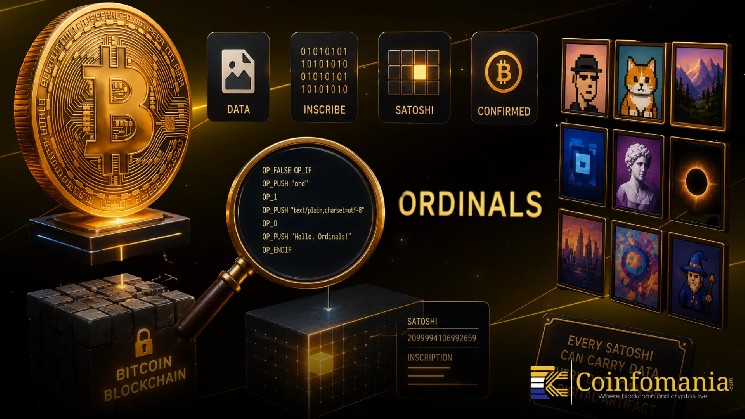
The Ordinals protocol, created by Casey Rodarmor and launched in January 2023, introduced a system for numbering individual satoshis (the smallest unit of Bitcoin) and attaching data to them. Think of it like serializing dollar bills: every single bill already exists, but now each one gets a unique number and can carry a tiny piece of art or text stapled to it. That “stapling” is what the protocol calls an inscription.
An inscription can be an image, a text file, audio, video, or even a small application. The data lives entirely on the Bitcoin blockchain, stored forever as long as Bitcoin exists. This is fundamentally different from most $NFT systems, where the actual media file often lives on a separate server or IPFS, with only a reference link stored on-chain.
The Concept of Satoshis as Individual Units
One Bitcoin contains 100 million satoshis, often called “sats.” Before Ordinals, every sat was identical and interchangeable: one sat was worth exactly the same as any other. The Ordinals protocol changed this by assigning each sat a sequential number based on the order it was mined. The very first sat ever created (in Bitcoin’s genesis block) is ordinal number zero. The second is number one. And so on, all the way up to the trillions of sats that exist today.
This numbering system creates what collectors call “rare sats.” A sat mined in the first block, or the first sat of a halving epoch, or the first sat of a new difficulty adjustment period carries special significance. Some collectors have paid substantial premiums for sats with historically notable ordinal numbers, treating them like rare stamps or coins.
Ordinal Theory: Serializing the Bitcoin Blockchain
Ordinal theory is the mathematical framework that makes tracking individual sats possible. It follows sats through transactions using a first-in, first-out method. When a transaction has multiple inputs and outputs, the protocol traces which specific sats end up where based on their position in the transaction.
This tracking is entirely a social convention: the Bitcoin protocol itself doesn’t recognize ordinal numbers. Nodes don’t validate ordinal assignments. Instead, the Ordinals community runs its own indexing software (like the ord client) that reads the blockchain and calculates which sat is where. It’s a layer of meaning imposed on top of Bitcoin’s existing data, not a modification to Bitcoin’s code.
The Technical Foundation: SegWit and Taproot
Ordinals didn’t appear out of thin air. They were made possible by two major Bitcoin upgrades that, ironically, were designed for completely different purposes. Without SegWit (2017) and Taproot (2021), inscriptions as we know them couldn’t exist.
How SegWit Expanded Block Capacity
Segregated Witness, activated in August 2017, separated transaction signature data from the main transaction data. This created a new area called the “witness” section, which receives a 75% discount on fees compared to regular transaction data. The practical effect was increasing Bitcoin’s effective block size from 1 MB to roughly 4 MB (measured in “weight units”).
SegWit’s designers intended this extra space for signature data and payment channel operations like Lightning Network transactions. Nobody anticipated that the discounted witness space would eventually become a canvas for digital art. But that fee discount is precisely what makes inscriptions economically viable: storing data in the witness section costs roughly one-quarter of what it would cost in regular transaction space.
Taproot Upgrades and Data Storage Limits
The Taproot upgrade, activated in November 2021, removed a previous limit on the size of data that could be stored in the witness section of a transaction. Before Taproot, witness scripts were capped at around 10,000 bytes. After Taproot, the only real constraint is the overall block weight limit of 4 million weight units.
This means a single Taproot transaction can theoretically fill an entire block with data: roughly 400 KB of arbitrary content. Rodarmor recognized this opening and built the Ordinals protocol to take advantage of it. Inscriptions are stored in Taproot script-path spend scripts, tucked inside the witness data of a transaction. The Bitcoin network processes them like any other valid transaction.
How the Inscription Process Works
Creating an inscription is a two-step process that happens across two Bitcoin transactions. It’s more involved than minting an $NFT on Ethereum, but the result is a piece of data permanently embedded in the most secure blockchain in existence.
Attaching Digital Artifacts to Satoshis
The first transaction (called the “commit”) creates a Taproot output containing a script that references the inscription data. The second transaction (the “reveal”) spends that output, which causes the full inscription data to be published on-chain. Once the reveal transaction is confirmed by miners and included in a block, the inscription is permanently associated with a specific sat.
Users typically interact with this process through wallet software like Xverse, Unisat, or Magic Eden’s Ordinals marketplace, which handle both transactions automatically. The cost depends on the file size and current network fee rates. During peak demand periods in 2023 and 2024, inscribing a single image could cost anywhere from $5 to over $200 in fees.
On-Chain vs. Off-Chain Storage Differences
This is where Ordinals differ most dramatically from typical NFTs. An Ethereum $NFT usually stores a token ID on-chain that points to metadata hosted elsewhere: maybe IPFS, maybe Arweave, sometimes just a company’s web server. If that external storage disappears, the $NFT’s content vanishes too. The token still exists, but it points to nothing.
Ordinals store everything on Bitcoin’s blockchain directly. The image, the text, the audio file: it’s all there in the transaction data. As long as Bitcoin nodes store the full blockchain (which they will, because that’s how Bitcoin works), the inscription persists. There’s no external dependency. This permanence is both the strongest selling point and the biggest criticism of the system.
Ordinals vs. Traditional Ethereum NFTs
The comparison between Bitcoin Ordinals and Ethereum-based NFTs reveals fundamentally different design philosophies rather than just technical differences.
Immutable Content and Permanent Storage
Ethereum NFTs can be updated. The smart contract owner can change the metadata URI, point the token to different content, or even freeze the contract. This flexibility is useful but introduces trust assumptions. You’re trusting that the creator won’t rug-pull the art or that the hosting service won’t go offline.
Ordinal inscriptions are immutable once confirmed. Nobody can alter the data after it’s written to the blockchain: not the creator, not a platform, not anyone. This appeals to collectors who want true digital permanence, but it also means mistakes are permanent. Inscribe the wrong file, and there’s no undo button.
Lack of Smart Contract Dependencies
Bitcoin doesn’t have a general-purpose smart contract layer like Ethereum’s EVM. Ordinals exist purely as data attached to sats, with no programmable logic governing their behavior. There are no royalty enforcement mechanisms built in, no automatic auction systems, and no composability with DeFi protocols (at least not natively on Bitcoin’s base layer).
This simplicity is a feature for some and a limitation for others. Ethereum’s $NFT ecosystem offers richer functionality: royalties, dynamic metadata, integration with lending protocols. Bitcoin’s approach offers stronger guarantees about permanence and censorship resistance. The tradeoff is real, and which matters more depends entirely on what you’re trying to do.
The BRC-20 Token Standard and Ecosystem
Shortly after Ordinals launched, a developer known as “domo” introduced BRC-20 tokens in March 2023: a way to create fungible tokens on Bitcoin using inscription data. The name is a nod to Ethereum’s ERC-20 standard, but the mechanism is entirely different.
BRC-20 tokens work by inscribing JSON data onto sats that defines a token’s name, supply, and transfer rules. There’s no smart contract. Instead, off-chain indexers read inscription data and maintain a ledger of who owns what. Tokens like $ORDI and SATS gained significant market capitalizations, with $ORDI reaching over $1 billion in late 2023.
The BRC-20 standard has evolved through several iterations, and competing standards like Runes (also created by Rodarmor, launched April 2024) have emerged as more efficient alternatives. Runes uses Bitcoin’s OP_RETURN field instead of inscriptions, producing less “junk” UTXO data. By 2026, the ecosystem includes multiple token standards coexisting on Bitcoin, each with different tradeoffs around efficiency, decentralization, and feature sets.
Impact on the Bitcoin Network and Future Outlook
Ordinals have forced the Bitcoin community to confront questions it had largely avoided: what is Bitcoin’s block space for, and who gets to decide?
Effects on Transaction Fees and Miner Revenue
Inscriptions have been a significant revenue boost for miners. During peak inscription activity, fees have sometimes exceeded the block subsidy reward. In May 2023, Bitcoin miners earned over $17 million in a single day from transaction fees, largely driven by BRC-20 minting activity. This matters because Bitcoin’s block subsidy halves every four years (most recently in April 2024), and miners need fee revenue to remain profitable long-term.
Some analysts argue that Ordinals are actually solving one of Bitcoin’s biggest unsolved problems: how to sustain miner security budgets as the subsidy approaches zero. If inscription and token activity maintains consistent fee pressure, it provides an economic incentive for miners to keep securing the network decades from now.
Community Debates Regarding Network Congestion
The flip side is real congestion. When inscription activity spikes, regular Bitcoin transactions get priced out. Users sending payments have to compete with inscribers for block space, and fees rise for everyone. During the busiest periods, simple Bitcoin transfers have cost $30 or more, which is painful for users in developing countries who rely on Bitcoin for everyday payments.
Bitcoin developers remain split. Some have proposed filtering inscription transactions at the node level. Others argue that any valid transaction that pays sufficient fees deserves inclusion, and that trying to censor certain transaction types undermines Bitcoin’s censorship-resistant properties. This debate isn’t going away anytime soon, and it touches on the deepest questions about Bitcoin’s purpose and governance.
Where This All Heads
Bitcoin Ordinals have permanently expanded what people think Bitcoin can do. Whether you view inscriptions as innovative or wasteful, they’ve proven that Bitcoin’s block space has value beyond simple monetary transfers. The technology works, the demand exists, and the ecosystem continues to mature with better tooling, more efficient token standards, and growing marketplace infrastructure.
If you’re considering collecting or creating inscriptions, start by understanding the fee dynamics and choosing a reputable wallet that supports Ordinals. Keep an eye on how Runes and newer protocols develop alongside the original inscription standard. And whatever you do, remember that everything you inscribe on Bitcoin is there forever: choose wisely.
