

The timing lines up with two big launches beginning to gain traction. Binance enabled bStocks in June and Robinhood Chain’s public blockchain went live in July. Since then, Robinhood Chain has become the second largest chain for tokenized stock deposits in about three months, a clear sign of how quickly brokerage-scale distribution can reshape onchain market share.
Solana and xStocks Hold the Top Spots
In terms of Tokenized Stocks DeFi TVL by chain, Solana leads the pack with $102.6 million, or 34.2% market share. In second and third place are Robinhood Chain and Ethereum respectively. With $BNB chain at $42.8 million and Base at $24.3 million, the top five chains make up about 96% of all deposits.
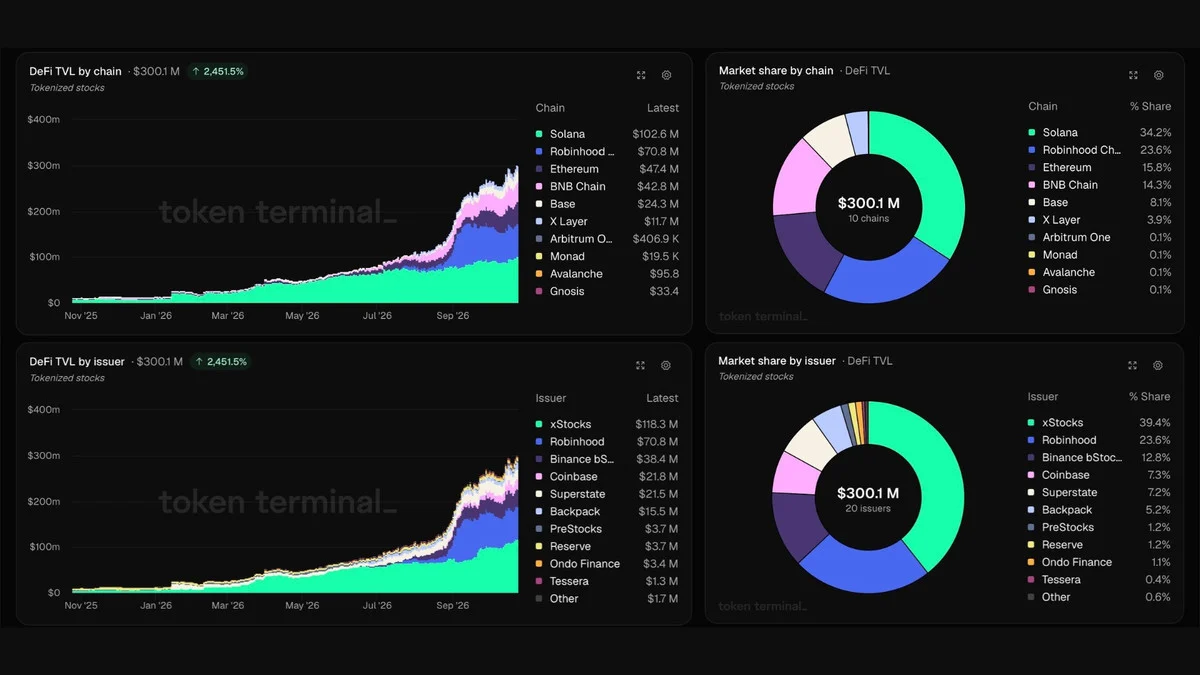
The issuer side is just heavily concentrated. xStocks holds over 39% of the market with $102.6 million ahead of Robinhood at $70.8 million and Binance’s bStocks at $38.4 million. Ondo Finance, one of the better known names in tokenized equities, accounts for just $3.4 million.
xStocks got there early. Its tokens are issued natively on Solana and have been plugged into lending markets like Kamino since July 2025, alongside liquidity pools on AMMs like Raydium. bStocks has grown past $1 billion in assets, yet only about $38 million of it sits in DeFi. Most bStocks are minted inside Binance accounts and appear to stay there, and the exchange now accepts them as margin for futures trading, none of which shows up in DeFi data.
Only 6.8% of Tokenized Stocks Are Being Put to Work
The total tokenized stock market is worth $4.4 billion, up 254.3% over the past 180 days and spread over 13,411 stocks from 36 issuers on 18 different chains. DeFi deposits make up only about 6.8% of that. If utilization climbs even modestly, DeFi deposits could grow faster than issuance itself.
The race for this collateral is turning into a contest between distribution models. Solana brings crypto-native liquidity and Robinhood Chain has a retail brokerage base behind it. $BNB Chain leans on Binance’s exchange users, while Base has Coinbase.
There’s also a use case brokerages can’t offer. Stocks that trade around the clock and plug into lending protocols mean someone could borrow against NVDA on a Sunday or LP TSLA while Wall Street is closed. For now, only a small slice of the market is doing that.
