
Close Menu
  • Coins
    • Bitcoin
    • Ethereum
    • Altcoins
    • NFT
  • Blockchain
  • DeFi
  • Metaverse
  • Regulation
  • Other
    • Exchanges
    • ICO
    • GameFi
    • Mining
    • Legal
  • MarketCap
What's Hot

South Korea weighs liquidity rules for won stablecoins

29/09/2026

The Quantum Issue: WTF Is Quantum Computing?

29/09/2026

FED Member Goolsbee on Inflation, Bessent on Warsh!

29/09/2026
Facebook X (Twitter) Instagram
  • Back to NBTC homepage
  • Privacy Policy
  • Contact
X (Twitter) Telegram Facebook LinkedIn RSS
NBTC News
  • Coins
    1. Bitcoin
    2. Ethereum
    3. Altcoins
    4. NFT
    5. View All

    The Quantum Issue: WTF Is Quantum Computing?

    29/09/2026

    Bitcoin Rally Cools, But a Golden Cross Is Coming

    29/09/2026

    Bitcoin price loses $78K as Supertrend turns bearish

    28/09/2026

    Bitcoin Price Tests Key Support Line With Sellers Missing All Month

    28/09/2026

    Ethereum’s Vitalik Buterin Explains Hybrid Architecture

    28/09/2026

    Vitalik Buterin maps Ethereum’s shift beyond a blockchain in sweeping 2030 vision

    28/09/2026

    Ethereum Glamsterdam upgrade enters final phase ahead of October testnet

    28/09/2026

    SEC staff’s staking-token split spotlights the exit risks behind staked ETH tokens

    28/09/2026

    Sui’s Hashi Set to Revolutionize Bitcoin Usage Amid $1T Idle

    29/09/2026

    RippleX Ships Batch V1.1 Amendment for XRP Ledger After Fixing Critical Bug

    29/09/2026

    Solana Raises Maximum Transaction Size to 4,096 Bytes as txv1 Goes Live

    28/09/2026

    Zcash holders overwhelmingly back faster transactions and bitcoin-style halvings

    28/09/2026

    Justin Bieber’s $1.3 Billion Bored Ape NFT is Worthless—Blockstream CEO

    28/09/2026

    The NFT party is over and everybody now owes storage rent

    27/09/2026

    How to reclaim your rescued NFTs after legacy Magic Eden approval exploit

    26/09/2026

    NFT sales rise 57.17% to $55.5M as Ethereum leads

    26/09/2026

    South Korea weighs liquidity rules for won stablecoins

    29/09/2026

    The Quantum Issue: WTF Is Quantum Computing?

    29/09/2026

    FED Member Goolsbee on Inflation, Bessent on Warsh!

    29/09/2026

    Sui’s Hashi Set to Revolutionize Bitcoin Usage Amid $1T Idle

    29/09/2026
  • Blockchain

    EU financial watchdogs warn quantum computing poses imminent threat to blockchain encryption

    28/09/2026

    Circle expands CCTP to EURC and cirBTC on Arc

    28/09/2026

    Hedera Expands Enterprise Open Source Commitment Via Linux Foundation Contribution

    28/09/2026

    Brazil’s Energy Market Tokenizes Supply on Solana Platform

    28/09/2026

    Bullish, Alpaca and Apex Fintech form coalition to push issuer-backed tokenized stocks

    28/09/2026
  • DeFi

    Aave’s live stock-token loans expose USDC lenders to a weekend price gap

    28/09/2026

    EU faces September 30 clock to decide future of DeFi loans

    27/09/2026

    AlphaFi Winds Down After Oracle Error, With Sui Foundation Support

    27/09/2026

    Morpho Blames AI Marketing Tool for Deleted Post Saying Its Own Curator Business Model is Broken

    27/09/2026

    Coinbase tokenized stocks go live on Aave V4 on Base

    26/09/2026
  • Metaverse

    Is Solana Gaming Back? Kintara Activity Fuels Renewed Optimism in Onchain MMOs

    24/06/2026

    The Sandbox launches AI game engine ‘The Sandbox Studio’ for next-generation creators

    10/06/2026

    Meta commits $13M in funding for Oversight Board through 2028

    29/05/2026

    Why Animoca’s Yat Siu says the future is 100 billion AI agents

    07/05/2026

    ‘8,000 Jobs’—Polymarket Sees Tech Layoff Surge As Meta AI Push Bites

    18/04/2026
  • Regulation

    FED Member Goolsbee on Inflation, Bessent on Warsh!

    29/09/2026

    Bitcoin ETFs Flip From $426M Outflow to $6M Weekly Inflow

    28/09/2026

    Why this investment bank expects little demand for tokenized stocks despite SEC’s new trading rules

    28/09/2026

    SparkLabs, Mirae Asset launch fund targeting Central Asia startups

    28/09/2026

    Evernorth adds $30M boost ahead of Nasdaq vote

    28/09/2026
  • Other
    1. Exchanges
    2. ICO
    3. GameFi
    4. Mining
    5. Legal
    6. View All

    South Korea weighs liquidity rules for won stablecoins

    29/09/2026

    Visa cuts reported stablecoin volume but there’s no proof payments fell

    29/09/2026

    Trader’s $67.88M Long on Solana Could Yield $65M Profit

    29/09/2026

    OKX Announces 24/7 Trading Capability for Tokenized Stocks

    28/09/2026

    ICO market slows sharply with only six completions in 2026

    30/04/2026

    South Korea Poised to Lift Ban on Domestic ICOs After 7 Years

    19/12/2025

    Why 2025’s Token Boom Looks Both Familiar and Dangerous

    31/10/2025

    ICO for bitcoin yield farming chain Corn screams we’re so back

    22/01/2025

    Top 12 NFT games every player should know about in August 2026

    19/08/2026

    GameShame Studios founder details Raijin Protocol’s roadmap in NeoPod’s sixth AMA

    13/08/2026

    How BC.GAME is turning players into stakeholders

    04/08/2026

    YGG Play Shuts Down Services as Yield Guild Pivots to AI Data

    01/08/2026

    Riot Platforms repays $200M credit facility, releases collateral

    28/09/2026

    Bitcoin hashrate falls to 3-week low as miners cut BTC

    27/09/2026

    Will Kazakhstan’s new Bitcoin mining strategy evolve into an AI compute playbook?

    27/09/2026

    Bitcoin Miner Hive Escalates Swedish VAT Dispute to European Commission

    26/09/2026

    Crypto market structure can’t wait for shot at post-election Clarity Act surge: White House

    29/09/2026

    Republican senator calls for probe into US presidents’ sons, citing crypto ventures

    28/09/2026

    ECB backs Tether’s MiCA concern—but USDT’s EU problem remains

    28/09/2026

    U.S. regulator warns about cheating risks in ‘mention markets’ on prediction platforms

    28/09/2026

    South Korea weighs liquidity rules for won stablecoins

    29/09/2026

    The Quantum Issue: WTF Is Quantum Computing?

    29/09/2026

    FED Member Goolsbee on Inflation, Bessent on Warsh!

    29/09/2026

    Sui’s Hashi Set to Revolutionize Bitcoin Usage Amid $1T Idle

    29/09/2026
  • MarketCap
NBTC News
Home»Bitcoin»The Quantum Issue: WTF Is Quantum Computing?
Bitcoin

The Quantum Issue: WTF Is Quantum Computing?

NBTCBy NBTC29/09/2026No Comments7 Mins Read
Share
Facebook Twitter LinkedIn Pinterest Email


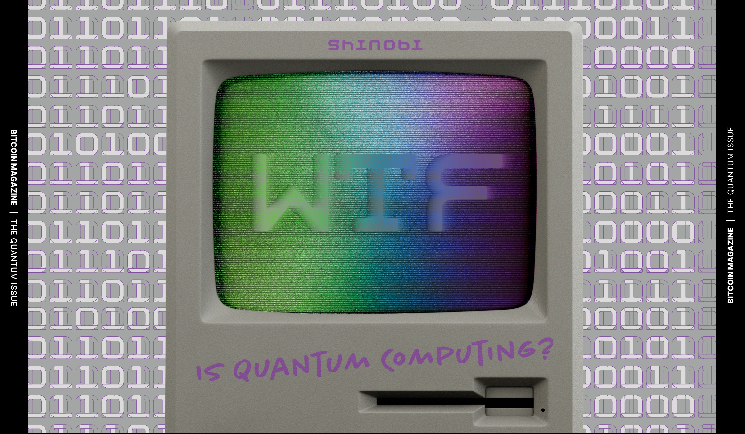
Quantum computers are not just “computers, but faster.” They function in a very fundamentally different way from a classical computer, and as such they are much more efficient than classical computers at very specific kinds of computations. Now obviously, I’m not going to actually explain how quantum computers work in minute detail within four pages, but I will give you the core intuition of how they are fundamentally different from a classical computer.

So let’s take a look at how both kinds of computers interact with things like large cryptographic keys.

Classical Computers

Everything stored in a classical computer (or just computer from here on out) is stored as a series of 1s and 0s. Each bit (1 or 0) is precisely a 1 or 0; there is no ambiguity. When a piece of data is stored, it’s 1s and 0s. When a piece of data is manipulated or modified, it is done bit by bit, step by step, on each 1 or 0.

That is how a computer works. It linearly, one step after the other, modifies the discrete unambiguous pieces of data that it is storing. It can’t skip ahead, or shortcut (in terms of the steps it’s taking, not more efficient ways to do things mathematically), it has to go through the steps of whatever computation it is doing one by one.

When you generate a private key using a computer, it acquires a random value (you inputting dice, general user input, randomness from device hardware, etc.) and stores that in memory as 1s and 0s. From there it has to multiply this value by the elliptic curve’s generator point to get a public key. This is accomplished with an algorithm, that boiled down to its most basic level, is literally instructions on what bits to take, how to modify them, what circuits to “push” them down on a physical level to accomplish that, and in the end put the new value that has been modified bit by bit back into memory.

There are other steps to arrive at an actual valid address, but for the purposes of this article those are not necessary to go into (but they are just like the above step, just step by step instructions on how to modify 1s and 0s in memory).

So what if someone wanted to use a computer to guess someone else’s private key?

There are 2256 possible private keys. That’s 115,792,089,237,316,195,423,570,985,008,687,907,853,269,984,665,640,564,039,457,584,007,913,129,639,936 different possible keys.

A computer would have to try every single one of those possible private keys, one after the other (or however many at a time it can do in parallel), step by step following the exact instructions above for generating keys. The more of them you try to check in parallel, the more computing power you need, with no ability to find any shortcuts around that cost.

The less computing power you want to use, the more time it will take, the less time you want it to take, the more computing power you need.

This is an impossible task to accomplish with a computer. On one side you have a computation cost that every computer on Earth is not enough to pay, and on the other side you have a cost in time that is so high every star in the universe would die before you checked them all.

To actually accomplish your goal, you need another option besides checking one by one linearly or in parallel. That’s where quantum computing comes in.

Quantum Computers

Quantum computers don’t work with discrete states. Everything is precisely a 1 or a 0. The most basic piece of information in a quantum computer is a qubit (the quantum version of a bit). Unlike a bit, a qubit is in a superposition where it is both simultaneously a 1 and a 0. It only settles into one or the other discrete states when it is observed.

This is one of the key building blocks that allow a quantum computer to compute differently. The other is entanglement. Qubits aren’t just stored in isolation, the physical atoms representing them and collapsing to a discrete state when observed are entangled together. This means when entangled atoms are observed and collapse to a single state, the entangled atoms collapse to the same state, no matter how far apart they are.

Now here’s where things get weird, and I’m going to have to get a little hand-wavy; you should still walk away with an intuitive understanding of why quantum computers are fundamentally different from a classical computer. An algorithm on a classical computer is a set of instructions to take a specific set of bits, and step by step modify them according to the algorithm’s instructions, until finishing and outputting the finished set of new bits. So the algorithm step by step takes one discrete state and turns it into another.

Qubits don’t store discrete states until they are observed and collapse to one. They store probabilities. When you have a set of qubits entangled of any given size (like in this hypothetical case 2256), each given possible state that it collapse to has a certain probability of collapsing to that given state.

Quantum algorithms, rather than being step by step instructions to operate on discrete states, are a set of instructions on how to operate on those entangled qubits in a way that alters the probabilities of different outcomes. Constructive interference is used to increase the probability of a correct outcome, and destructive interference to decrease the probability of incorrect outcomes (note that this is NOT the noise or interference that makes it difficult for physical quantum computers to function accurately, that is a different concept).

So while a classical computer would have to check each individual private key one by one to find the one matching a specific public key, a quantum computer can simply run a few times using the right algorithm and arrive at the correct answer. It does not do this by “checking all the possibilities at once.” It simply modifies the probabilities of what a superposition will collapse into.

This is why a quantum computer could break the assumptions underlying elliptic curve cryptography, and a classical computer could not (and it is also why quantum computers are only useful for certain types of computations with a massive possible space of answer candidates to check).

Don’t Panic

This fundamental difference between classical and quantum computation means, that yes, if a viable quantum computer is actually produced, that functions correctly, then the underlying assumption that secures all Bitcoiners’ individual bitcoin is broken. All of those funds are insecure.

Yes, this is a serious risk if such a device is actually manufactured, and it works, but we are not entirely unprepared. We understand the problem, we understand the exposure, and a good number of possible solutions to many different facets of the problem are coming together.

Breathe, and relax. Through the rest of this issue we are going to walk you through the whole problem.

This piece is featured in the latest Print edition of Bitcoin Magazine, The Quantum Issue. We’re sharing it here as an early look at the ideas explored throughout the full issue.

This post The Quantum Issue: WTF Is Quantum Computing? first appeared on Bitcoin Magazine and is written by Shinobi.

Share. Facebook Twitter Pinterest LinkedIn Tumblr Email
NBTC

NBTC is the editorial account for NBTC News, covering Bitcoin, Ethereum, DeFi, blockchain infrastructure, exchanges, mining, regulation and digital asset markets. The editorial team focuses on clear sourcing, timely updates and practical context for crypto readers.

Related Posts

Bitcoin Rally Cools, But a Golden Cross Is Coming

29/09/2026

Bitcoin price loses $78K as Supertrend turns bearish

28/09/2026

Bitcoin Price Tests Key Support Line With Sellers Missing All Month

28/09/2026

Bitcoin Suffers On Renewed US-Iran Fighting

28/09/2026
Add A Comment

Comments are closed.

Top Posts
Get Informed

Subscribe to Updates

Get the latest news from NBTC regarding crypto, blockchains and web3 related topics.

Your source for the serious news. This website is crafted specifically to for crazy and hot cryptonews. Visit our main page for more tons of news.

We're social. Connect with us:

Facebook X (Twitter) LinkedIn RSS
Top Insights

South Korea weighs liquidity rules for won stablecoins

29/09/2026

The Quantum Issue: WTF Is Quantum Computing?

29/09/2026

FED Member Goolsbee on Inflation, Bessent on Warsh!

29/09/2026
Get Informed

Subscribe to Updates

Get the latest news from NBTC regarding crypto, blockchains and web3 related topics.

Type above and press Enter to search. Press Esc to cancel.