
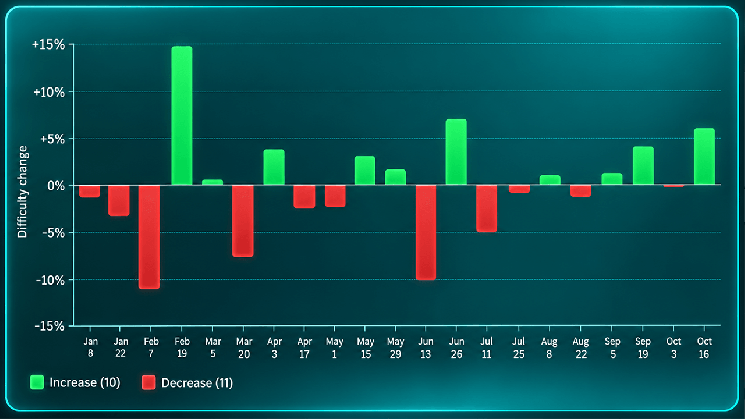

Bitcoin Mining Difficulty Hits Seven-Month High After 5.92% Increase
The network’s difficulty, basically how hard miners must work to find the next Bitcoin block, increased from 132.72 trillion to 140.58 trillion. It was the third-largest increase of the year and continued a recovery that began over the summer. Metrics show that Bitcoin has logged a total of 21 difficulty adjustments this year, with the latest being the 10th rise.
The increase coincided with bitcoin’s price spike, which led to better revenue for miners. On Sept. 16, the hashprice, which measures the estimated daily revenue generated by a single petahash per second (PH/s) of computing power, stood at $37.56 before climbing above $41 on two occasions over the past 30 days, including Oct. 2.
Bitcoin Hashrate Reclaims 1 ZH/s
For much of the past 30 days, mining revenue hovered between 6% and 9% above its Sept. 16 level, but by Friday, Oct. 16, the hashprice had retreated to $36.75 per petahash per second. The improved revenue environment encouraged greater miner participation, propelling Bitcoin’s total network hashrate back above 1,000 exahash per second (EH/s), equivalent to 1 zettahash per second (ZH/s).
