


Notably, the downside was amplified when BitMine’s chairman, Tom Lee, stated that BitMine will stop open-market $ETH purchases. This will be upon reaching a 5% cap of circulating supply.
He further stated that Bitmine needs to purchase only 100,000 more $ETH to hit the target.
Breakdown Volume reached its highest point ever during the time frame that it traded within. This confirmed increased selling pressure. Thus, if Ethereum can hold at $2,565, there is potential for it to recover back to $2,625-$2,650.
However, losing this level would expose $2,500, followed by $2,380-$2,400, weakening the broader recovery and increasing pressure on buyers.
Ethereum ETF outflows deepen
Following the breakdown, Ethereum’s ETF amplified the weakness. Notably, Bitcoin’s [BTC] ETF was stronger than Ethereum’s ETF in terms of institutional demand. As demonstrated by both funds’ net flow numbers from BlackRock.
On the 6th of October, BlackRock’s ETHA recorded $201.89 million in outflows. In contrast, its Bitcoin counterpart, IBIT, attracted $122 million. Notably, across the broader market, Bitcoin ETFs gained $119 million, while Ethereum ETFs lost $201.89 million.
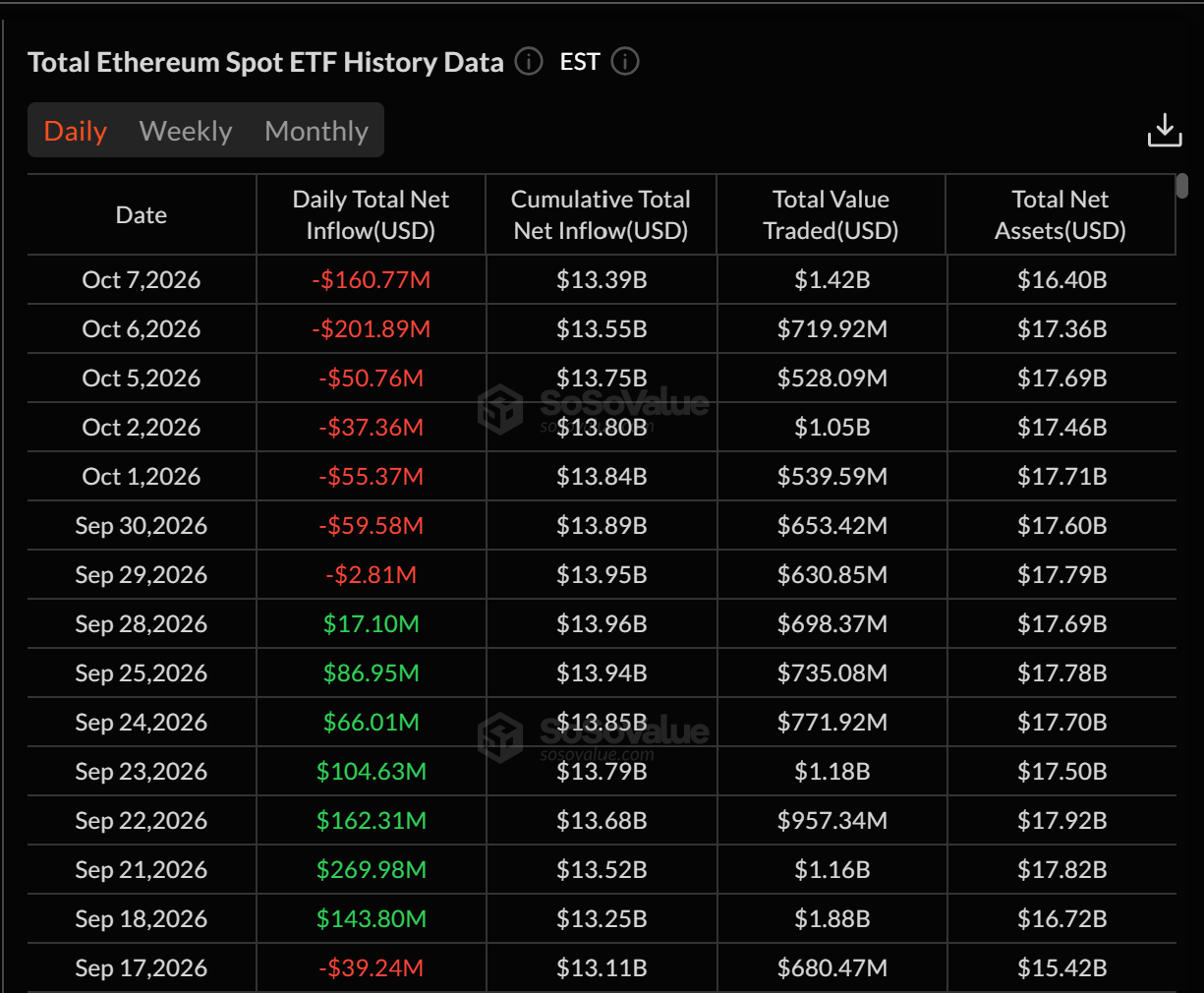
As such, during this period, Bitcoin received the majority of investment inflows due to institutional demand despite being in a “risk off” environment. Therefore, an increase in money flowing into Ethereum’s ETF would be needed to help stabilize demand for the altcoin.
All together, institutional preference favors Bitcoin, leaving Ethereum dependent on stronger flows to stabilize demand.
AI raises new security risks for Ethereum
Beyond ETF demand, Ethereum faces a new security question as AI accelerates mathematical research and attack capabilities. Ethereum core researcher at the Ethereum Foundation, Justin Drake, warned that AI could weaken ECDSA sooner than expected.
However, Ethereum co-founder Vitalik Buterin acknowledged the risk while cautioning users against panic-driven migrations. That distinction matters because rushed wallet moves can create new security risks.
Meanwhile, Ethereum’s security teams are using AI to test protocol code and uncover vulnerabilities. One disclosed issue, CVE-2026-34219, showed how automated testing can expose weaknesses.
Attackers are also using AI to scan unverified contracts more efficiently. Therefore, Ethereum must strengthen defenses as AI advances. Moreover, better audits, safer wallet practices, and measured migration could limit future risks.
Final Summary
- Ethereum faces deeper downside risk as $2,565 becomes the key support level after heavy selling.
- $ETH needs stronger ETF inflows and safer AI-driven security measures to restore institutional confidence and market stability.
