

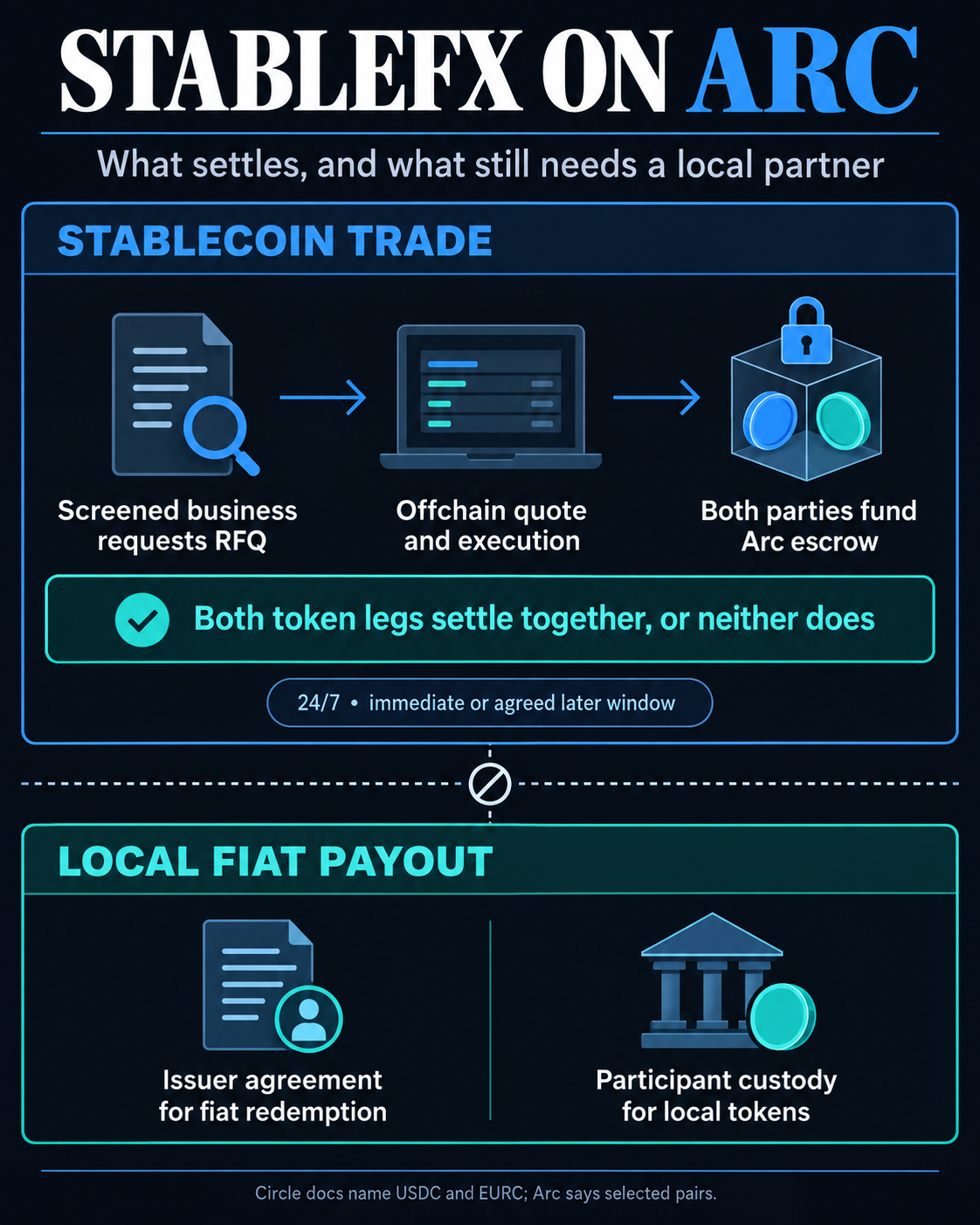
The system separates trade execution from settlement. Businesses submit a currency pair, amount, and preferred settlement window through a request-for-quote process, allowing approved liquidity providers to compete for the order. Execution happens off-chain before counterparties fund a smart-contract escrow on Arc.
Settlement then occurs on a payment-versus-payment basis: both stablecoin legs transfer together, or neither does. That structure is designed to reduce settlement risk while allowing businesses to contract with Circle once and access multiple vetted counterparties through the same venue.
Circle Chief Executive Jeremy Allaire described StableFX as a “strong emerging primitive” for atomically settled, real-time onchain foreign exchange, pointing to the stablecoin issuers and market participants being assembled around the service.
Arc pushes beyond payments into institutional FX infrastructure
The launch gives Arc an immediate institutional use case less than a week after Circle brought the blockchain to mainnet on Sept. 16.
Circle’s developer documentation currently names $USDC and euro-denominated $EURC, including an example of an exchange between the two tokens. Circle has said it will add additional local stablecoin pairs, though it has not published a complete list of pairs already available for live StableFX trading.
That distinction could determine how quickly the service expands beyond dollar-euro transactions. Circle listed a wider group of stablecoins as active or onboarding to Arc at mainnet launch, but blockchain participation does not automatically make each token available through StableFX.
Access is also restricted. Circle screens counterparties and limits StableFX to eligible incorporated businesses, positioning the service for payment companies, financial institutions and corporate treasury desks rather than retail traders.
For those firms, the attraction is partly operational. A payments company needing to rebalance stablecoin liquidity across currencies could execute the trade overnight or during a weekend rather than wait for traditional banking rails to reopen. Deferred settlement also gives treasury teams flexibility to match execution with their funding schedules.
The harder part begins after settlement.
StableFX exchanges digital currencies but does not automatically turn a local-currency stablecoin into cash in a recipient’s bank account. Firms using partner-issued stablecoins still need arrangements with their issuers for deposits and redemptions, suitable custody, and local payout infrastructure.
Circle Mint can provide $USDC and $EURC liquidity and fiat conversion in supported markets, but that access does not extend automatically to tokens issued by other companies.
