


BlackRock’s ETHA recorded net outflows of $31.9 million on October 5, followed by $201.9 million on October 6 and $116.1 million on October 7. Withdrawals then slowed to $71.1 million on October 8 and $56.1 million on October 9.
The five-day total reached $477.1 million. BlackRock’s second Ethereum ETF, ETHB, recorded no net flows during the period.
Across all U.S. spot Ethereum ETFs, daily net outflows totaled $50.8 million on October 5, $201.9 million on October 6, $160.9 million on October 7, $72.5 million on October 8, and $56.1 million on October 9.
Despite the slowdown in withdrawals toward the end of the week, no session recorded positive net flows. Cumulative net inflows since the funds launched in July 2024 remained positive at approximately $13.3 billion, according to SoSoValue data.
Ethereum price correction
Ethereum also declined 9.2%, closing at approximately $2,725 on October 5 before falling to around $2,474 on October 9.
The decline followed a broader cryptocurrency sell-off, as rising U.S. Treasury yields, elevated oil prices, and a stronger dollar weighed on risk assets. Ethereum fell below $2,600 on October 7 as ETF withdrawals accelerated and leveraged positions faced liquidation pressure.
ETF outflows reflect net redemptions and do not necessarily indicate direct open-market selling of all underlying holdings. However, persistent withdrawals alongside falling prices suggest weakening demand for regulated Ethereum exposure.
Meanwhile, BlackRock’s Bitcoin ETF, the iShares Bitcoin Trust (NASDAQ: IBIT), recorded approximately $1.1 million in net inflows over the same five trading sessions.
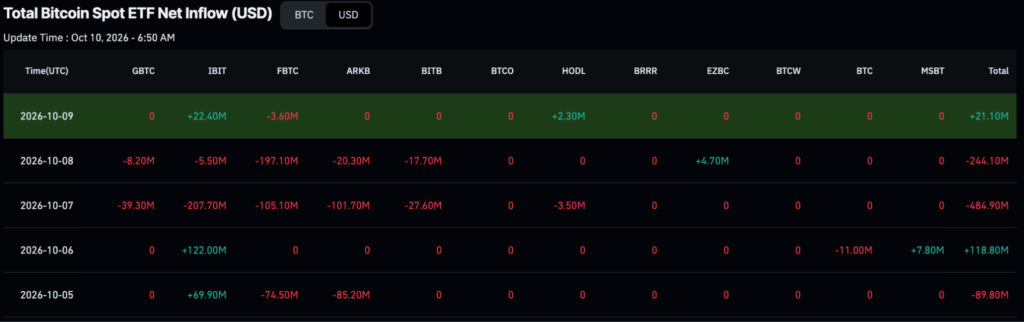
In contrast, U.S. spot Bitcoin ETFs recorded combined net outflows of approximately $678.9 million from October 5 to October 9.
The figures point to weak institutional flows across both major cryptocurrencies, although BlackRock’s Bitcoin fund ended the period marginally positive while its Ethereum counterpart faced substantially heavier redemptions.
Featured image via Shutterstock
