
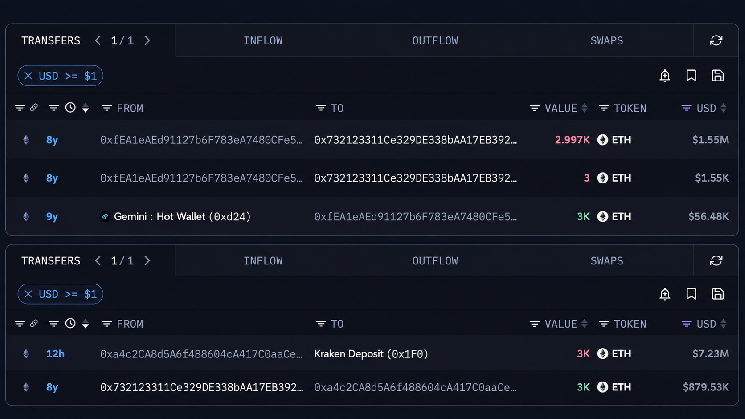

The Same Whale Twice?
This is probably not the first time this buyer has cashed out, given that on Sept. 29, onchain analysts tracked a different dormant wallet with an almost identical profile, i.e. 3,000 $ETH bought around $18.80 in 2017, withdrawn from Gemini. That wallet had already sold 2,000 $ETH at an average of $3,096 for $6.19 million, then sent another 1,000 $ETH to Kraken.
Prominent Chinese analyst Ai Yi connected the two wallets, saying the purchase timing, funding source and deposit patterns all matched. If they belong to the same entity, Ai Yi estimates the buyer has sold about 6,000 $ETH since August 2025, worth roughly $15.85 million at an average deposit price of $2,642.42. That is a return of more than 139x on the combined position.
A Look at the Conditions the Buyer Is Selling Into
The timing lines up with a market where large capital is pulling back from ether. Spot ether exchange-traded funds (ETFs) have been posting persistent outflows even as bitcoin funds have drawn billions. Tom Lee’s Bitmine, the largest corporate ether buyer, said it will stop buying $ETH once it holds 5% of supply, putting a ceiling on one of the market’s steadiest bids.
There is also a counterweight in the mix and holders are locking up more ether than ever, with a Bitwise report showing a record 43.8 million $ETH staked. Supply that sits in staking contracts is supply that is not for sale, which partly offsets old wallets taking profit.
Lastly, it bears mentioning that wallets that have not moved since 2017 carry a special weight with traders since they rode out the 2018 crash, the 2022 bear market and every rally in between without selling. Consequently, when one finally does send coins to an exchange, the market reads it as a signal from someone with a very long and mature perspective.
That reading can and has been overdone, though, in recent years, and a nine-year holder taking a 128x profit may simply have hit a personal target, or needed the cash.
