

Ethereum’s network has been the home of many narratives throughout the years, and liquid restaking is undoubtedly one to look into.
You might be confused by the term liquid restaking, and that’s completely understandable. After all, another popular narrative is centered around liquid staking.
Before we dive into the intricacies of the Renzo Protocol, which is the ultimate purpose of this guide, it’s essential to understand a few fundamental principles first.
Quick Navigation
- What’s the difference between Liquid Staking and Liquid Restaking?
- Liquid Staking Tokens (LST)
- Liquid Restaking Tokens (LRT)
- What is EigenLayer?
- Understanding Actively Validated Services (AVS)
- What is Renzo Protocol?
- Understanding restaking strategies
- Understanding ezETH
- Restaking with Renzo Protocol: step-by-step guide
- ezPoints: everything you need to know
- The REZ token in depth
- Utility
- Tokenomics
- Token Distribution
- Token Release Schedule
- The Renzo (REZ) airdrop
- The Team
- Investors
- Participating in the Binance Launchpool for Renzo Protocol (REZ)
- That’s a Wrap
What’s the difference between Liquid Staking and Liquid Restaking?
Let’s keep it simple. Both of these involve some sort of staking, which is the process of taking your tokens (we will use ETH as an example throughout the entire guide) and locking them within a protocol to serve a certain purpose. For this, you will receive a reward (in the form of interest).
Liquid Staking Tokens (LST)
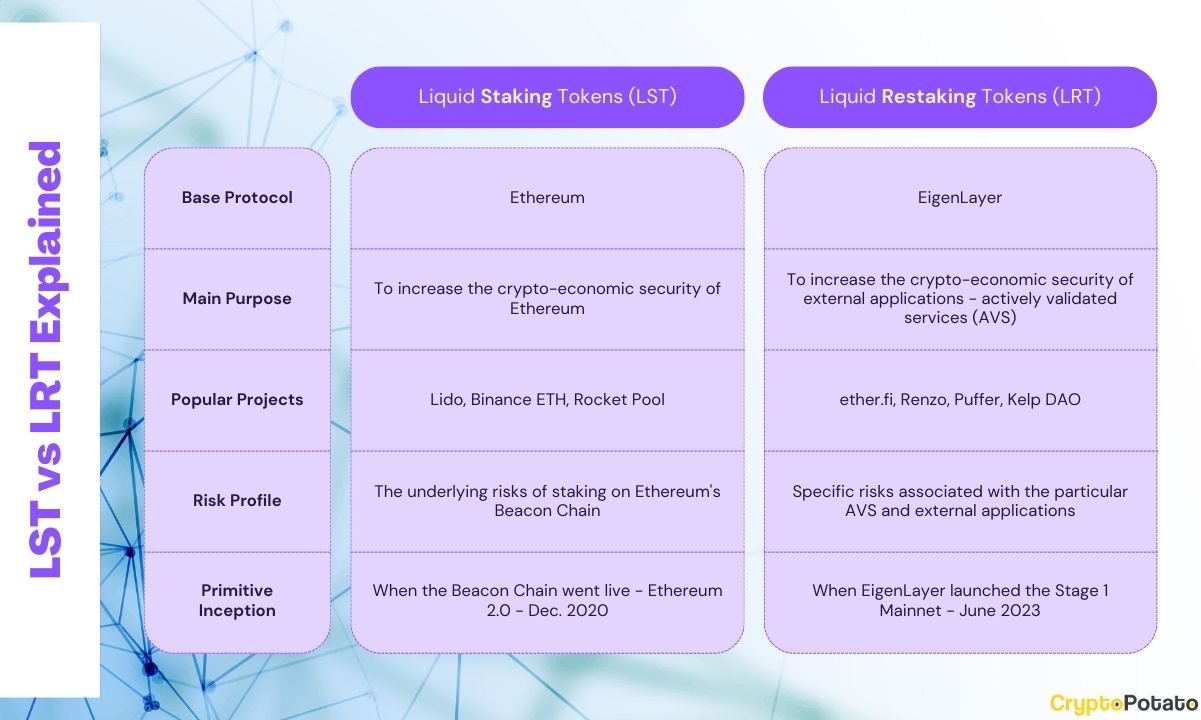
Liquid staking is a process where you stake your ETH in protocols, which in turn mint a synthetic representation of your ETH – that’s called a liquid staking token (LST). The purpose of your ETH, however, is always to increase the economic security of Ethereum. It’s staked to validate and secure the Ethereum network. The term “liquid” comes from the fact that the synthetic asset that you receive can then be used in various DeFi initiatives that you find fit.
The base protocol here is Ethereum, and there are different LST protocols such as Rocket Pool, Lido, Binance ETH, Mantle ETH, and so forth.
Liquid Restaking Tokens (LRT)
With liquid restaking, the purpose of your staked ETH is to increase the economic security of external systems. These can be Oracle networks, Rollups, and whatnot. So, you will still stake your ETH within a certain protocol, and you will once again receive a synthetic representation of your tokens called a liquid restaking token (LRT), but the purpose is different.
The base protocol here is EigenLayer. Some of the top LRT protocols include Renzo, Eigenpie, Kelp DAO, Puffer, ether.fi, and others.
Important note: both LSTs and LRTs are pegged to ETH in a 1:1 manner, and you should always be able to redeem your synthetic tokens for the ETH you’ve staked.
Here’s a table to visualize the above:
What is EigenLayer?
Now that you know what LRTs are, let’s quickly explain the role of EigenLayer in all this. This is important for our guide because Renzo Protocol is essentially a Liquid Restaking Token and a strategy manager for EigenLayer. Don’t worry. It will make more sense in a moment.
EigenLayer is a protocol that’s built on Ethereum, and it was the first to introduce restaking as a primitive. Through that protocol, users are able to repurpose their ETH on the consensus layer. They are now able to opt-in to EigenLayer smart contracts and restake their ETH to increase the crypto-economic security of other applications on the network.
It’s essentially a middle layer where users agree to grant EigenLayer more enforcement rights on their staked ETH. This then allows the protocol to restake the ETH on other applications.
These applications can be rollups, oracle chains, or pretty much any application that is based on similar cryptoeconomic principles. They are called Actively Validated Services (AVS). These are very important to understand the purpose of the Renzo Protocol.
Understanding Actively Validated Services (AVS)
In essence, an AVS is any system that has a requirement for distributed validation for verification. These can be sidechains, bridges, keeper networks, data availability layers, oracle networks, and so forth.
To put it in very simple terms, your staked ETH is being restaked to secure these AVSs. But since each AVS is different and it might come with inherently variable risk profiles, the rewards are also different (you get rewards for staking and restaking, remember?) So, which AVS should you direct your tokens to, and what’s the best strategy?
This is where the Renzo Protocol comes in.
What is Renzo Protocol?
Renzo is a platform that’s built on EigenLayer and basically serves as an interface to its ecosystem. It uses a combination of operator nodes and smart contracts to make sure that its users get the best risk/reward restaking strategy.
We know this can be quite confusing, so let’s try to break it down even further.
Understanding restaking strategies
Now that you know what EigenLayer is and what LRTs are let’s attempt to simplify even more what Renzo does.
As we already explained, the AVSs in EigenLayer are any sort of decentralized service looking to inherit Ethereum’s security. A restaking strategy is, then, a position where you (the user) decide to secure any of the many available AVSs. You can also make all sorts of combinations. The number of possible strategies, however, increases with the number of available AVSs.
This makes it hard to choose the one which will bring the best risk/reward ratio. This is what Renzo does. It simplifies this process and makes the choice for you, ensuring the best R:R ratio.
Understanding ezETH
ezETH is the Liquid Restaking Token (LRT) of the Renzo Protocol. It represents the user’s restaked position at Renzo.
Users are able to stake native ETH or liquid staking tokens (LSTs), such as wBETH and stETH, and receive ezETH.
An important factor here is that ezETH is a reward-bearing token. As such, its value can increase relative to the underlying tokens, as it yields more rewards because of its usage in AVSs.
Renzo has also integrated with Pendle Finance, where a new token is created through a single contract – EIP5115 SY Token. It represents ezETH at a 1:1 ratio, but it can also be tokenized in principal tokens and yield tokens for those who want to do that.
Restaking with Renzo Protocol: Step-by-Step Guide
Now that you have a fundamental understanding of how the Renzo protocol works, let’s find out how to actually use it in practice.
Step 1: You will need some ETH (or LSTs such as stETH) in your MetaMask wallet.
Step 2: Visit the Renzo Protocol restaking dashboard and connect your wallet.
Step 3: You will be able to choose between the different ecosystems, as well as between native ETH or any other LSTs that are supported. These include wBETH (Binance Staked Ether) and stETH (Lido Staked Ether) for Ethereum.
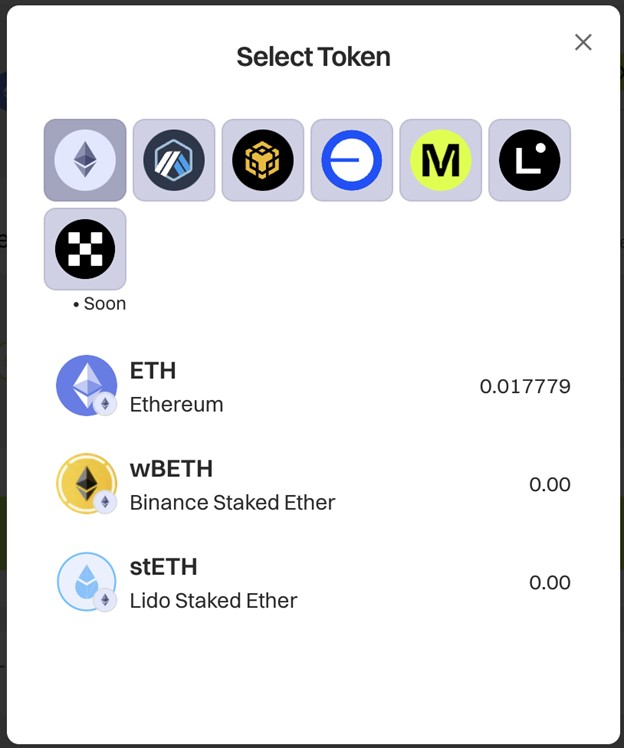
Step 4: In our case, we will restake native ETH.
Step 5: Enter the amount you wish to stake and hit “Confirm.”
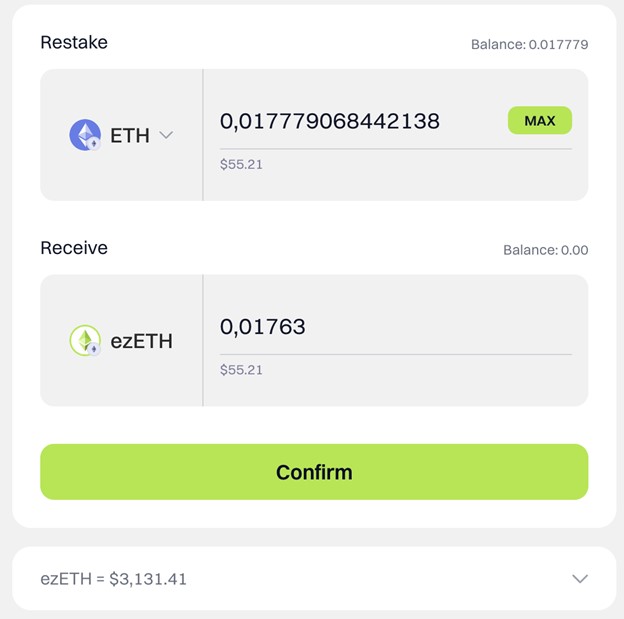
Step 6: Confirm the transaction from the interface.
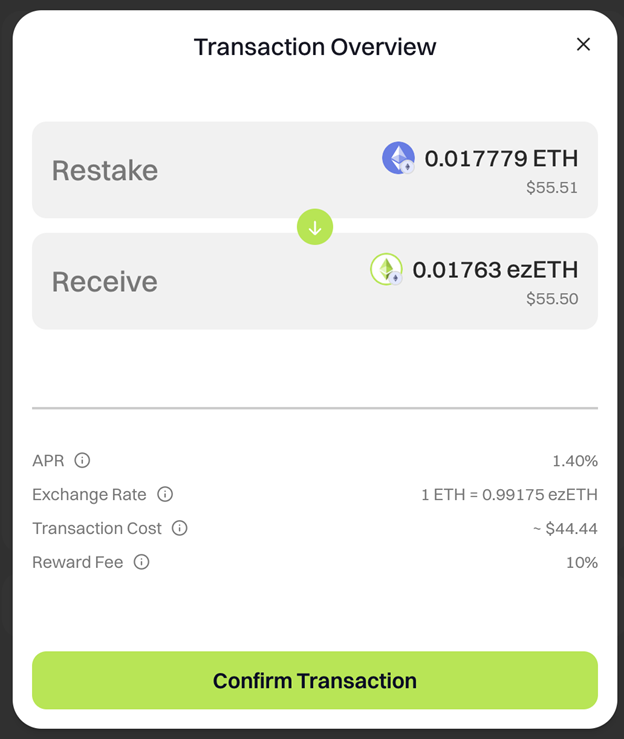
Step 7: Confirm the transaction from your wallet.
Step 8: Head to the Portfolio tab where you’ll be able to view your earned points and rewards.
And you’re done!
Please note that withdrawals are currently disabled. Users will be able to withdraw their deposited ETH following a so-called cooldown period, to be determined by the team. However, ezETH is traded on secondary markets so you can always swap it on DEXs.
ezPoints: Everything You Need to Know
Renzo’s points (ezPoints) are designed to reward users who actively participate and contribute to the success of the protocol. Every participant receives points but their number varies based on the duration and the nature of this participation.
Holding ezETH, for instance, rewards ezPoints. Every ezETH holder receives 1 Renzo ezPoint per hour per 1 ezETH. Early participation is also rewarded, while users who hold more ezETH receive more points, based on different boosts such as these:
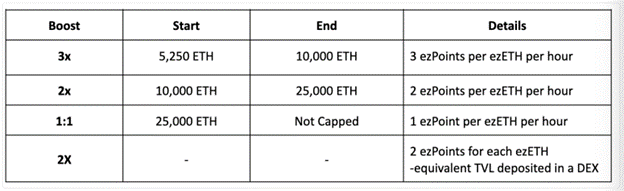
ezPoints determine the number of REZ tokens a user will receive following the token generation event, which brings us to the next point.
The REZ Token in Depth
Imperative to Renzo’s commitment to decentralization is the REZ token – a cryptocurrency that’s designed to power the governance of the protocol.
Utility
REZ is the native governance token for the protocol. Holders of REZ will be able to vote on governance proposals regarding various matters, including but not limited to:
- Operator whitelisting
- Actively Validated Services whitelisting
- Frameworks for general risk management
- Community and treasury grants
- Concentration amounts, collateral assets, deposits, etc.
Tokenomics
The total supply of REZ tokens is capped at 10,000,000,000.
The initial circulating supply (listing on April 30th) will be 1,150,000,000.
You can find the contract here.
Token Distribution
Fundraising: 31.56%
- These tokens are for the project’s early investors.
Community: 32%
- 7% will be for Season 1 airdrop rewards based on the earned ezPoints.
- Various community campaigns
- 5% allocated towards second season of incentives
Core Contributors: 20%
- Distribution to Renzo Labs’ team and advisors
Foundation: 12.44%
Binance Launchpool: 2.5%
Liquidity: 1.5%
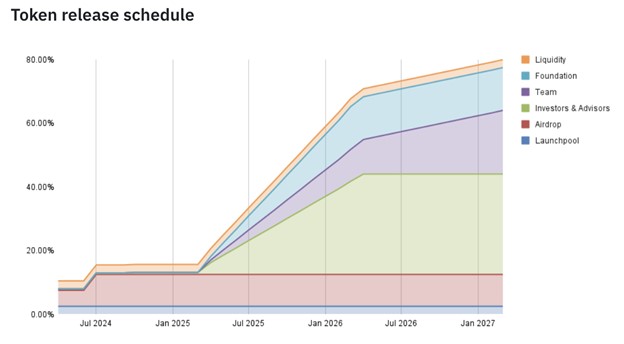
Token Release Schedule
The token release schedule looks like this:
The Renzo (REZ) Airdrop
The REZ airdrop has been a much-anticipated event for community members who have been farming ezPoints since their announcement.
As stated above, 7% of the total supply will be distributed for Season 1 airdrop rewards based on the user’s earned ezPoints.
Here are the airdrop eligibility criteria:
- You need minimum 360 ezPoints per wallet.
- Most of the eligible wallets, accounting for over 99% of the total, will be fully unlocked at TGE.
- This doesn’t apply to larger wallets. Those who have more than 500,000 ezPoints will see 50% unlocked at TGE and the rest vested linearly over 3 months.
The snapshot date is April 26th, 2024, while the claim date will be on April 30th. The claim window will open an hour before the listing on Binance, which is at 12:00 (UTC).
There will also be a Season 2 with undisclosed dates for now. It will receive 5% of the total supply.
The Team
Lucas Kozinski is part of the founding team at Renzo Protocol. He comes with rich background in the crypto industry, having previously worked at lending and borrowing app Moonwell, TokenSoft, and the Tezos Foundation.
James Coole is another founding contributor at Renzo. He had previously co-founded TokenSoft, where he served as the Chief Technology Officer for five years.
Kratik Lodha is also listed as one of the founding contributors. His background consists of multiple analytic positions in various funds such as the Woodstock Funds, WorldQuant, Equity Research, and others.
Investors
In January 2024, Renzo disclosed a $3.2 million seed round led by Maven11. Other participants included IOSG Ventures, Figment Capital, SevenX Ventures, and more.
According to its official website, investors also include Binance Labs, OKX Ventures, Mantle, Edessa Capital, BODHI Ventures, Robot Ventures, Re7Capital, and others.
Participating in the Binance Launchpool for Renzo Protocol (REZ)
The Binance Launchpool campaign will last until April 30th. Trading will start at 12:00 (UTC).
To participate, you will need a Binance account. If you don’t have one, you can create it using this link. You will also need to complete your KYC verification. The whole process takes no more than a few minutes.
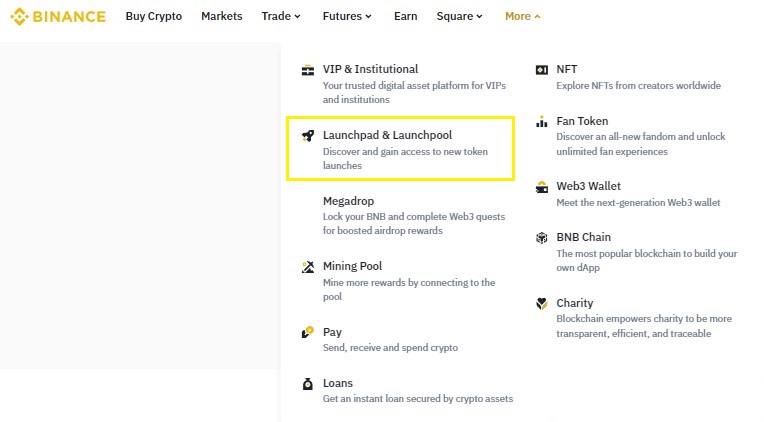
Step 1: Locating the Launchpool Section
Once you have your account prepared, you will need to navigate to the Launchpad & Launchpool section from the top navigation menu (if you’re on Desktop).
Step 2: Selecting a Pool
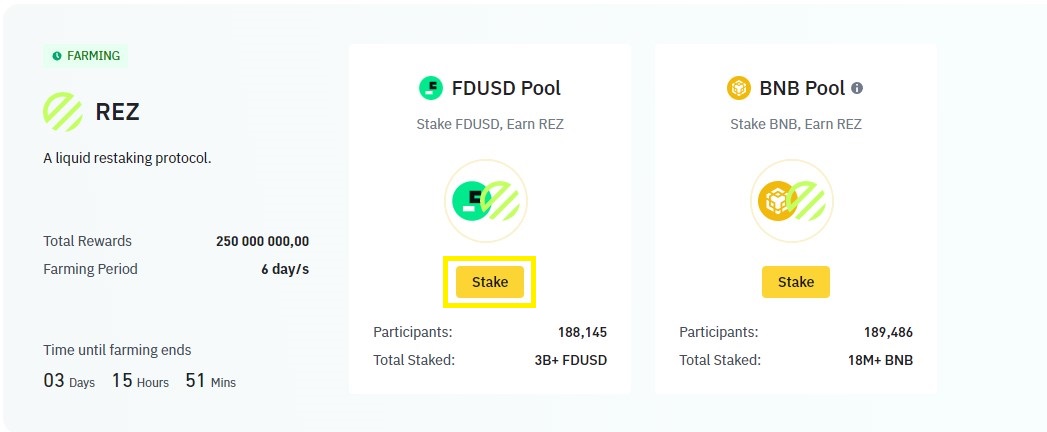
Once there, the Renzo launchpool will appear as the latest one, and you will have to choose which pool you want to join. For REZ, there are two pools:
For the sake of this guide, we will choose the FDUSD Pool. You will be staking FDUSD to receive rewards in REZ.
Click on “Stake.”
Step 3: Staking the Selected Cryptocurrency
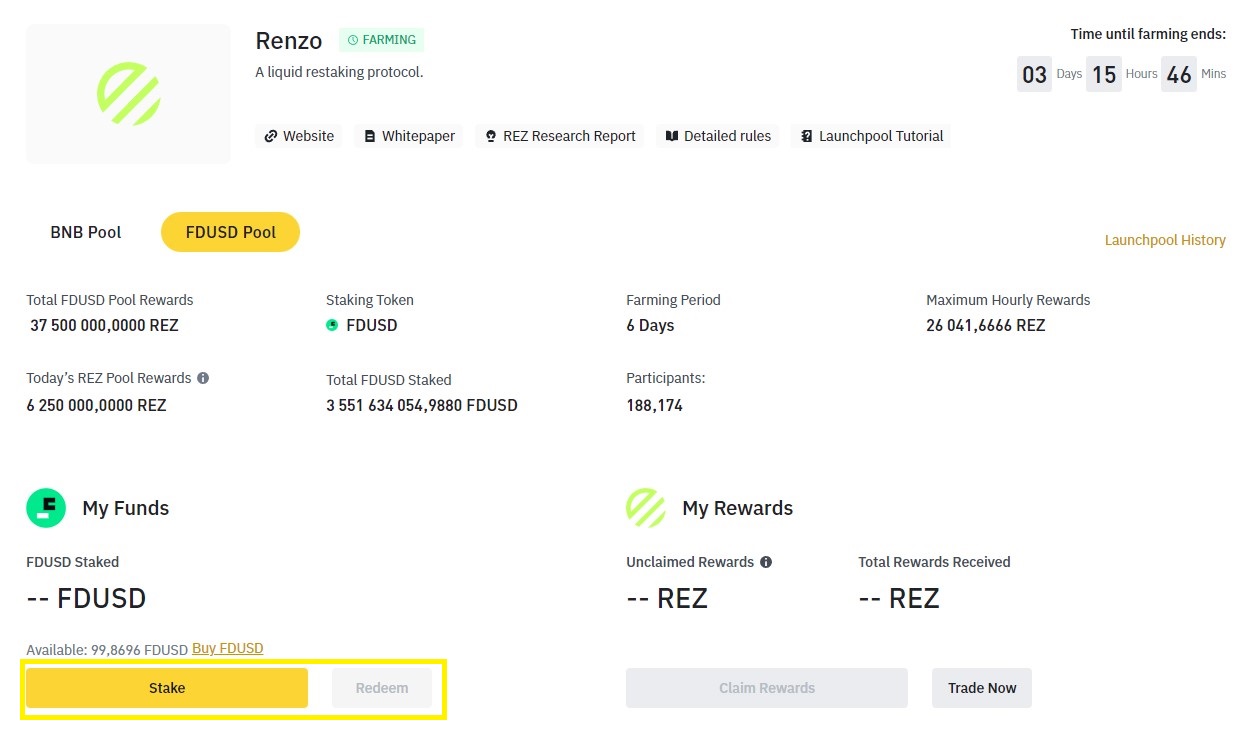
You will be taken to a new window, where you will be able to monitor all the information for the pool you’ve selected. This includes total pool rewards, maximum hourly rewards, how many people participate, how much is staked, and so forth. Here, you will also be able to track your rewards and claim once the claiming window opens.
You will once again have to click on “Stake.”
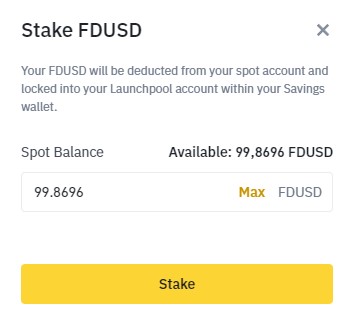
After that, all you need to do is input the amount you wish to stake and, you guessed it, click “Stake” again.
Step 4: Claim Your Rewards When Possible
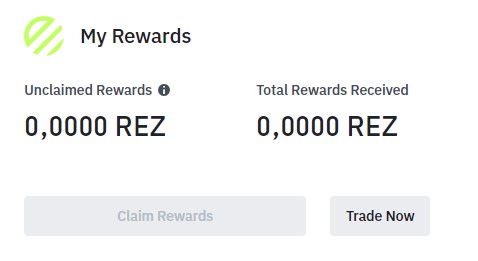
Rewards are calculated hourly, so once enough time has passed, you will see the claimable amount appear under the “My Rewards” tab on the page. You can claim them, but you will only be able to trade REZ once the listing takes place on April 30th.
That’s a Wrap
Renzo Protocol has managed to attract a lot of attention through its considerable growth in a relatively short period of time. The liquid restaking narrative is also one of the more interesting trends in 2024, with EigenLayer booming in both usage and popularity.
The protocol provides an easy-to-use way to earn a yield on otherwise dormant tokens, but there are also certain risks involved.
While Renzo does what it can to ensure security, it’s also highly advisable for every user to do extensive research, assess their risk profile, and—if needed—even consult with a professional before making any financial decisions.
The above post is powered by Renzo Protocol.
