


Hedera Hashgraph introduces a new approach to distributed ledger technology (DLT) with the potential to overcome limitations in existing networks. Specifically, it promises to tackle five critical pain points that have traditionally slowed down DLT’s mainstream acceptance and adoption. Hedera sets out to solve these with a high-speed, low-cost, and enterprise-grade network that delivers near-instant finality without compromising decentralization. This guide explores the ins and outs of Hedera Hashgraph, including how it works and what sets it apart from blockchain networks.
In this guide:
- What is Hedera Hashgraph?
- How Hedera Hashgraph works
- Hedera Hashgraph vs. blockchains: Key differences
- Hedera’s service offerings
- HBAR: The native crypto of Hedera Hashgraph
- What gives Hedera an edge?
- Is Hedera centralized or decentralized?
- Hedera use cases
- What lies ahead of Hedera Hashgraph?
- Frequently asked questions
What is Hedera Hashgraph?
Hedera Hashgraph is a public distributed ledger platform and governing body designed for the real-world enterprise adoption of decentralized applications (DApps), digital payments, and asset tokenization.
The platform is governed by a council of leading global enterprises, which it claims ensures decentralization and stability.
Hedera’s key features include:
- High throughput: The hashgraph algorithm enables hundreds of thousands of transactions per second and is capable of supporting large-scale applications.
- Security: It achieves asynchronous Byzantine Fault Tolerance (aBFT). For the uninitiated, aBFT is the highest standard for distributed security, which makes a network resilient to DDoS attacks.
- Fairness: Transactions are ordered exactly as they are received, thereby preventing manipulation and front-running.
- Stability: Technical and legal measures are in place to prevent forking while maintaining network integrity.
- Governance: A decentralized model led by the Hedera Governing Council, where rotating, term-limited members have equal voting rights to shape network decisions.
How Hedera Hashgraph works
Hedera Hashgraph operates on a fundamentally different consensus model than traditional blockchain networks. Instead of using the likes of proof-of-work (PoW) or proof-of-stake (PoS), it relies on a hashgraph consensus algorithm, which optimizes speed, security, and fairness without requiring miners or energy-intensive computations.
This model enables faster and more scalable transaction processing while maintaining decentralized trust.
Hashgraph consensus
You could call hashgraph an alternative to — or even the next generation of — the technology powering blockchain consensus mechanisms.
While both technologies store and encrypt data, blockchains organize transactions into sequentially linked blocks, verified by a set of validators. This linear approach creates a single, growing chain — hence the moniker blockchain, i.e., a chain of blocks.
In contrast, Hashgraph does not rely on blocks or miners. Instead, it maintains a graph of cryptographically linked events. In this model, transactions are recorded asynchronously while still ensuring that all nodes reach a consensus across the network.
Unlike blockchains, where only validators verify transactions, Hashgraph enables every node in the network to participate in reaching consensus.
Virtual voting and gossip protocol
In a gossip-based system, each node randomly selects another node to exchange known transactions and historical event data. With such exponential dissemination of information, Hedera allows all nodes to quickly reach an agreement on the transaction order. In other words, the process executes smoothly without requiring dedicated leaders or coordinators.
Similarly, the gossip-about-gossip method ensures that as nodes communicate, they also share cryptographic hashes of past transactions. This enables each node to build a full history of the network’s activity. In doing so, it reduces communication overhead and allows for efficient validation of transactions.
The virtual voting process further strengthens consensus by enabling nodes to infer the votes of others based on the shared event history. It ensures that all nodes independently agree on the final transaction order.
So, rather than requiring direct communication or multiple rounds of message exchanges, each node can independently determine what the majority of the network will decide. This approach gets rid of the need for additional coordination messages. In other words, it significantly reduces latency and increases throughput.
Fair ordering and time stamping
Hedera enforces fair transaction sequencing through a median timestamping approach.
This is one key aspect that separates it from blockchain networks, where transaction order is dictated by miners or validators. Each transaction is given a consensus timestamp.
Transactions in Hedera are processed in the order they are submitted rather than being manipulated by entities looking to reorder them for financial gain. This is how the network offers a more transparent and equitable distributed ledger free from front-running and other exploitative practices.
Security and Byzantine Fault Tolerance (aBFT)
Hedera’s asynchronous Byzantine Fault Tolerance (aBFT) ensures that the network remains secure even if a portion of nodes act maliciously or fail to communicate.
Unlike traditional blockchain models that rely on probabilistic finality, Hedera’s consensus provides guaranteed finality. In simpler words, transactions cannot be reversed once confirmed.
Also, because Hedera does not rely on economic incentives, its leaderless architecture leaves no room for single points of failure. This design reduces the threat of common attack vectors such as DDoS attacks, Sybil attacks, and selfish mining.
Fork prevention and network stability
One of the key advantages of Hedera is its resistance to forking. Unlike open-source blockchain networks, which often experience contentious forks that lead to chain splits, Hedera ensures stability through both technical and legal controls.
The Governing Council, consisting of industry-leading enterprises, ensures that any changes to the network are implemented in a coordinated and structured manner.
Additionally, the network’s consensus model prevents competing transaction histories from emerging. Since transactions achieve instantaneous finality with no risk of reorganization, all nodes maintain a single, immutable version of the ledger.
This property makes Hedera particularly well-suited for applications requiring high trust, such as financial transactions, supply chain tracking, and identity verification.
Hedera Hashgraph vs. blockchains: Key differences
Hedera’s service offerings
Hedera provides three primary services — consensus, tokenization, and smart contracts — each designed to optimize performance, security, and efficiency in distributed applications.
These services leverage the Hashgraph consensus algorithm to ensure high throughput, deterministic finality, and low-cost execution while maintaining enterprise-grade security.
Hedera Consensus Service (HCS)
HCS functions as a distributed trust layer for applications requiring secure, verifiable event logging. It enables high-throughput, tamper-proof transaction ordering without the need for a dedicated blockchain.
- Event sequencing and timestamping: Transactions receive cryptographically verifiable timestamps generated by the median consensus of network nodes. This ensures fair ordering and prevents manipulation.
- Immutable data logging: Applications can record events in a transparent, auditable, and append-only manner (ideal for regulatory compliance and dispute resolution).
- Enterprise and IoT integration: HCS is optimized for banking, healthcare, and supply chain management. It allows businesses to securely validate transactions and asset transfers in real time without relying on centralized databases.
Hedera Token Service (HTS)
HTS provides native tokenization capabilities without requiring smart contracts and offers low-latency and cost-effective digital asset management. Unlike Ethereum-based token standards such as ERC-20 and ERC-721, HTS enables direct token issuance and transfers at the protocol level. This approach significantly reduces execution overhead.
- Fungible and non-fungible tokens (NFTs): Supports customizable token properties, including fixed or variable supply, transfer restrictions, and account-level compliance controls.
- Atomic token transfers: Multi-token transactions execute in a single operation. It lowers the risk of partial failures and ensures consistency in DeFi applications and asset settlements.
- Fee customization and role-based permissions: Token creators can define transaction fees in HBAR or native tokens, assign custom administrative roles, and configure KYC requirements or spending limits for regulatory compliance.
Hedera Smart Contract Service (HSCS)
HSCS enables EVM-compatible smart contracts to run on Hedera’s high-speed, low-fee network. It provides efficient contract execution with deterministic finality, unlike traditional blockchains that suffer from gas price volatility and execution bottlenecks.
- EVM compatibility and Solidity support: Developers can deploy Solidity-based smart contracts without modifications. This feature ensures interoperability with Ethereum DApps, DeFi protocols, and web3 applications.
- Optimized execution via Hashgraph consensus: Smart contract operations benefit from parallel transaction processing and deterministic finality (miner-driven delays and network congestion are less of a concern).
- Enterprise-ready automation: Supports tokenized financial instruments, gaming economies, supply chain automation, and enterprise workflows, with governance and permissioning tools for compliance-driven applications.
HBAR: The native crypto of Hedera Hashgraph

HBAR is the native cryptocurrency of the Hedera Hashgraph network. It is designed to power the Hedera ecosystem while maintaining security and efficiency. It serves a dual purpose — acting as fuel for network services and incentivizing node participation.
Transactions on Hedera are processed with negligible fees (~$0.0001), which enables cost-effective microtransactions, smart contract execution, and decentralized file storage.
HBAR’s role in network security
HBAR plays a critical role in maintaining Hedera’s security and decentralization. Nodes can participate in transaction validation and consensus by staking HBAR. This helps maintain the network’s resilience while rewarding operators for their contributions.
As mentioned earlier, Hedera’s aBFT consensus ensures finality and security without excessive computational energy costs. This is unlike traditional blockchain models that rely on mining or economic incentives.
HBAR supply and controlled release
Hedera launched with a fixed total supply of 50 billion HBAR, which cannot be altered without unanimous approval from the Hedera Governing Council.
Until transferred to user accounts, all unreleased HBAR remains locked. The network follows a gradual and controlled token release strategy to prevent market oversaturation.
- Network security: Prevents centralization risks by ensuring no single entity accumulates excessive control.
- Market stability: Reduces inflationary pressure, allowing HBAR’s value to be driven by organic demand rather than oversupply.
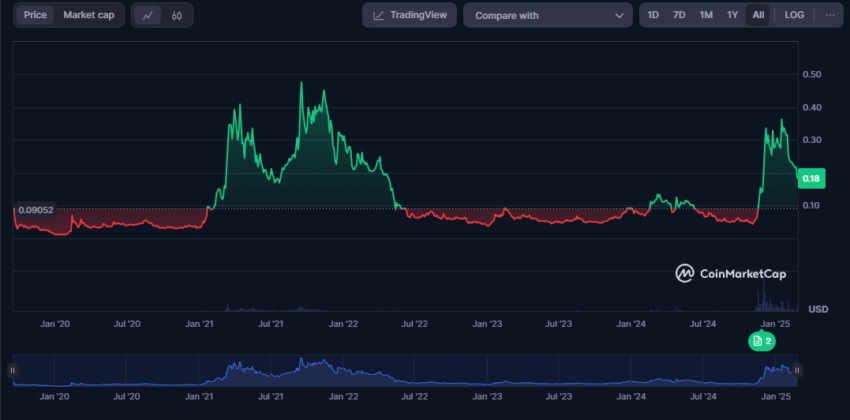
HBAR price history, as of Feb. 25, 2025: CoinMarketCap
What gives Hedera an edge?
Some of the key benefits Hedera promises include:
➤ Predictable and low-cost transactions: Hedera’s stable fee structure prevents price spikes caused by network congestion. This cost predictability makes it a practical choice for businesses that require financial planning certainty.
➤ Enterprise-grade governance and compliance: A council of global enterprises oversees Hedera’s upgrades and security policies. This structured governance ensures regulatory compliance and network stability.
➤ Native token services for asset tokenization: Hedera allows token creation without smart contracts through the Hedera Token Service (HTS). This ensures security, low costs, and built-in compliance controls.
➤ Real-world applications beyond finance: Hedera supports enterprise use cases like supply chain tracking, identity verification, and data integrity. Its Consensus Service (HCS) enables tamper-proof event logging without blockchain overhead.
➤ Energy efficiency without trade-offs: Hedera’s consensus model eliminates mining and staking competition. This is a major advantage, considering it significantly reduces energy consumption. This also makes Hedera one of the most sustainable DLT solutions available.
Is Hedera centralized or decentralized?
Some question how Hedera can be decentralized when its governance is controlled by 39 enterprises, but the reality is more nuanced. While the Hedera Governing Council oversees decision-making, network consensus remains fully decentralized.
Also, let’s not forget that despite structured governance, anyone can participate in the network.
As we explained in a previous section, Hedera’s consensus mechanism — asynchronous Byzantine Fault Tolerance — is leaderless. That means no miner or validator can manipulate transactions. This prevents censorship, front-running, and forks, which, in turn, makes the ledger tamper-proof and transparent.
Overall, this balance between enterprise-grade governance and decentralized consensus ensures that Hedera remains secure, scalable, and fair.
Hedera use cases
The following are some of the most promising ways organizations can use Hedera:
- Financial services and payments: Low-cost, high-speed transactions, stablecoin issuance, and cross-border settlements.
- Decentralized identity: Self-sovereign identity (SSI) solutions for secure authentication and KYC compliance.
- Supply chain and logistics: Tamper-proof tracking of goods, timestamped audits, and transparent record-keeping.
- DeFi and tokenization: Stablecoins, securities, and real-world asset tokenization with low fees and high efficiency.
- NFTs and digital collectibles: Cost-effective minting and trading of NFTs without high gas fees.
- Gaming and virtual assets: Secure in-game economies, NFT ownership verification, and play-to-earn models.
- Enterprise and data integrity: Verifiable, immutable logs for compliance, auditing, and document verification.
- Healthcare and medical records: Secure data sharing, patient record tracking, and pharmaceutical supply verification.
- Carbon credits and sustainability: Transparent tracking of carbon offsets and ESG initiatives.
- IoT and smart cities: Real-time, trusted data exchange for automation, traffic management, and connected devices.
What lies ahead of Hedera Hashgraph?
There is no denying that Hedera shows a great deal of potential — both in terms of technology and as an investment opportunity. That said, its shot at success in the long run rests squarely on its ability to meet regulatory challenges, strengthen community support, and outperform newer-generation blockchains.
While its high transaction throughput and efficiency surpass traditional blockchains, some concerns over decentralization and governance remain. If Hedera can address these concerns while expanding enterprise adoption in finance, supply chain, and gaming, it could establish itself as a leading DLT.
