
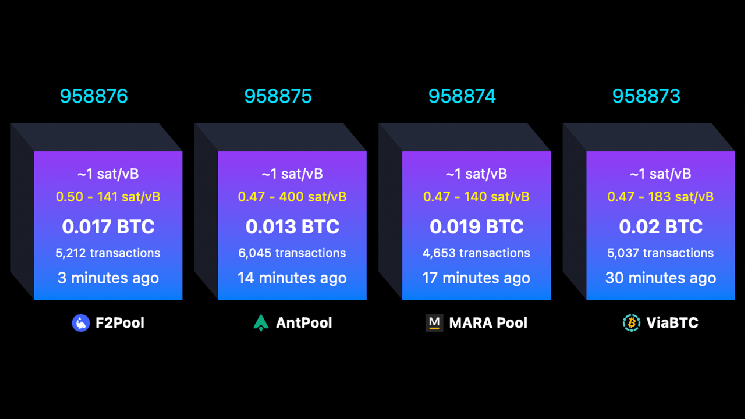
Close Menu
  • Coins
    • Bitcoin
    • Ethereum
    • Altcoins
    • NFT
  • Blockchain
  • DeFi
  • Metaverse
  • Regulation
  • Other
    • Exchanges
    • ICO
    • GameFi
    • Mining
    • Legal
  • MarketCap
What's Hot

What Happens When a Bitcoin Block Is Full? Every Byte Sparks a Live Fee Auction

15/09/2026

XRP holders could earn new yield, but getting out may take up to 60 days

15/09/2026

South Korea’s On-Chain Crypto Activity Hits $10.9B in 2023, Ranking 11th Globally

15/09/2026
Facebook X (Twitter) Instagram
  • Back to NBTC homepage
  • Privacy Policy
  • Contact
X (Twitter) Telegram Facebook LinkedIn RSS
NBTC News
  • Coins
    1. Bitcoin
    2. Ethereum
    3. Altcoins
    4. NFT
    5. View All

    What Happens When a Bitcoin Block Is Full? Every Byte Sparks a Live Fee Auction

    15/09/2026

    Bitcoin Whale That Accumulated for Six Years Moves $52.2M to Cumberland in Potential Sell Signal

    15/09/2026

    50% Dip Is Shallowest on Record

    15/09/2026

    New Onramp Report Makes the Case for Spot Bitcoin Over Paper Claims as Price Sits at Half Its Peak

    14/09/2026

    Ethereum Glamsterdam Upgrade Set for Sepolia on October 6

    14/09/2026

    Could a Liquidity Sweep Precede a $2,535 Breakout?

    14/09/2026

    Ethereum price must break $2,530 to extend recovery

    14/09/2026

    BitMine’s staked ETH equals nearly 12% of Ethereum’s active stake, but who controls it?

    14/09/2026

    $PUMP, $ZRO, and $BSV Lead the Pack of Top Crypto Gainers of the Week

    15/09/2026

    Grayscale Withdraws Filing for Planned Spot Cardano ETF

    15/09/2026

    Shibarium Transactions Surge 507% as Shiba Inu Layer-2 Network Hits One-Month High

    15/09/2026

    Aster Burns $1.7M More ASTER, Total Supply Reduction Reaches 3.78%

    14/09/2026

    Pixelmon shuts down game development after inconclusive publisher test

    15/09/2026

    NFT sales rise 6.8% to $46.8M as Bitcoin trades surge

    12/09/2026

    NFT sales surge 55.6% as BNB Chain overtakes Ethereum for first time

    06/09/2026

    OpenSea Users Demand ETH/USD Switcher Amid Frustration

    05/09/2026

    What Happens When a Bitcoin Block Is Full? Every Byte Sparks a Live Fee Auction

    15/09/2026

    XRP holders could earn new yield, but getting out may take up to 60 days

    15/09/2026

    South Korea’s On-Chain Crypto Activity Hits $10.9B in 2023, Ranking 11th Globally

    15/09/2026

    $PUMP, $ZRO, and $BSV Lead the Pack of Top Crypto Gainers of the Week

    15/09/2026
  • Blockchain

    Wall3 Labs Brings RWA Hedge-Fund Strategies to Your Wallet

    14/09/2026

    Stellar Records $149.4M Increase in RWA Market Cap to $3.3B

    14/09/2026

    Circle’s $3B Arc Mainnet Goes Live in Four Days With BlackRock, Visa Validators

    14/09/2026

    BNB Chain Flips Solana to Become Fastest-Growing Chain by RWA Value

    14/09/2026

    Funds Are Being Tokenized at New Magnitudes, Says Arbitrum

    14/09/2026
  • DeFi

    XRP holders could earn new yield, but getting out may take up to 60 days

    15/09/2026

    Aave V4 proposal would put DAO funds first in line to absorb lending losses

    15/09/2026

    Why 90% of your DeFi trades are quietly being routed back to Wall Street market makers

    14/09/2026

    Uniswap leads DEX trading with $71.1B in volume – Can UNI capture more value?

    14/09/2026

    Aave Reports $900M in Deposits, Signaling DeFi Confidence

    13/09/2026
  • Metaverse

    Is Solana Gaming Back? Kintara Activity Fuels Renewed Optimism in Onchain MMOs

    24/06/2026

    The Sandbox launches AI game engine ‘The Sandbox Studio’ for next-generation creators

    10/06/2026

    Meta commits $13M in funding for Oversight Board through 2028

    29/05/2026

    Why Animoca’s Yat Siu says the future is 100 billion AI agents

    07/05/2026

    ‘8,000 Jobs’—Polymarket Sees Tech Layoff Surge As Meta AI Push Bites

    18/04/2026
  • Regulation

    South Korea’s On-Chain Crypto Activity Hits $10.9B in 2023, Ranking 11th Globally

    15/09/2026

    Tether CEO Slams BIS Over Tokenized Bank Deposit Push

    15/09/2026

    Revolut begins EURR rollout as ECB details digital euro privacy safeguards

    15/09/2026

    FOMO Cracks Top 5 US Finance Charts, Passes Kalshi and Cash App

    14/09/2026

    Crypto Stocks Rally in Premarket as Bitcoin-Linked Firms Post Gains

    14/09/2026
  • Other
    1. Exchanges
    2. ICO
    3. GameFi
    4. Mining
    5. Legal
    6. View All

    Social Trading Predictions Point to Crypto’s Next Roaring Kitty

    15/09/2026

    ThunderCore (TT) Surges Over 200% on Upbit KRW Pair Ahead of Scheduled Delisting

    15/09/2026

    Crypto.com to Launch AI Prediction Markets in September via CFTC-Regulated Platform

    15/09/2026

    Phemex puts 82 tokens on notice over liquidity and project compliance concerns

    14/09/2026

    ICO market slows sharply with only six completions in 2026

    30/04/2026

    South Korea Poised to Lift Ban on Domestic ICOs After 7 Years

    19/12/2025

    Why 2025’s Token Boom Looks Both Familiar and Dangerous

    31/10/2025

    ICO for bitcoin yield farming chain Corn screams we’re so back

    22/01/2025

    Top 12 NFT games every player should know about in August 2026

    19/08/2026

    GameShame Studios founder details Raijin Protocol’s roadmap in NeoPod’s sixth AMA

    13/08/2026

    How BC.GAME is turning players into stakeholders

    04/08/2026

    YGG Play Shuts Down Services as Yield Guild Pivots to AI Data

    01/08/2026

    “Mining This Altcoin Has Become More Profitable Than Even Bitcoin; This Could Create a Positive Cycle”

    12/09/2026

    Zcash mining revenue per megawatt tops Bitcoin 4x

    11/09/2026

    Bitcoin mining supplies 90% of HIVE’s $1 million daily revenue despite ongoing AI expansion

    11/09/2026

    Retirees sue fund linked to public Dogecoin miner Z Squared

    10/09/2026

    Inside The CLARITY Act’s Do-Or-Die Vote On September 15

    15/09/2026

    Coinmint CEO accused of misappropriating 448 BTC in lawsuit

    15/09/2026

    Bessent Urges Senate to Advance CLARITY Act as Crypto Rules Stall

    15/09/2026

    Lucy Rigby Advocates for Tokenization of Wholesale Markets

    14/09/2026

    What Happens When a Bitcoin Block Is Full? Every Byte Sparks a Live Fee Auction

    15/09/2026

    XRP holders could earn new yield, but getting out may take up to 60 days

    15/09/2026

    South Korea’s On-Chain Crypto Activity Hits $10.9B in 2023, Ranking 11th Globally

    15/09/2026

    $PUMP, $ZRO, and $BSV Lead the Pack of Top Crypto Gainers of the Week

    15/09/2026
  • MarketCap
NBTC News
Home»Bitcoin»What Happens When a Bitcoin Block Is Full? Every Byte Sparks a Live Fee Auction
Bitcoin

What Happens When a Bitcoin Block Is Full? Every Byte Sparks a Live Fee Auction

NBTCBy NBTC15/09/2026No Comments7 Mins Read
Share
Facebook Twitter LinkedIn Pinterest Email


The Line Forms Before the Block

Think of a crowded subway platform at rush hour. Every new rider has a valid ticket, but the arriving train has limited room. On Bitcoin, a transaction first enters a node’s mempool, a temporary holding area for valid payments that have not yet been confirmed. The important wrinkle is that there is no single, universal mempool. Each node keeps its own version, applies its own local policies, and may see a slightly different collection of pending transactions.

As of 8 a.m. EDT on Monday, Bitcoin has roughly 90,617 unconfirmed transfers waiting in the mempool. Image source: Mempool.space

A full block and a full mempool are also different events. Bitcoin blocks are limited by consensus to 4 million weight units, a measurement that accounts for how transaction data is structured. Bitcoin Core nodes, by default, allow roughly 300 MB of memory for their local mempools and may retain transactions for as long as 336 hours. A block can fill while plenty of transactions remain in memory, waiting for a later train.

A Full Block Turns Waiting Into an Auction

Miners do not normally choose transactions by age. They build block templates around fees, transaction weight, and dependencies between payments. The practical unit users see is satoshis per virtual byte, or sat/vB. A higher rate offers miners more revenue for the same scarce block space, so the strongest fee packages tend to move first.

That means a payment sent first can be confirmed after one sent minutes later. A high-fee transaction may spread broadly across the network and land in miners’ next templates. A low-fee transaction can remain below the cutoff, even after several blocks pass. Confirmation estimates help, but they are not promises because new transactions arrive continuously and blocks themselves appear at irregular intervals.

When enough pending transactions compete for every block, the mempool becomes less like a polite line and more like an airport upgrade list. New, better-paying passengers can displace weaker bids. If a Bitcoin Core node reaches its configured memory limit, it trims the economically weakest connected group of transactions and raises a rolling local fee floor. The evicted transaction is not invalid, and the blockchain has not canceled it. That node has simply stopped carrying it.

Congestion Reaches the Wallet

For an ordinary user, the first consequence is delay. A wallet may say a payment is pending for hours while newer transactions confirm. For a trader, exchange or treasury desk, that delay can postpone an exchange deposit, slow collateral movement, interrupt an arbitrage transfer or leave funds unavailable during a fast market.

Because fees are tied primarily to transaction weight rather than the value transferred, a $50 payment and a $5 million transfer can compete on similar terms when their transaction structures are comparable. The more time-sensitive the transfer, the more expensive underpaying can become.
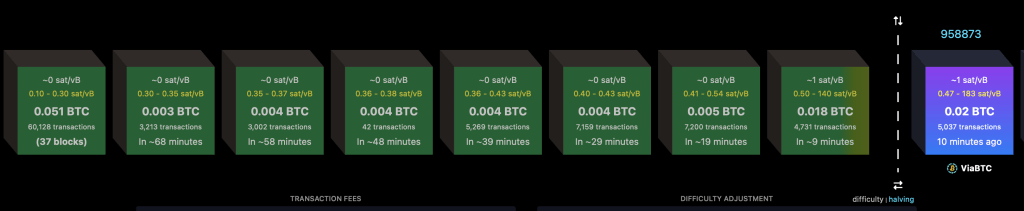
The green blocks on mempool.space represents groups of unconfirmed Bitcoin transactions waiting in the mempool to be selected by miners. Each block estimates the transactions likely to fit into a future block based on their fee rates, measured in satoshis per virtual byte (sat/vB). Miners typically prioritize the highest-fee transactions first because they maximize block revenue. As new blocks are mined roughly every 10 minutes, transactions are removed from the mempool, while newly broadcast transactions continuously refill it, creating a constantly changing queue.

The second consequence is a higher fee market. Bitcoin has no protocol-level base fee like Ethereum’s. Instead, users compete against the marginal fee rate miners can fit into the next block, while each node also maintains a local admission floor. Under pressure, that dynamic floor can rise far above the software’s basic relay setting. The fee shown yesterday, or even 20 minutes ago, may no longer buy the same confirmation speed.

The third consequence is uncertainty before settlement. Seeing a transaction in a block explorer is evidence that some nodes know about it, not proof that every miner does. An unconfirmed payment can be replaced, evicted or disappear from a node’s view while remaining a valid possible spend. Businesses that release goods, credit accounts or treat a deposit as final at zero confirmations are accepting a risk that congestion can make more visible.

A Few Ways to Rescue a Stuck Payment

Bitcoin itself gives users two main ways to reprice a delayed payment. Replace-by-fee, known as RBF, lets the spender replace an unconfirmed transaction with one paying more. Think of it as canceling a low bid and submitting a stronger one for the same seat. Child-pays-for-parent, or CPFP, takes another route: A spendable output from the delayed transaction is used in a new, high-fee child transaction, giving miners an incentive to include the parent and child together.

Neither tool is magic. An RBF replacement must satisfy node policy and pay enough to beat both the transaction it replaces and the current market. A CPFP child must lift the combined fee rate of the entire package, not merely look expensive on its own. In a sharply rising market, a modest bump can still leave the payment below the moving cutoff. The real target is not the minimum relay fee. It is the fee rate near the tail of the next likely block.
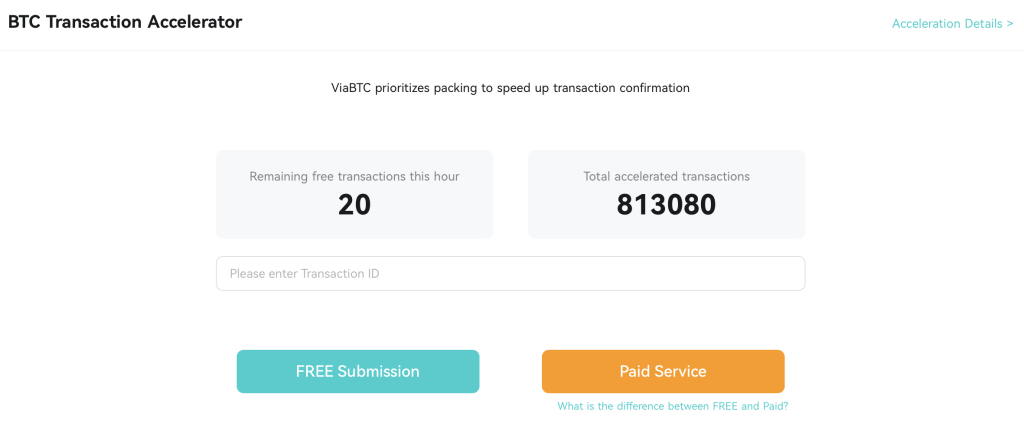
ViaBTC’s transfer accelerator offers 20 free pushes per hour.

Outside these two options, mining accelerators are services offered by some bitcoin mining pools that let users submit a transaction for priority consideration when it is stuck in the mempool with a low fee. Rather than changing Bitcoin’s consensus rules, the accelerator simply asks participating miners to include that transaction in one of the next blocks they mine. Some accelerators are free but have eligibility requirements, while others charge a fee or require the transaction to meet a minimum fee rate.

Core 31.0 Changes the Machinery, Not the Ceiling

Bitcoin Core 31.0 changes some of the machinery behind that contest. Its cluster mempool groups connected unconfirmed transactions and orders them by the fee rate at which the group is expected to be mined. The default cluster limits are 64 transactions and 101 kB in virtual size. The design is intended to improve block construction, eviction, transaction relay and replacement decisions without changing Bitcoin’s 4 million-weight-unit consensus ceiling.
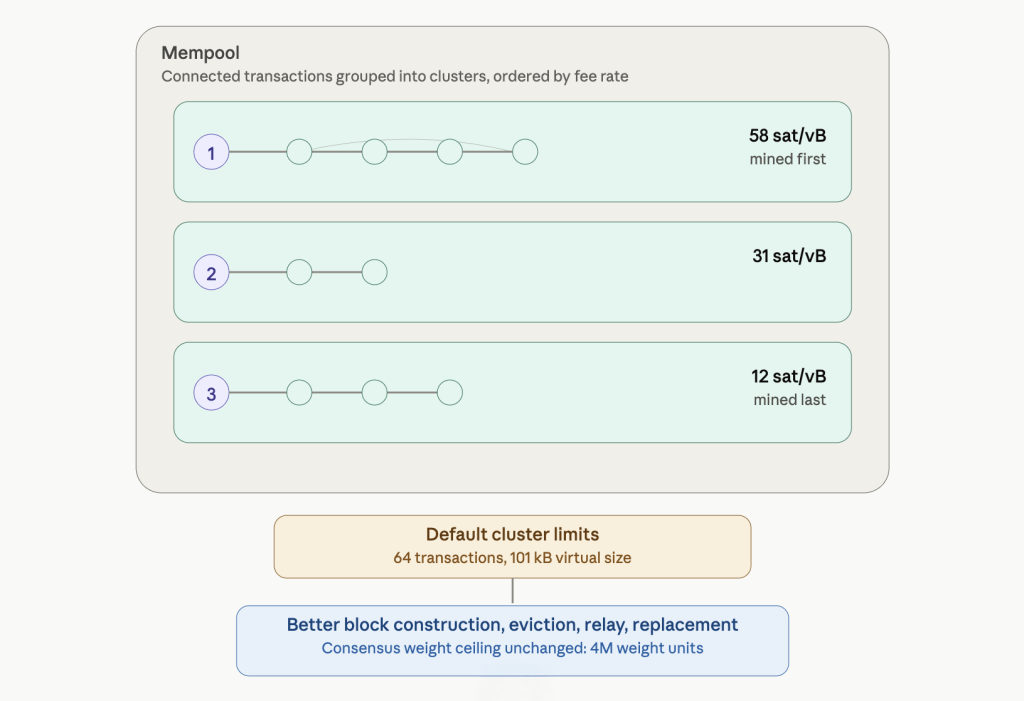
A visual of Bitcoin Core’s cluster mempool concept.

Other engineering work tries to reduce the cost of moving full blocks through the network. A compact block relay allows a node to reconstruct much of a new block from transactions it already holds, reducing the data and time needed to propagate it. That matters because slower propagation can increase the risk that two miners briefly build on different chain tips. More block capacity may lower short-term fee pressure, but it can also add bandwidth, validation, and propagation demands.

The practical lesson is simple. When a Bitcoin block is full, nothing breaks and no transaction earns seniority for waiting. Miners confirm the most economically attractive valid packages that fit, while cheaper payments remain pending, get repriced or lose relay reach. For investors and businesses, the fee is not a postage stamp. It is a bid for scarce settlement space. Treat confirmation time as a probability, and watch current fee conditions before a routine delay becomes an expensive operational problem.

Hero/Feature image source: mempool.space

Share. Facebook Twitter Pinterest LinkedIn Tumblr Email
NBTC

NBTC is the editorial account for NBTC News, covering Bitcoin, Ethereum, DeFi, blockchain infrastructure, exchanges, mining, regulation and digital asset markets. The editorial team focuses on clear sourcing, timely updates and practical context for crypto readers.

Related Posts

Bitcoin Whale That Accumulated for Six Years Moves $52.2M to Cumberland in Potential Sell Signal

15/09/2026

50% Dip Is Shallowest on Record

15/09/2026

New Onramp Report Makes the Case for Spot Bitcoin Over Paper Claims as Price Sits at Half Its Peak

14/09/2026

Bitcoin price gains to $66.3K as range breakout attempt sparks one-month high

14/09/2026
Add A Comment

Comments are closed.

Top Posts
Get Informed

Subscribe to Updates

Get the latest news from NBTC regarding crypto, blockchains and web3 related topics.

Your source for the serious news. This website is crafted specifically to for crazy and hot cryptonews. Visit our main page for more tons of news.

We're social. Connect with us:

Facebook X (Twitter) LinkedIn RSS
Top Insights

What Happens When a Bitcoin Block Is Full? Every Byte Sparks a Live Fee Auction

15/09/2026

XRP holders could earn new yield, but getting out may take up to 60 days

15/09/2026

South Korea’s On-Chain Crypto Activity Hits $10.9B in 2023, Ranking 11th Globally

15/09/2026
Get Informed

Subscribe to Updates

Get the latest news from NBTC regarding crypto, blockchains and web3 related topics.

Type above and press Enter to search. Press Esc to cancel.