However, increased long-term holdings don’t always mean investors are buying more $XRP. Some tokens enter older holding groups simply because their owners leave them unmoved for longer periods.
What the HODL Waves Indicator Reveals
The recent trend was highlighted by Glassnode’s $XRP HODL Waves indicator. For context, this metric tracks how long tokens remain in wallets without moving.
It divides the circulating supply into age groups, and this allows analysts to see how the share of short-term and long-term holdings changes over time.
Data from Jan. 1, 2026, when $XRP traded at $1.88, and Oct. 16, 2026, when it traded at $1.31, shows an observable increase in long-term holdings.
The combined share of $XRP held for at least one year rose from 50.99% to 55.91% during this period, an increase of nearly five percentage points. This happened even as $XRP faced months of price weakness, with the token trading well below its January level by October.
Spike in $XRP Supply Held by Long-Term Holders
The 1y-2y band recorded one of the largest increases among the long-term groups, rising from 11.698% on Jan. 1 to 16.742% on Oct. 16. The increase of more than five percentage points made the group a major contributor to the growth in long-term holdings.
The 7y-10y band also grew, rising from 3.894% to 5.411%. This suggests that more $XRP entered this age group as previously held tokens remained untouched.
In contrast, the 3y-5y band, which was the largest long-term group at the start of the year, fell from 18.432% to 17.801%. The 2y-3y band declined from 5.621% to 5.073%, while the 5y-7y band dropped from 4.597% to 4.324%.
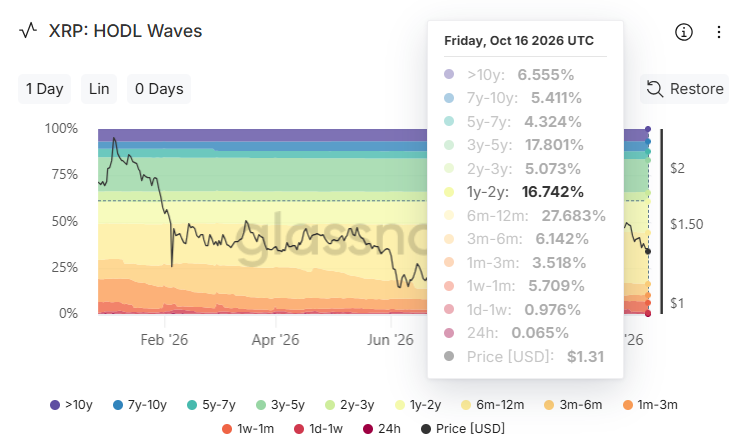
The group holding $XRP for more than 10 years also decreased, moving from 6.747% to 6.555%. Profit-taking among investors who acquired $XRP between 2019 and 2023 may partly explain these declines.
Shorter-term holdings recorded bigger changes. The 1m-3m band dropped from 12.286% to 3.518%, while the 3m-6m band fell from 10.588% to 6.142%.
Together, these groups accounted for more than 22% of $XRP’s supply in January but less than 10% by October 16. This shows that the share of supply held for shorter periods has fallen during the year.
Future Long-Term Holders
The 6m-12m band recorded the largest increase across all age groups, climbing from 19.351% to 27.683%. It became the largest individual group, overtaking the 3y-5y band, which had previously held that position.
These tokens were accumulated roughly between October 2025 and April 2026, a period that coincided with $XRP’s steep decline from its cycle highs.
If investors continue holding these tokens without moving them, they will gradually enter the one-year-plus category over the coming months. This could push the long-term share of $XRP’s circulating supply higher and also reduce the number of tokens available for trading.
The increase in long-term holdings alongside the decline in exchange balances recorded this year suggests that less $XRP may be available for immediate trading. This could support the price if demand remains strong, although the data alone does not guarantee further gains.