
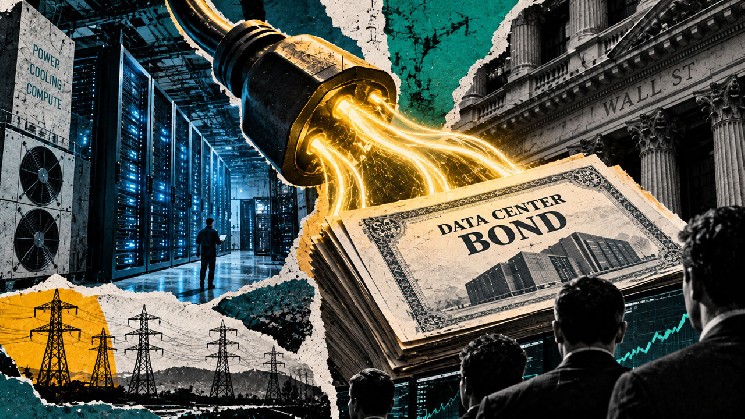

Every interaction with AI uses electricity in a data center. Servers calculate the answer, cooling equipment carries away the heat, and network connections send the result back to the user.
Multiply that process across millions of requests and the electric bill becomes one of the facility’s highest costs, while access to enough power determines how much computing the building can support and how much money it can earn.
Wall Street is now packaging that income into bonds. Once a data center is open and has paying customers, its owner can transfer the facility and its contracts to a separate legal entity that issues debt. Investors are repaid from the rent and service fees paid by the data center’s customers after expenses such as electricity, maintenance, taxes, and insurance are covered.
The collateral extends beyond rent, covering the property, its essential systems, customer agreements, and the business that keeps everything running. Electricity appears as an expense in the cash-flow waterfall, so power prices and deliverable megawatts can shape the bond almost as much as tenant credit.
In February, S&P assigned an A(sf) rating to Sabey Data Center Issuer’s $475 million 2026-1 notes, backed by real estate and tenant lease payments. Across the sector, outstanding>Structured Finance Association research drawing on Barclays data.
The bond gives investors a claim on real estate and operating revenue, though the economic unit underneath is nothing more than reliable electricity delivered to a creditworthy computing customer.
AI has turned the megawatt into something Wall Street can price and place in a fixed-income portfolio.
The new unit of real estate is a megawatt
Conventional property language struggles with a data center because square footage explains only the shell. Server campuses need a utility connection, substations, backup generation, cooling, security, and fiber routes designed around each rack’s power draw.
Space with little usable electricity offers little to an AI company, while a secured megawatt in a region short on capacity can define the entire project.
The national totals show how fast that physical requirement is expanding. Lawrence Berkeley National Laboratory’s 2025 update estimates that US data centers could consume 649 terawatt-hours in 2030 in its reference case, equal to 11.8% of total US electricity use.
The wider model range runs from 521 to 843 TWh, or 9.5% to 15.3%, depending partly on chip shipments, server use, equipment life, and cooling performance.
For bond investors, that wide range captures how far the industry’s power needs could move during the life of a long-dated security.
More AI chips can lift revenue but also require extra power equipment, utility upgrades, and cooling. Even a facility with a long customer contract may need expensive retrofits as new processors pack more heat into each rack.
The customer agreement translates that computing demand into revenue. Large cloud and AI tenants lease a data hall or a block of capacity measured in megawatts, then pay for the space, available power, and operating services.
Those payments create recurring cash while tenant concentration ties an entire campus to a small number of technology companies.
The transaction structure described to the SEC starts with tenant and customer revenue, then deducts taxes, insurance, electricity, repairs, and operating costs before bondholders get paid.
The property and contracts form the collateral, while the electric bill controls how much revenue completes the trip from an AI tenant to an investor’s coupon.
That leaves bond buyers with two connected underwriting jobs, since an investment-grade hyperscaler can make lease payments look dependable even when the building faces limits around power and technological usefulness.
Tenant credit asks whether the customer can pay, while facility design asks whether that customer will still want the building when denser chips demand another electrical and cooling configuration.
How an AI server hall becomes a bond
Data centers pass through several kinds of finance as their risk profile matures. Construction loans, project finance, private credit, or corporate bonds can fund the land, equipment, permits, and utility work.
Those early lenders bear the danger of a delayed grid connection, cost overruns, or a facility that opens without enough tenants.
Once the building is operating and leased, its owner can refinance through a data-center securitization or commercial mortgage-backed security. Corporate debt depends on the company’s broad balance sheet, while a commercial mortgage-backed deal owns a mortgage loan secured by the property.
A data-center securitization places the facilities and operating assets themselves inside a ring-fenced issuer, giving investors recourse mainly to that pool.
The special-purpose issuer can own the property, power and cooling systems, fiber, leases, and service contracts, while an operator runs the facilities. A master trust lets the sponsor add qualifying data centers and issue more notes over time, turning a portfolio of server campuses into a repeat source of finance for another round of construction.
The Latham letter filed with the SEC says these transactions usually start with debt equal to no more than 70% of the appraised asset value, leaving at least 30% as sponsor equity. The notes often carry an expected repayment point around five years and a legal final maturity of 25 to 30 years.
Such a wide gap creates refinancing exposure because the business plan assumes the owner can issue new debt or repay early many years before the legal deadline.
Wall Street can divide the same pool into classes with different claims on the cash, allowing one building portfolio to serve pension funds, insurers, hedge funds, and other buyers with different risk appetites.
Senior classes receive their payments first and usually carry lower coupons, while junior classes collect more interest because they absorb losses sooner.
The Structured Finance Association’s sector review puts average data-center ABS issuance near $600 million and average data-center CMBS issuance near $1.2 billion.
Securitizations and commercial mortgage bonds could supply around $150 billion, leaving corporate debt, bank loans, project finance, private credit, and equipment lending to fund the rest.
Data centers already take up much more room in structured credit. The same paper puts data-center ABS at about 12% of the esoteric ABS market in 2026, up from 3% in 2020, while data-center CMBS represents about 6% of single-asset, single-borrower CMBS.
A Barclays projection cited in the report puts outstanding data-center securitizations as high as $180 billion by the end of 2028.
The AI bond market sheds an ABS label
A legal distinction gave this market a valuable opening on July 29, when the SEC’s Office of Structured Finance agreed that data-center securitizations matching Latham’s description fall outside the Exchange Act definition of an asset-backed security.
The SEC staff response applies only to the facts presented, carries no independent legal force, and leaves room for staff to reach another conclusion when a deal uses a different structure.
The reasoning depends on what is left once investors have been repaid. Conventional asset-backed securities often contain mortgages, car loans, or receivables that convert into cash and disappear as borrowers pay them down.
Data-center issuers still own and operate the facility once its notes have been repaid, and the land, power gear, cooling equipment, contracts, and business can keep producing value. That makes the structure much closer to financing an operating real-estate company.
It also creates a language issue because the market still refers to these instruments as data-center ABS, while the SEC letter deals with the narrower legal definition of an Exchange Act ABS. The familiar market label and the statutory category can now point to different things without either usage being wrong.
That classification lets qualifying deals avoid several ABS-specific obligations. Latham’s explanation of the SEC view says market participants can stop voluntarily observing the federal rule requiring securitizers to retain 5% of the credit risk.
Rule 192, which bars certain conflicts of interest for covered securitizations, also falls outside the structure, along with disclosure provisions tied to repurchase activity and third-party due-diligence reports.
Typical data-center structures keep sponsor equity at 30% or more, giving owners plenty of their money at risk, though that feature differs from a statutory retention rule.
Federal antifraud law and the relevant registration or offering exemption still apply. The staff letter can reduce the cost and work of issuing the bonds while still leaving investors to study the deal documents for power contracts, tenant exposure, refinancing assumptions, and asset condition.
If lower issuance costs bring more operating facilities into the bond market, voluntary disclosure will carry more weight. Investors need enough information to compare deliverable power, tenant concentration, equipment age, and debt due at the expected repayment point.
Familiar ratings compress a complicated credit view into a letter, while the physical reasons behind that view can stay buried several layers down.
Those layers connect in ways that make AI credit different from an ordinary office mortgage. Delayed grid connections postpone the lease and the revenue that comes with it, while concentrated tenants can choose to renegotiate or leave. Higher electricity costs then reduce cash available for debt service, and denser chips can force expensive retrofits.
If the bond market also turns hostile near the five-year repayment point, the issuer may need another lender just as demand for its older facilities is weakening.
AI data centers are testing the power-saving playbook pioneered by Bitcoin miners, using flexible computing to cut electricity use when the grid is strained.
The bond version carries the same physical reality into credit markets. A facility that can manage power intelligently may preserve margins and improve reliability, while one built around uninterrupted maximum demand leaves the grid and its operating cash with less room.
The user who receives an AI-generated answer sees software moving at extraordinary speed. The investor holding a data-center note owns a claim that may stretch across decades.
Between them lies a chain of utilities, substations, leases, servers, and refinancing assumptions, all feeding one stream of operating cash. Wall Street has made AI’s electric appetite investable, and every coupon now carries the physical constraints the interface leaves out.
