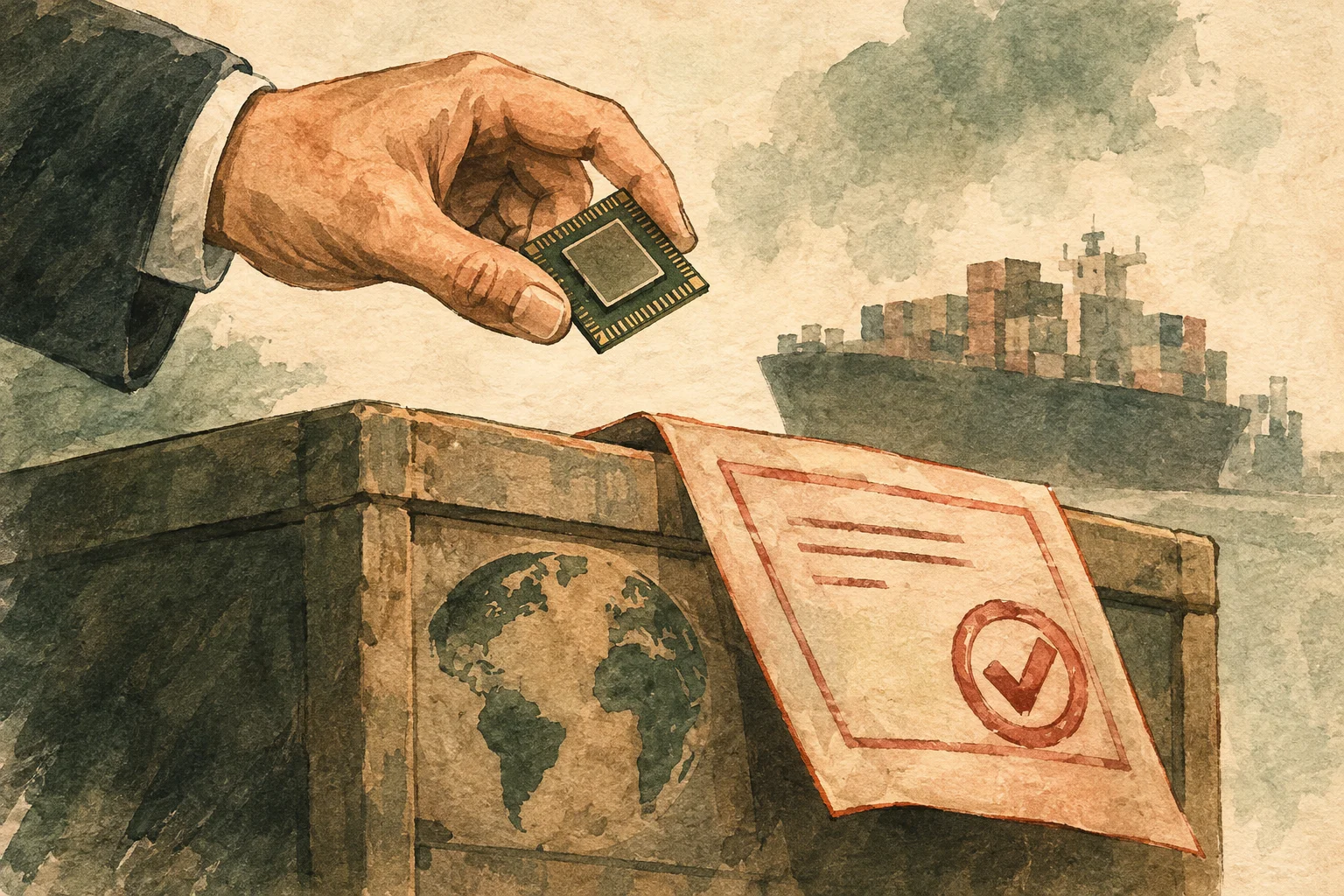
Washington wants to know exactly where its most powerful AI chips end up. The United States is moving to require licenses before advanced chips can be reexported to Singapore, Brazil, Indonesia, Malaysia and Thailand.
The aim is to prevent chips that China cannot buy directly from reaching the country through a neighboring server room.
What the rule would actually do
The measure comes from the US Department of Commerce’s Bureau of Industry and Security, known as BIS. Its draft rule would require export licenses for AI chips in the Blackwell class and above.
The scope is specific: the license requirement would apply when these chips are exported or reexported to data centers and cloud service providers in the five named countries.
The list may include more than five countries. Norway and South Africa could reportedly also be covered by the regulation, extending the rule beyond Southeast Asia and Latin America.
Timing matters. As of November 16, 2026, the rule was still in draft form and had not been officially published.
BIS has indicated that an announcement may come soon. The rule could be unveiled as early as November 2026.
Why these five countries
The rule is intended to prevent circumvention. US export controls already restrict which advanced chips can be sold to China, but those controls work only if the chips remain where they are shipped.
Recent enforcement activity helps explain regulators’ concerns. On November 12, 2026, authorities in Singapore charged an individual with 41 counts related to server transfers to Malaysia.
Malaysia is also conducting an investigation into possible reexports of AI chips imported by local entities.
The investigation is examining two companies: Singapore-based Megaspeed and its Malaysian unit, Speedmatrix. Both are under investigation for potential violations related to Nvidia chip exports.
Malaysia was already tightening controls
Malaysia did not wait for Washington. Since July 2025, the country has required permits to export high-performance US AI chips under its Strategic Trade Act, legislation dating back to 2010.
The permit system covers chips leaving Malaysia, whether they are exported or reexported. Imports intended for domestic data centers, however, have remained exempt from that scrutiny.
That distinction is where the new US rule would have an effect. Malaysia monitors what leaves the country, while the BIS draft would regulate chips brought in for data center use.
Together, the two layers would create tighter controls. A chip destined for a Malaysian data center could face a US license check on arrival and a Malaysian permit check on departure.
What the rule could mean for chipmakers and cloud operators
Companies selling advanced AI hardware would face the most direct pressure. Nvidia, whose chips are central to the Malaysian investigation, is closely connected to the technology targeted by the rule.
The main questions are whether and when the rule will be formally published, and whether Norway and South Africa will be included on the final list.
The court cases are also worth watching. The outcome of the Singapore charges and the investigations into Megaspeed and Speedmatrix will indicate how seriously circumvention is being punished.