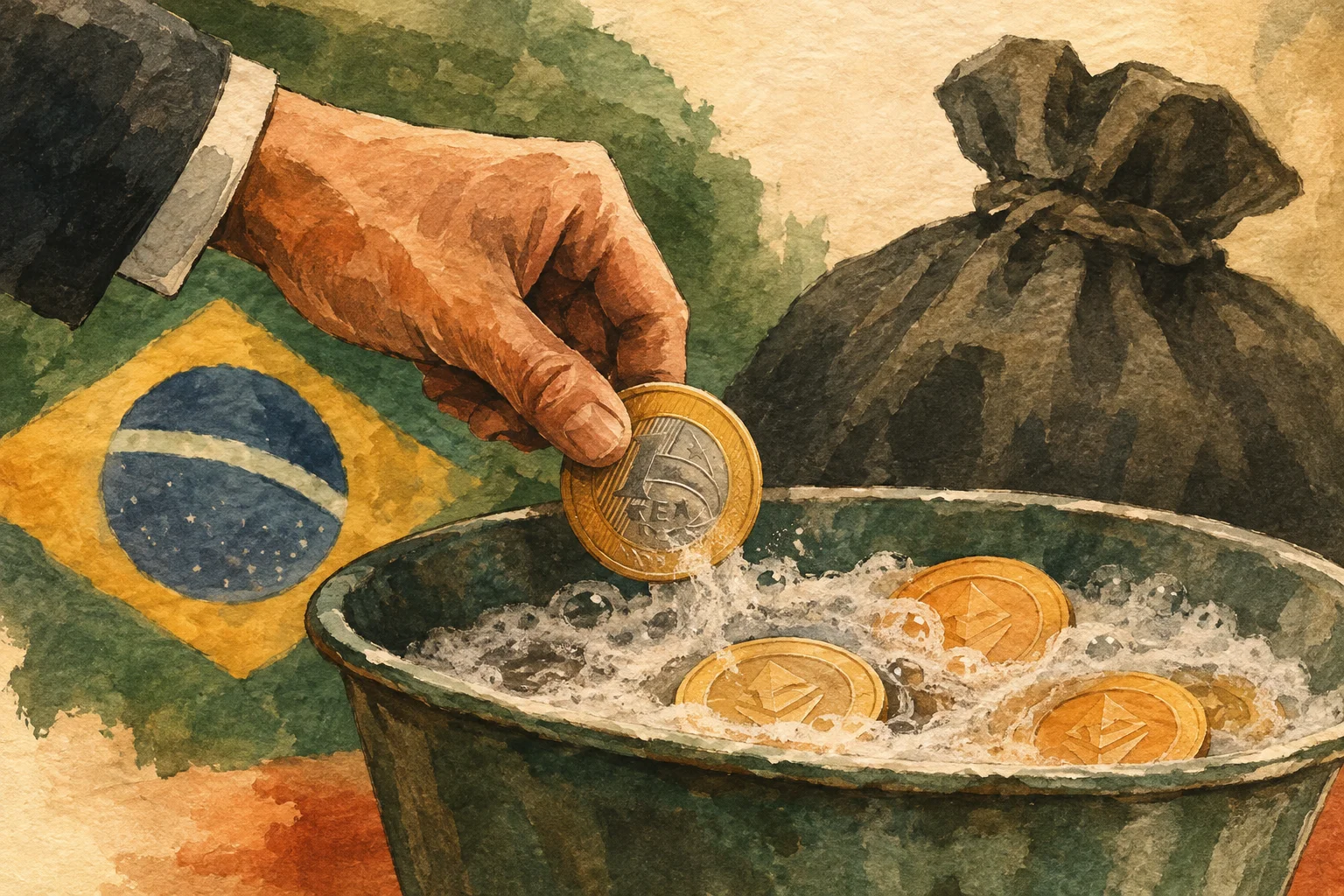
A senior official at the Central Bank of Brazil has suggested that converting legitimate reais into stablecoins could be treated as money laundering. It is a striking claim. The usual laundering scenario involves dirty money being cleaned, not clean money becoming dirty.
Gerson Romantini, the BCB’s head of foreign exchange, reportedly made the remarks on November 13, 2026, during a closed session with industry stakeholders. He said that converting fiat currency into stablecoins taints “good money” with money-laundering implications, reversing the familiar script.
What the central bank is targeting
Romantini’s comments focused on a practice known as “stablecoin sandwiching.” In this arrangement, fintechs convert reais into stablecoins and use them to make international payments.
Brazil has already banned the practice. BCB Resolution No. 561/2026, which took effect on October 1, 2026, specifically prohibits stablecoin sandwiching.
The November remarks therefore did not announce a new rule. They explained, in fairly blunt terms, how the regulator views the activity that the rule was designed to stop.
The framing matters. Calling something a compliance violation is one thing. Linking it to money laundering considerably raises the stakes for any firm still testing the boundaries.
The stance also builds on earlier groundwork. Resolutions Nos. 519 through 521, introduced from late 2025 into early 2026, reclassified transactions involving fiat-pegged stablecoins as foreign-exchange operations under BCB supervision.
That reclassification is crucial. Once a stablecoin transfer counts as a currency trade, it is subject to all the rules that apply to currency trades.
Those rules include anti-money laundering (AML) and counter-financing of terrorism (CFT) requirements. The reclassification also creates the possibility of taxation.
A tax that hasn’t landed yet
On taxation, the BCB proposed a 3.5% tax on cross-border stablecoin transactions. The proposal has faced difficulties.
The proposal drew significant opposition from industry groups and congressional entities, and its implementation has been postponed. For now, the levy remains a proposal, not a line item on anyone’s payment receipt.
A forthcoming regulatory discussion is expected to further restrict fintech involvement and could shift remittance activity back toward traditional banks.
How Brazil got here
Brazil’s crypto rulebook has been under development for some time. The foundation was Law 14.478, enacted in 2022, which set the stage for a detailed framework covering virtual assets.
From 2025 onward, the BCB has issued a series of resolutions that added detail to that framework. The regulator has imposed licensing requirements on virtual-asset service providers, or VASPs, including the exchanges, brokers and custodians that handle crypto for customers.
The licensing push also has implications for capital. Reports suggest that nearly one-third of virtual-asset service providers may not meet the new capital requirements.
What this means for fintechs and stablecoin users
The most immediate effect is on Brazilian fintechs that relied on stablecoins for payment processing. With sandwiching banned and officials publicly linking it to money laundering, the compliance risk for anything resembling that arrangement has increased.
Any product that converts reais into stablecoins for overseas transfers now needs to clearly demonstrate that it complies with the foreign-exchange framework and includes full AML and CFT controls.
If nearly one-third of VASPs fail to meet the capital requirements, better-funded firms could gain market share and customers.
Key developments to track include the upcoming regulatory discussion on fintech involvement in remittances, whether the 3.5% cross-border tax resurfaces, and how many VASPs meet the capital requirements.