
Close Menu
  • Coins
    • Bitcoin
    • Ethereum
    • Altcoins
    • NFT
  • Blockchain
  • DeFi
  • Metaverse
  • Regulation
  • Other
    • Exchanges
    • ICO
    • GameFi
    • Mining
    • Legal
  • MarketCap
What's Hot

The next currency crisis may be harder to contain because of stablecoins, New York Fed report shows

18/09/2026

Cardano Founder Pushes for Reputation Revival, Says ADA Needs a Narrative Reset

18/09/2026

BitGo buys NYDIG trading unit as institutions consolidate crypto services

18/09/2026
Facebook X (Twitter) Instagram
  • Back to NBTC homepage
  • Privacy Policy
  • Contact
X (Twitter) Telegram Facebook LinkedIn RSS
NBTC News
  • Coins
    1. Bitcoin
    2. Ethereum
    3. Altcoins
    4. NFT
    5. View All

    Bitcoin Onchain Signal Says Worst of Bear Market May Be Over

    18/09/2026

    Michael Saylor Opposes BIP 110, Says Proposal Risks Bitcoin’s Neutrality

    18/09/2026

    Why analyst expects Bitcoin ETF will follow gold’s ‘triumph and pain’ pattern

    17/09/2026

    Bitcoin Flashes ‘End of Bear’ Signal as Cost Basis Crossover Suggests Final Bear Market Phase

    17/09/2026

    North Korean Hacker Group Lazarus Made Large Sales of This Altcoin! Here Are the Details

    17/09/2026

    Ethereum Price Today Holds Uptrend, But Hourly Momentum Breaks Down

    17/09/2026

    What Could Break ETH’s $2500 Consolidation

    17/09/2026

    Is Ethereum price at risk of a drop below $2,400?

    17/09/2026

    Cardano Founder Pushes for Reputation Revival, Says ADA Needs a Narrative Reset

    18/09/2026

    HYPE Explodes 79% During Hyperliquid Breakout Quarter

    18/09/2026

    Evernorth CEO Shares His Vision for the Token’s Future

    18/09/2026

    Shiba Inu Team’s Most Active Voice Returns to X After Two Months of Silence

    18/09/2026

    Pixelmon shuts down game development after inconclusive publisher test

    15/09/2026

    NFT sales rise 6.8% to $46.8M as Bitcoin trades surge

    12/09/2026

    NFT sales surge 55.6% as BNB Chain overtakes Ethereum for first time

    06/09/2026

    OpenSea Users Demand ETH/USD Switcher Amid Frustration

    05/09/2026

    The next currency crisis may be harder to contain because of stablecoins, New York Fed report shows

    18/09/2026

    Cardano Founder Pushes for Reputation Revival, Says ADA Needs a Narrative Reset

    18/09/2026

    BitGo buys NYDIG trading unit as institutions consolidate crypto services

    18/09/2026

    HYPE Explodes 79% During Hyperliquid Breakout Quarter

    18/09/2026
  • Blockchain

    UAE Integrates Avalanche Blockchain Into National Digital ID Platform

    17/09/2026

    ‘Long Way to Flip ETH,’ Binance’s CZ Reacts as BNB Chain Outperforms Solana in DeFi TVL

    17/09/2026

    BNK-EverTreasure deal expands South Korea’s tokenized securities ahead of 2027

    17/09/2026

    USDC, WETH arrive on Neo X through Chainlink CCIP-powered Transporter bridge

    17/09/2026

    BNB Smart Chain upgrade lifts gas limit to 70M as network hits 95% capacity

    17/09/2026
  • DeFi

    Pendle Introduces Confidential cUSDC Deposits via Morpho

    17/09/2026

    Pendle Ecosystem Hits $60M in USDC Deposits, Leading

    17/09/2026

    Malicious Uniswap v4 hooks are baiting DeFi traders with fake swap quotes

    17/09/2026

    Aave Unveils RWA Hub on Avalanche, Major Step

    17/09/2026

    Aave’s Anchorage proposal bridges institutional custody and DeFi – Explained

    17/09/2026
  • Metaverse

    Is Solana Gaming Back? Kintara Activity Fuels Renewed Optimism in Onchain MMOs

    24/06/2026

    The Sandbox launches AI game engine ‘The Sandbox Studio’ for next-generation creators

    10/06/2026

    Meta commits $13M in funding for Oversight Board through 2028

    29/05/2026

    Why Animoca’s Yat Siu says the future is 100 billion AI agents

    07/05/2026

    ‘8,000 Jobs’—Polymarket Sees Tech Layoff Surge As Meta AI Push Bites

    18/04/2026
  • Regulation

    The next currency crisis may be harder to contain because of stablecoins, New York Fed report shows

    18/09/2026

    BitGo buys NYDIG trading unit as institutions consolidate crypto services

    18/09/2026

    Evernorth clears SEC hurdle as XRP-focused Nasdaq listing moves closer

    18/09/2026

    HashKey Revenue Rises 20.6% as Adjusted First-Half Loss Narrows

    18/09/2026

    Abu Dhabi royal backs 49% stake in Trump-linked crypto bank venture: WSJ

    17/09/2026
  • Other
    1. Exchanges
    2. ICO
    3. GameFi
    4. Mining
    5. Legal
    6. View All

    Upbit Temporarily Suspends HBAR Deposits and Withdrawals for Hedera Wallet Maintenance

    17/09/2026

    Binance Introduces Agent OS for AI-Connected Financial Applications

    17/09/2026

    BIT-Linked Addresses Boost ETH Long to 29,500 on Hyperliquid, Data Shows

    17/09/2026

    Korbit to Cover Harmony Token Shortfall After Security Incident

    17/09/2026

    ICO market slows sharply with only six completions in 2026

    30/04/2026

    South Korea Poised to Lift Ban on Domestic ICOs After 7 Years

    19/12/2025

    Why 2025’s Token Boom Looks Both Familiar and Dangerous

    31/10/2025

    ICO for bitcoin yield farming chain Corn screams we’re so back

    22/01/2025

    Top 12 NFT games every player should know about in August 2026

    19/08/2026

    GameShame Studios founder details Raijin Protocol’s roadmap in NeoPod’s sixth AMA

    13/08/2026

    How BC.GAME is turning players into stakeholders

    04/08/2026

    YGG Play Shuts Down Services as Yield Guild Pivots to AI Data

    01/08/2026

    Zcash miner Fortitude names former Hut 8 chief Jaime Leverton CEO ahead of Nasdaq deal

    17/09/2026

    Bitcoin miners have amassed $100 billion of AI deals, but almost none of the revenue exists yet

    17/09/2026

    U.S. diesel prices hit record high as bitcoin and gold struggle

    17/09/2026

    Ethiopia cuts Bitcoin miners’ power by 77% amid hydropower shortage: Report

    16/09/2026

    Polish prosecutors charge fifth suspect in a massive crypto probe

    17/09/2026

    If CLARITY Act fails before 2030, these 2 crypto sectors will explode

    17/09/2026

    Former Federal Prosecutor Says as “CLARITY Is Dead,” After Congress Talks

    17/09/2026

    Senator Lummis Warns CLARITY Act Failure Could Delay Crypto Rules Until 2030

    17/09/2026

    The next currency crisis may be harder to contain because of stablecoins, New York Fed report shows

    18/09/2026

    Cardano Founder Pushes for Reputation Revival, Says ADA Needs a Narrative Reset

    18/09/2026

    BitGo buys NYDIG trading unit as institutions consolidate crypto services

    18/09/2026

    HYPE Explodes 79% During Hyperliquid Breakout Quarter

    18/09/2026
  • MarketCap
NBTC News
Home»Regulation»The next currency crisis may be harder to contain because of stablecoins, New York Fed report shows
Regulation

The next currency crisis may be harder to contain because of stablecoins, New York Fed report shows

NBTCBy NBTC18/09/2026No Comments6 Mins Read
Share
Facebook Twitter LinkedIn Pinterest Email


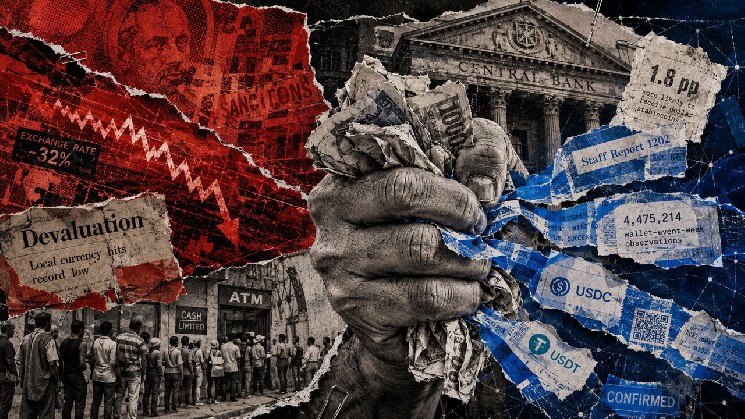
A New York Federal Reserve study found that dollar stablecoins are more likely to flow into wallets tied to countries experiencing currency or banking crises.

Wallets linked to countries experiencing some form of financial crisis were 1.8% more likely to receive dollar stablecoins during the week a crisis began, researchers Pablo Azar, Maryam Farboodi and Nish Sinha found in an August staff paper. Receipt volumes of these assets across these wallets also increased significantly during those periods.

The findings provide evidence for a growing challenge facing central banks in economies under financial stress.

Governments have traditionally relied on banks and other regulated intermediaries to enforce restrictions on foreign-exchange purchases and cross-border transfers.

However, the advent of stablecoins has given households and businesses another route to dollar exposure that can operate outside those domestic banking channels.

The research comes as the stablecoin market has grown beyond $300 billion and is expected to reach the trillions of dollars before the end of the decade. That expansion could make the alternative payment rails identified by the New York Fed increasingly relevant during future currency crises.

Crisis demand shifts onto blockchain rails

According to the paper, the researchers studied nine episodes across eight countries between 2021 and 2025, including monetary disruptions, banking restrictions, sanctions and devaluations affecting Argentina, Egypt, Iran, Myanmar, Nigeria, Russia, Turkey and the United Kingdom.

They linked Ethereum Name Service registrations carrying country signals, such as languages, scripts and national identifiers, with transfer histories for 19 major dollar-pegged stablecoins.

During crisis weeks, tagged wallets recorded both a higher probability of receiving stablecoins and larger receipt volumes. A separate specification found no significant increase in the two weeks before the shocks, while the probability of receiving stablecoins rose 1.9% during the crisis week.

Sending activity increased later, with wallets becoming 1.3% more likely to send stablecoins two weeks after the crisis began.

The sequence supports the researchers’ argument that demand for blockchain-based dollars rises when confidence in domestic financial arrangements comes under pressure.

However, these estimates require qualification. The dataset does not represent every resident or crypto wallet in the countries studied. Its roughly 4.5 million observations are wallet-event-week records, and the sample focuses on wallet-country pairs that received stablecoins at some point within a 53-week window around each crisis.

The result therefore captures a change in behavior among wallets already connected to stablecoin activity rather than showing that stablecoin adoption rose by 1.8% across an entire national population.

Stablecoins complicate the capital-control playbook

The behavior feeds directly into a longstanding constraint on monetary policy.

Under the Mundell-Fleming framework, countries cannot simultaneously maintain a fixed exchange rate, unrestricted capital mobility, and independent control over domestic interest rates.

Governments seeking to protect a currency while retaining monetary autonomy can restrict capital movement through banks and other financial institutions.

The New York Fed researchers model stablecoins as weakening that enforcement channel.

A household facing restrictions on buying or transferring dollars through its bank may instead receive dollar-denominated tokens into a blockchain wallet. As access to those rails expands, the government must devote more resources to enforcement or allow more of the pressure to emerge through currency depreciation or domestic interest rates.

The paper does not establish that stablecoins caused particular currencies to weaken during the nine episodes.

Instead, the observed wallet activity supports the model’s central assumption that financial stress encourages stablecoin adoption. Its broader monetary-policy consequences remain theoretical.

Governments also retain significant points of control. Major dollar tokens such as USDT and USDC are issued by centralized companies that can freeze addresses, while regulated exchanges can be required to restrict transactions or identify customers.

Those powers shift enforcement away from a country’s banking system toward a wider network of issuers, exchanges, and blockchain addresses.

Transfers between self-custodied wallets can leave governments with fewer immediate domestic chokepoints even when issuers retain the ability to intervene at other stages.

A $300 billion market shifts where governments can’t intervene

The policy challenge becomes more consequential as stablecoins expand from a niche crypto product into a global dollar-payment network.

The market has already grown beyond $300 billion and is expected to reach trillions of dollars before the end of the decade.

Blockchain analysis firm Chainalysis projects an even steeper rise in activity, estimating that adjusted stablecoin transaction volume could reach $719 trillion by 2035 through organic growth alone and approach $1.5 quadrillion if broader macro and adoption trends accelerate usage.

That growth would increase the number of routes available to households seeking dollar exposure during periods of domestic financial stress, but it would not put stablecoins entirely beyond government reach.

The largest dollar tokens remain centralized. Issuers such as Circle and Tether can freeze identifiable addresses, while governments can impose requirements on regulated exchanges and other intermediaries even when a transfer initially bypasses the domestic banking system.

The problem is that enforcement becomes less uniform once tokens move beyond those points.

Federal Reserve Vice Chair for Supervision Michael Barr warned in June that US stablecoin legislation left an illicit-finance vulnerability around secondary-market transfers involving unhosted wallets.

The Bank for International Settlements has identified a similar problem for monetary policy, arguing that stablecoin dollarization can threaten monetary sovereignty while restrictions may prove less effective when bearer-like tokens circulate through self-custodied wallets.

That creates a more fragmented enforcement map. Governments can exert substantial control over banks, stablecoin issuers and regulated trading venues, but may have less visibility or immediate reach when dollar tokens move between private wallets without returning to those intermediaries.

The distinction becomes particularly important during a currency crisis, when demand for an alternative store of value and payment rail can rise just as authorities try to restrict capital movement.

The New York Fed paper suggests that this choice of financial infrastructure is becoming part of the macroeconomic constraint itself. As stablecoin networks grow, effective capital mobility increasingly depends on both the controls governments impose and the blockchain rails households can still access.

At the scale projected for the next decade, that could turn stablecoins from an alternative payment mechanism into a material constraint on how governments defend currencies during periods of financial stress.

Share. Facebook Twitter Pinterest LinkedIn Tumblr Email
NBTC

NBTC is the editorial account for NBTC News, covering Bitcoin, Ethereum, DeFi, blockchain infrastructure, exchanges, mining, regulation and digital asset markets. The editorial team focuses on clear sourcing, timely updates and practical context for crypto readers.

Related Posts

BitGo buys NYDIG trading unit as institutions consolidate crypto services

18/09/2026

Evernorth clears SEC hurdle as XRP-focused Nasdaq listing moves closer

18/09/2026

HashKey Revenue Rises 20.6% as Adjusted First-Half Loss Narrows

18/09/2026

Abu Dhabi royal backs 49% stake in Trump-linked crypto bank venture: WSJ

17/09/2026
Add A Comment

Comments are closed.

Top Posts
Get Informed

Subscribe to Updates

Get the latest news from NBTC regarding crypto, blockchains and web3 related topics.

Your source for the serious news. This website is crafted specifically to for crazy and hot cryptonews. Visit our main page for more tons of news.

We're social. Connect with us:

Facebook X (Twitter) LinkedIn RSS
Top Insights

The next currency crisis may be harder to contain because of stablecoins, New York Fed report shows

18/09/2026

Cardano Founder Pushes for Reputation Revival, Says ADA Needs a Narrative Reset

18/09/2026

BitGo buys NYDIG trading unit as institutions consolidate crypto services

18/09/2026
Get Informed

Subscribe to Updates

Get the latest news from NBTC regarding crypto, blockchains and web3 related topics.

Type above and press Enter to search. Press Esc to cancel.