

Routine transit-provider maintenance activated that route, while transposed values in a routing policy applied a “no-export” instruction toward Europe and Asia-Pacific.
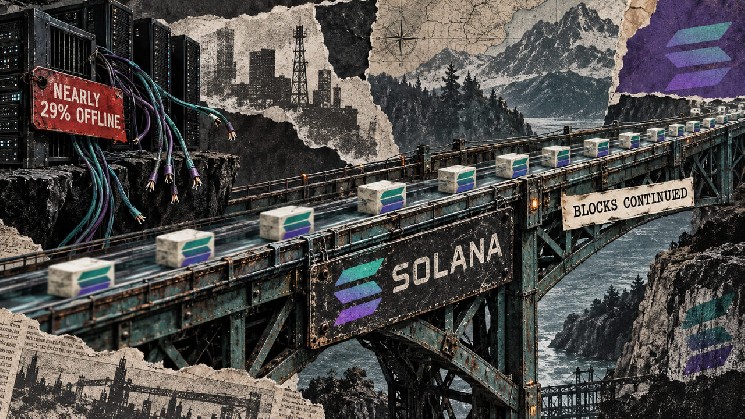
In practical terms, the bad route spread across Teraswitch’s network and prevented affected data centers from reaching the Internet through healthy local routers. Twelve sites across Europe and Asia-Pacific lost Internet and inter-site connectivity, including infrastructure hosting Solana validator and RPC nodes.
Independent blockchain-risk monitoring firm Metrika broadly corroborated both the scale of the disruption and continuous block production. Its data showed skipped slots rising above 32% and non-vote transaction throughput dropping below 300 per second from a typical range of roughly 1,100 to 1,300.
Metrika’s observer also recorded about half an hour in which newly produced blocks had not yet reached finality, the point at which their transactions become irreversible. The backlog finalized as connectivity returned.
Solana avoided a chain-wide production halt, but users and systems depending on rapid settlement faced materially weaker performance.
Solana needs more than 66% of stake voting to maintain consensus finality. The roughly 29% offline share stayed about 4% to 5% below the corresponding 33% finality-halt threshold, according to Metrika.
The Foundation said Teraswitch had hosted 38% of network stake in 2025 and that its team reduced the provider’s share below 30% before the outage. That hosting share and the incident’s delinquent stake estimate measure different things, even though both highlight concentration risk.
Many separately operated validators lost connectivity together because they shared one provider failure domain.
Teraswitch later deployed provider-side hardening that day so an invalid route can no longer stop sites from using healthy local edge routers. Its September postmortem said additional route monitoring remained in progress, leaving infrastructure diversity and observability as continuing resilience tests.
