
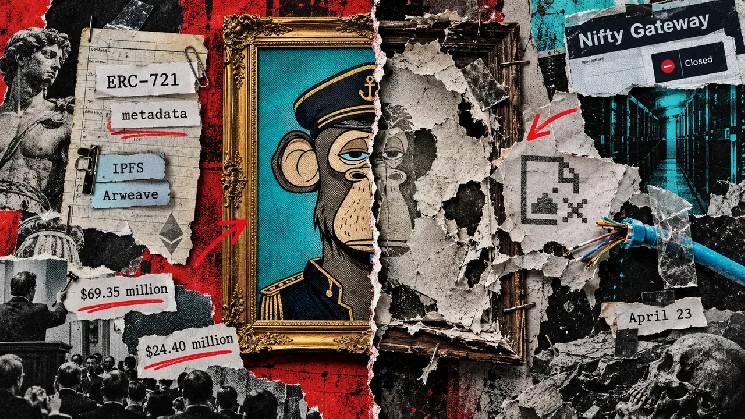

In 2021, Christie’s sold a Beeple $NFT for $69.35 million, and Sotheby’s took another $24.40 million for 101 Bored Ape Yacht Club NFTs, giving cartoon primates the kind of auction-house treatment usually reserved for Fabergé eggs.
But now, not five years later, one of the marketplaces that helped sell the digital art revolution is explaining how customers could take their belongings with them when it closed.
Nifty Gateway, the $NFT marketplace owned by crypto exchange Gemini, announced its closure in January as its parent decided to concentrate on its primary financial app. The exit arrangements included plans for a bulk withdrawal tool and somewhere to host the artwork.
That’s a pretty sad and uneventful end for an industry that made ownership sound like a technological breakthrough on the order of discovering fire.
To be fair, there was real art underneath the sales pitch, along with artists who’d found paying audiences and collectors who liked what they bought. But the boom encouraged the assumption that once you’d paid for the token, the business of owning the thing was taken care of, preferably forever.
Marketplace closures have quickly made that assumption incorrect, because the token, the artwork, and the website displaying it can survive for very different lengths of time. As crypto companies close businesses and retire products, somebody has to work out where the files go and who’ll keep them available when selling the next collection no longer covers the bills. The person who can answer that has become considerably more relevant to your collection than the person who once assured you that you were early.
Your ape needs a forwarding address
When you buy an $NFT, it’s easy to think you’re putting a picture in your wallet because that’s what the app shows you. Underneath that display, though, several separate things are happening, and knowing what lives where explains how you can still own a token while struggling to load the art.
Many Ethereum NFTs use the ERC-721 standard that records who owns each token and allows it to be transferred. The blockchain keeps that ownership record, while the token often points to a separate descriptive file, known as metadata, containing information such as the work’s name and a link to its image or video. Your wallet retrieves those files and assembles what you see, so the collection looks like one self-contained possession even when its parts depend on several different services.
Keeping big media files outside the blockchain is a reasonable design choice, but it means those files need their own home. Sending the token to a wallet you control puts you in charge of transferring it; it doesn’t automatically download the artwork, take over the server hosting it, or pay the person running that server. If you’re picturing your expensive ape safely tucked inside your phone, the app may have given you a rather generous impression of what the transfer accomplished.
Nifty Gateway’s closure update addressed this problem, with plans to move descriptive records and media hosting to Arweave, a network designed for long-term storage, but some NFTs created in 2021 or earlier had records permanently linked to its own servers. The company promised to keep hosting that metadata indefinitely and extended its withdrawal window to April 23.
Those promises describe the arrangements the company said it would make, without establishing that every migration succeeded or that any particular artwork was lost. They show us the consequence of making a link permanent: when the address belongs to a company, fixing it in place can preserve your dependence on that company for as long as you want the link to work.
Buyers were supposed to enjoy the freedom of owning something outside a platform’s control, and some instead inherited a lasting relationship with its hosting department. The technology can faithfully preserve an ownership record while leaving the owner dependent on a business that has other things it would rather do.
Forever isn’t a payment plan
Distributed storage offers a way to reduce that dependence, provided someone actually keeps the files. IPFS, which is used for $NFT media, identifies content from the data itself, allowing different computers to provide a verifiable copy without tying its identity to one company’s website. That makes it possible for another provider (or the collector) to keep serving the same artwork if the original host stops.
The catch is that joining a network doesn’t oblige every computer on it to preserve your collection. The IPFS documentation explains that cached files can be deleted to free space, while a process known as pinning tells a computer to retain specified content. Someone can run that computer themselves or pay a service, but the continuing cost belongs to whoever agrees to keep the copy available.
This also explains why a missing picture doesn’t necessarily mean the artwork has vanished. Your browser may retrieve an IPFS file through a gateway, a website that fetches the content for you, and the IPFS guide to $NFT storage warns that this route can fail even when the data exists elsewhere. In that case, another gateway can help, but if nobody has retained the data at all, a different web address won’t bring it back.
Collectors therefore have to understand whether the problem is reaching their file or finding a surviving copy, which is quite an introduction to network administration for someone who thought they’d just bought a picture. The rare hat on the ape contributes very little to the diagnosis, however much it contributed to the price.
There are ways to reduce these risks, including putting artwork data directly on the blockchain or using storage networks designed to finance retention over many years. Each arrangement has its own dependencies, from the continued operation of the chain to the incentives keeping storage providers involved, so judging a collection means looking at how it’s built. The fact that one $NFT depends on a company’s server tells you very little about another that stores its image data on-chain.
Across those designs, though, the economic problem is the same: selling something brings money in at the moment somebody wants to buy, while caring for it creates work for as long as somebody wants it to survive. Those two periods can be wildly different, especially when the business was built around selling new collections to an excited audience.
Even inexpensive storage needs someone to accept responsibility for it, check that it works, and arrange a successor when the original provider loses interest. Collectors can take on that job, and systems that let them preserve files independently give them real control, but the freedom comes with some administration. Selling people on the future of ownership was always going to be easier than persuading them to become competent custodians of a folder.
The boring people had a point
Museums were thinking about this while the auction records were being set, because caring for art has always involved work that its purchase price doesn’t perform. In a December 2021 discussion published by LACMA, digital preservation manager Joey Heinen and computer scientist Elian Carsenat examined the software, storage, and continuing responsibility involved in keeping $NFT artworks accessible. While the market was celebrating scarcity, they were considering what would still function in 10 or 30 years.
The profession already had plenty of experience with art that could stop working. In MoMA’s 2016 account of restoring Teiji Furuhashi’s Lovers, conservator Ben Fino-Radin described a project involving obsolete technology, including MS-DOS and LaserDiscs. Preserving the installation required making its projected images and interactive behavior work again, because keeping old components in storage wouldn’t preserve the experience people came to see.
$NFT art inherits that responsibility whenever the work depends on software or a live service. Saving a still image is comparatively straightforward, while preserving something interactive can mean documenting how it behaves and maintaining the environment that lets it run. You could retain every original file and still lose the ability to experience the work if nobody knows how its pieces fit together.
That gives the boom’s endless arguments about screenshots a pretty funny ending. The token never made the visible image impossible to copy, and preserving faithful copies is precisely what can help the artwork survive. Someone duplicating the media hasn’t thereby taken ownership of your token, but by keeping the only surviving copy, they might eventually be doing your collection a favor.
The artists and collectors doing this work deserve better than being treated as props in another joke about expensive JPEGs, even if the market spent several years behaving like a casino with an art department. Some of the work is worth preserving because people care about it, regardless of whether anyone will ever pay its former price again, and digital systems can let those people cooperate without waiting for a marketplace’s permission.
That kind of ownership asks more from a collector than clicking buy and watching the valuation. It means knowing where the work lives, keeping what can be copied, and making sure someone else can take over its care when you can’t.
If your ape is still visible decades from now, it’ll be because people kept doing those jobs long past the point when anyone found them exciting enough to sell.
