

Protocol 27 is the final planned upgrade. ESMA registered the whitepaper. But PayPal integration remains unconfirmed, RoboPay is disputed, and PI trades at a fraction of its peak. What is real and what is not.
Every few weeks, a headline declares that Pi Network has secured a partnership that will finally deliver the real world utility its community has been waiting for since the project launched in 2019. In August 2026 alone, reports emerged that PayPal had added PI to its merchant payment program and that RoboPay would integrate PI for AI driven robot service payments. Each announcement triggered a spike in social media activity and a brief uptick in trading volume.
Neither has been confirmed by the parties allegedly involved.
This pattern, in which ecosystem claims outrun verifiable facts, defines the central tension of Pi Network in 2026. The project has real infrastructure. Its protocol upgrades are genuine. Its ESMA whitepaper filing is a matter of public record. But the gap between what the network has built and what its community claims it has partnered with is wide enough to matter.
What the protocol upgrades actually changed
Pi Network’s technical roadmap in 2026 centers on two mandatory upgrades: Protocol 26 and Protocol 27.
Protocol 26 carried a hard deadline of Aug. 11, 2026. All mainnet node operators were required to complete the upgrade or risk disconnection from the network. The upgrade enhanced contract security and state management, laying the groundwork for more complex smart contract interactions on the Pi blockchain.
NEW: Pi Network begins Protocol 26 Mainnet upgrade
The deadline for node operators is August 11 ahead of the final Protocol 27 release pic.twitter.com/F0E4Y95oWm
— crypto.news (@cryptodotnews) July 30, 2026
The Pi Core Team has designated Protocol 27 as the “final planned upgrade” in the current development sequence. That language is significant. It does not mean the network will stop evolving, but it signals that the foundational infrastructure layer is approaching a state the team considers stable enough to support sustained application development.
The node network itself has grown. Pi reports more than 421,000 active nodes, a figure that reflects the network’s distributed validator model. Validators on Pi do not stake tokens in the way Ethereum or Solana validators do. Instead, they run lightweight software that contributes to consensus through Pi’s adaptation of the Stellar Consensus Protocol.
The distinction matters for understanding Pi’s security model. The network trades the economic security guarantees of proof of stake (where validators risk capital) for a broader distribution model (where more participants run nodes at lower cost). Whether that trade off produces sufficient security for high value transactions remains an open question.
The ESMA whitepaper: what it means and what it does not
In 2026, ESMA registered Pi Network’s MiCA whitepaper as entry 549 in its public registry. The filing was submitted by PiBit Ltd, the entity that appears to manage Pi’s European regulatory compliance.
MiCA, the Markets in Crypto Assets regulation, requires crypto asset issuers operating in the European Union to publish a whitepaper that meets specific disclosure standards. Registration of the whitepaper is a procedural step. It means ESMA has received the document and made it publicly available. It does not mean ESMA has reviewed the document for accuracy, endorsed the project, or granted any form of regulatory approval.
The distinction is critical because the Pi community has at times characterized the ESMA registration as an endorsement. It is not. It is closer to a filing requirement, similar to how a company files a prospectus with a securities regulator before the regulator reviews it.
That said, the filing is not trivial. Completing a MiCA compliant whitepaper requires legal and compliance work that many crypto projects have not undertaken. It positions Pi to operate within the EU regulatory framework if and when full authorization is granted. For a project that began as a mobile mining experiment with no clear regulatory strategy, the ESMA filing represents a genuine step forward.
The PayPal question
In mid August 2026, reports circulated that PayPal had added PI to its “Pay with Crypto” program, which allows eligible U.S. merchants to accept cryptocurrency payments. The claim appeared in several crypto news outlets and spread rapidly through Pi community channels.
JUST IN: Pi Network releases Node version 0.6.2 with connectivity upgrades
The update arrives as operational mainnet apps reach 82 toward the 100 milestone pic.twitter.com/YwkxdWdwlm
— crypto.news (@cryptodotnews) August 16, 2026
The evidence does not support the claim as of this writing.
PayPal’s official documentation lists Bitcoin, Ethereum, Litecoin, Bitcoin Cash, and PayPal USD (PYUSD) as supported assets in its crypto payment program. PI is not on that list. PayPal has not issued a press release, blog post, or public statement confirming PI integration.
On the Pi side, PayPal does not appear on the KYB (Know Your Business) verified business list that Pi Network maintains. The KYB list is Pi’s own registry of businesses that have been verified to operate on its mainnet. If PayPal had completed a formal integration, a KYB listing would be expected.
The gap between the claim and the evidence is not unusual in crypto. Unconfirmed partnership reports are common, particularly for projects with large and active communities. But the pattern is worth noting because PayPal integration, if real, would be genuinely transformative for a token trading at $0.09. The fact that it remains unverified after more than a week of circulation suggests that the claim was at best premature and at worst fabricated.
RoboPay and the AI robotics narrative
On Aug. 5, 2026, the Fabric Foundation announced that Pi Network had joined RoboPay as a payment partner. The stated purpose was to enable on chain payments for AI driven robot services and autonomous agent hiring, using PiRC2 smart contracts for recurring and automated settlements.
The announcement painted an ambitious picture: a future in which humans hire robotic services through programmable payment channels on the Pi blockchain. Instead of purchasing a robot, a user would purchase the outcome they need, with payment settled automatically through smart contracts.
The Pi Core Team has not confirmed the partnership.
This is the second high profile ecosystem claim in August 2026 that lacks official confirmation from Pi’s own team. The pattern raises a structural question about Pi’s ecosystem development model. Third party organizations announce integrations. The Pi community amplifies them. Pi’s core team remains silent. The result is a steady stream of partnership news that cannot be independently verified.
Whether the RoboPay integration is real, planned, or aspirational is unclear. What is clear is that the Pi Core Team’s silence does not help its community distinguish between confirmed partnerships and speculative announcements.
The tokenomics problem
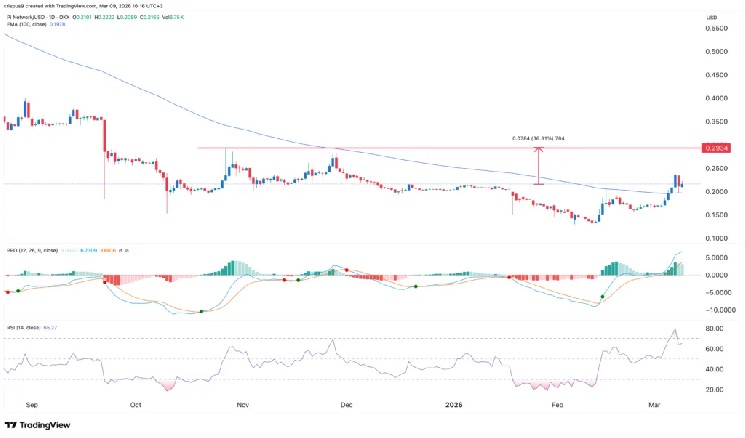
PI’s price action in 2026 tells a story that no partnership announcement has been able to change.
The token trades near $0.09, with a market cap hovering around $1 billion. Its 24 hour trading volume sits near $11.5 million, modest for a token in the top 60 by market cap. The most active trading pair is PI/USDT on OKX, with approximately $3.6 million in daily volume.
The deeper issue is supply. Pi has a maximum supply of 100 billion tokens, of which approximately 11 billion are currently in circulation. That means roughly 89% of the total supply has yet to enter the market. As locked tokens vest and new tokens are distributed through mining rewards, the circulating supply will continue to grow.
For PI to reach $1, a target that many community members have discussed publicly, the fully diluted market cap would need to exceed $100 billion. That would place Pi roughly in line with Ethereum’s current market cap. For a network with $11.5 million in daily trading volume, no confirmed major partnerships, and a token economy built on mobile phone mining, that valuation is difficult to justify on fundamentals alone.
The circulating supply dynamic also creates selling pressure. Each new batch of tokens that enters circulation represents potential sell orders from miners who have been accumulating PI since the project’s early days. Unless demand from new buyers matches or exceeds the rate of new supply, the price faces persistent downward pressure.
What the ecosystem actually looks like
Strip away the unconfirmed partnerships and the picture that remains is simpler than the headlines suggest.
Pi Network has a working mainnet with more than 421,000 active nodes. It has completed two major protocol upgrades in 2026. It has filed a MiCA whitepaper with ESMA. It has an ecosystem directory where developers can build and list applications.
JUST IN: Pi Network details Launchpad model for project token launches
Proceeds from Pi go into a liquidity pool with the ecosystem token to bootstrap liquidity pic.twitter.com/88WRoCcNjM
— crypto.news (@cryptodotnews) July 30, 2026
The number of operational mainnet apps is growing but remains modest. Pi’s ecosystem directory includes applications ranging from payment tools to social platforms, but none has achieved the kind of adoption metrics (daily active users, transaction volume, revenue) that characterize successful decentralized applications on more mature blockchains.
The Pi Browser, which serves as the gateway to Web3 applications on the network, provides a curated entry point for users. The App Studio offers development tools for builders. But the developer ecosystem lacks the depth of tooling, documentation, and community support that Ethereum, Solana, or even newer chains like Sui and Aptos provide.
Pi’s differentiation has always been accessibility. Mining on a mobile phone, with no hardware costs and minimal technical knowledge required, created a user base that now numbers in the tens of millions. Whether that user base translates into an economically active network is the question that Protocol 27, the final planned upgrade, is supposed to answer.
What to watch
The aftermath of the credibility gap will play out across several measurable indicators over the coming weeks and months.
- Protocol 27 release timeline. This is designated as the final planned upgrade. Its contents and execution will signal whether the Pi Core Team believes the infrastructure layer is ready for sustained application development.
- PayPal’s official crypto asset list. If PI appears in PayPal’s next quarterly update to supported assets, the integration is real. If it does not, the community will need to reckon with another unconfirmed claim.
- KYB verified business count. Pi maintains its own registry of verified businesses. Growth in confirmed KYB listings, particularly from recognizable brands, would be a more reliable indicator of ecosystem adoption than third party partnership announcements.
- Circulating supply growth rate. The pace at which new PI enters circulation relative to trading volume will determine whether selling pressure continues to weigh on the price.
- ESMA review outcome. The whitepaper registration is a disclosure step. The next milestone is whether ESMA grants full authorization, which would allow Pi to operate as a regulated crypto asset within the EU.
Is Pi Network’s PayPal integration confirmed?
No. As of Aug. 20, 2026, PayPal’s official documentation does not list PI as a supported asset in its “Pay with Crypto” program. PayPal also does not appear on Pi Network’s KYB verified business list. The claim remains unverified.
What is Pi Network’s Protocol 27?
Protocol 27 is designated by the Pi Core Team as the “final planned upgrade” in the current development sequence. It follows Protocol 26, which enhanced contract security and state management. Protocol 27’s full contents have not been publicly detailed.
What does ESMA registration mean for Pi Network?
ESMA registered Pi’s MiCA whitepaper as entry 549, filed by PiBit Ltd. This is a disclosure step required under EU regulations. It does not constitute regulatory approval or endorsement of the project.
How many nodes does Pi Network have?
Pi Network reports more than 421,000 active nodes. These nodes run lightweight consensus software based on Pi’s adaptation of the Stellar Consensus Protocol, rather than staking tokens.
Why is PI’s price near $0.09 despite a large user base?
PI has a maximum supply of 100 billion tokens, of which approximately 11 billion are in circulation. The high maximum supply means that reaching $1 would require a fully diluted market cap exceeding $100 billion. Additionally, daily trading volume near $11.5 million is modest relative to the market cap.
Is the RoboPay partnership with Pi Network confirmed?
The Fabric Foundation announced the partnership on Aug. 5, 2026, but the Pi Core Team has not confirmed it. This follows a pattern in which third parties announce integrations that Pi’s own team has not verified.
How does Pi Network’s consensus mechanism work?
Pi uses an adaptation of the Stellar Consensus Protocol. Validators run lightweight software on mobile phones and computers to contribute to consensus. Unlike proof of stake networks, Pi validators do not stake tokens, trading economic security guarantees for broader participation.
What would it take for PI to reach $1?
At a maximum supply of 100 billion tokens, PI at $1 would require a fully diluted market cap exceeding $100 billion. That would place Pi roughly in line with Ethereum’s current valuation, requiring a level of adoption, utility, and trading volume that the network has not yet achieved. This is educational analysis, not investment advice.
Disclaimer: This article is for informational purposes only and does not constitute financial, investment, or trading advice. Cryptocurrency markets carry substantial risk. Always conduct your own research before making any investment decisions. Published Aug. 21, 2026.
