Tokenomics still matters for crypto platforms, with tokens reacting differently to unlocks. The effects of unlocks, incentives, and burns can give some assets an edge, even amid volatile market sentiment.
Tokens fell into distinct groups based on their reactions to unlocks and the potential market pressure. Their short-term performance varied, while their performance over a longer period reflected the new supply entering circulation.
As Cryptopolitan reported, some cliff unlocks can alter a token’s trajectory, particularly when tokens are distributed to investors ready to sell immediately.
Cryptorank tracked 50 tokens and altcoins, comparing their unlocks and price returns over six months.
Which Tokens Performed Well Despite Unlocks?
According to Cryptorank’s research, some tokens were organic winners, with relatively low unlocks and positive returns. NEAR posted the biggest gain, with a net return of 131% over the period. MET and ETHFI also had low unlocks and periods of outperforming the market.
Positive returns alongside high unlocks indicated that the market was ready to absorb the supply. Bitway (BTW), AGT and BR were among these winners.
Legacy tokens faced the greatest unlock pressure. In 2026, crypto traders shifted toward newer assets, while legacy coins and tokens lagged.
Tokens with ongoing, pre-programmed unlocks showed weak demand. Long-term staples such as SOL and AVAX fell over the past six months, pressured by the continued inflow of new supply. Although supply growth was restricted, ongoing unlocks added to market exhaustion.
Some tokens, including 2Z, 0G and OPEN, fell by as much as 82% over the period, facing both weak demand and large-scale unlocks.
Layer Zero ($ZRO), a high-profile project, illustrated the immediate reaction to a major unlock. The token had one of the largest unlocks in the past month, contributing to a loss of more than 13% over the period. $ZRO is undergoing predictable, ongoing step unlocks rather than large cliffs, but they are still prominent enough to pressure the market.
Burns and Revenue Sharing Help Offset Token Unlocks
Token burns only partially offset unlocks. Net burns have less influence and are much smaller than unlocks.
However, burns can encourage holders to limit selling in exchange for predictable revenue.
Token unlocks average $3B to more than $4B per month. Burn schedules destroy far fewer tokens, with $BNB Chain an exception.
In October, $BNB Chain recorded a $1.2B burn, resulting in a record day with $1.57B worth of tokens destroyed.
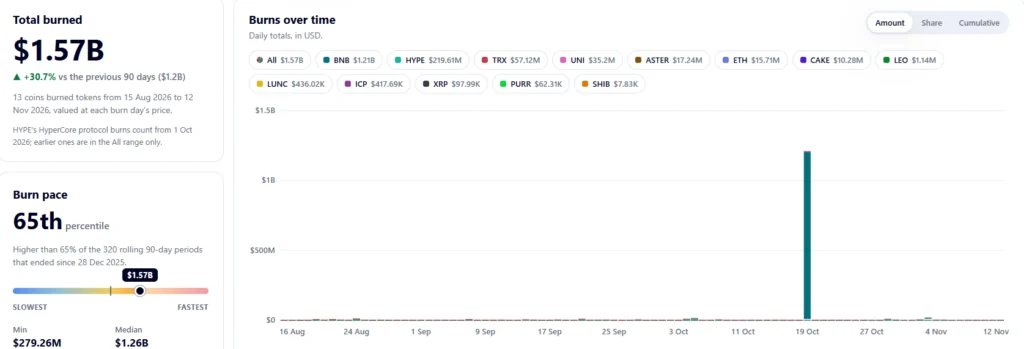
Unlike unlocks, token burns are not fixed or predictable. In some cases, they depend on actual on-chain activity, such as trading or transactions. Hyperliquid was the largest burner as of November 2026, driven by trading fees. Even Hyperliquid’s burn value varies from week to week.
On November 13, Hyperliquid burns totaled $9.61M, down 66% from the previous week.
Token burns and revenue sharing have one advantage: they are among the positive crypto trends for 2026. Rough estimates suggest that protocols generating real revenue spent up to $900M on buybacks in 2026. These buybacks were in addition to algorithmic burns of tokens that were not taken from the market.
In the coming months, burns funded by token buybacks may be a stronger signal than regular algorithmic burns, even if their effect on supply is smaller.