
Close Menu
  • Coins
    • Bitcoin
    • Ethereum
    • Altcoins
    • NFT
  • Blockchain
  • DeFi
  • Metaverse
  • Regulation
  • Other
    • Exchanges
    • ICO
    • GameFi
    • Mining
    • Legal
  • MarketCap
What's Hot

Rushed quantum fix may backfire for Bitcoin, Samson Mow warns

27/04/2026

Top NFT Sales of the Week, Flying Tulip on Top

27/04/2026

ETH Coin Targets $2,500 as Bulls Defend a Strong Support

27/04/2026
Facebook X (Twitter) Instagram
  • Back to NBTC homepage
  • Privacy Policy
  • Contact
X (Twitter) Telegram Facebook LinkedIn RSS
NBTC News
  • Coins
    1. Bitcoin
    2. Ethereum
    3. Altcoins
    4. NFT
    5. View All

    Rushed quantum fix may backfire for Bitcoin, Samson Mow warns

    27/04/2026

    Bitcoin is Predicted to Reach $ 75,157 By Apr 10, 2026

    26/04/2026

    “BTC’s Net Inflation Rate Has Turned Negative”

    26/04/2026

    Bitcoin Price Builds for Surge, Bulls Eye Explosive Breakout

    26/04/2026

    ETH Coin Targets $2,500 as Bulls Defend a Strong Support

    27/04/2026

    Ethereum Near Key Zone After 36% Gain – What’s Next?

    26/04/2026

    What’s Happening Between ETH And The Financial Systems?

    26/04/2026

    Ethereum Bounces Back Above $2,300 After Bitcoin Opens Above $78,000

    26/04/2026

    Chainlink Unlocks 19M LINK, $165M Moved to Market

    27/04/2026

    Ripple Engineer Explains XRPL Update Pace, Focus Turns to Bug Fixes and Reliability

    26/04/2026

    ‘Midnight Isn’t Hurting Cardano,’ Insider Defends Charles Hoskinson’s Vision

    26/04/2026

    Circle Mints Over $10B USDC on Solana in One Month

    26/04/2026

    Top NFT Sales of the Week, Flying Tulip on Top

    27/04/2026

    Cardano NFT Marketplace Announces Permanent Closure, Shocking ADA Community

    24/04/2026

    Bored Ape Yacht Club turns five today and nobody seems to care

    23/04/2026

    WWE Partners with Blockchain Creative Labs for Official NFT Marketplace – Epic Digital Collectibles Ahead

    20/04/2026

    Rushed quantum fix may backfire for Bitcoin, Samson Mow warns

    27/04/2026

    Top NFT Sales of the Week, Flying Tulip on Top

    27/04/2026

    ETH Coin Targets $2,500 as Bulls Defend a Strong Support

    27/04/2026

    Fed rate cut chance hits zero, threatening stagflation where Bitcoin thrives as a hedge against long term inflation

    27/04/2026
  • Blockchain

    Nick Pell: The oil industry’s lobbying stifled electric vehicle growth, how battery technology transformed EVs, and Tesla’s game-changing charging strategy

    26/04/2026

    Illia Polosukhin: AI will replace traditional operating systems, blockchain serves as a root of trust for secure AI, and the need for user-owned AI is crucial

    26/04/2026

    Karen Hao: Profit motives drive AI development, current technologies harm society, and labor exploitation is rampant in the industry

    26/04/2026

    Christian Catalini: AI will transform job markets, coding professions face uneven automation, and human expertise remains critical in decision-making

    26/04/2026

    B.AI and Pundi X Unveil Autonomous AI Data Framework

    25/04/2026
  • DeFi

    Aave Takes Action to Resolve $290 Million Hack Crisis – Will Donate a Large Amount of ETH

    26/04/2026

    Aurelion allocates $48M in tokenized gold to new XAUE yield protocol

    26/04/2026

    DeFi heavyweights press SEC for formal broker rules after ‘non-custodial UI’ guidance

    26/04/2026

    DeFi losses are now 8,500% higher than TradFi breaches per dollar moved

    26/04/2026

    ‘Precautionary’- Wrapped Bitcoin (wBTC) tightens security after KelpDAO $293M exploit

    26/04/2026
  • Metaverse

    ‘8,000 Jobs’—Polymarket Sees Tech Layoff Surge As Meta AI Push Bites

    18/04/2026

    Planet Hares Partners With Magne.AI To Bridge Web3 Metaverse With Smartphone Mobile-Ready Applications For Mass Adoption

    08/04/2026

    Mark Zuckerberg’s Meta launches new AI initiative after metaverse retreat

    25/03/2026

    Meta partners with Arm to develop new CPUs for AI deployments

    24/03/2026

    Land values capitulate as $24M metaverse plot collapses to just $9,000

    20/03/2026
  • Regulation

    Fed rate cut chance hits zero, threatening stagflation where Bitcoin thrives as a hedge against long term inflation

    27/04/2026

    “Fed Will Keep Interest Rates Unchanged for Two Years”

    26/04/2026

    Bitfarms Rebrand Signals Strong Push Into HPC and AI Data Centers

    26/04/2026

    Jeremy Grantham: The AI investment boom risks overvaluation, historical bubbles provide crucial insights, and value investing’s cyclical nature remains vital

    26/04/2026

    Shaunt Voskanian: Curiosity and prescriptiveness drive success in enterprise tech sales, Figma’s shift to outbound sales enhances customer engagement, and the future of pricing models remains uncertain

    26/04/2026
  • Other
    1. Exchanges
    2. ICO
    3. GameFi
    4. Mining
    5. Legal
    6. View All

    Alex Wilson: Building crypto payment solutions requires collaboration, Shift4’s dual role enhances market entry, and navigating regulatory landscapes is crucial for success

    26/04/2026

    Infinite Launches Fiat and Stablecoin Bank Accounts Powered by Erebor Bank for US Businesses

    25/04/2026

    Gensyn Network Debuts Delphi, a Permissionless AI Prediction Market Platform, on Mainnet

    25/04/2026

    Moneygram and Stellar Expand USDC Push Amid Stablecoin Growth

    25/04/2026

    South Korea Poised to Lift Ban on Domestic ICOs After 7 Years

    19/12/2025

    Why 2025’s Token Boom Looks Both Familiar and Dangerous

    31/10/2025

    ICO for bitcoin yield farming chain Corn screams we’re so back

    22/01/2025

    Why 2025 Will See the Comeback of the ICO

    26/12/2024

    Tomoland Partners With Anome Protocol To Advance Web3 Gaming Engagement With DeFi Applications

    25/04/2026

    GameFi is effectively dead as 93% of projects collapse

    23/04/2026

    More than 90% of Web3 games failed after $15 billion boom as gamers never showed up: Caladan

    23/04/2026

    UXLINK Taps ANOME Protocol to Redefine Web3 Gaming, SocialFi, and NFTFi

    23/04/2026

    Olenox Announces Merge With CS Digital to Develop Low Cost, Off-Grid Bitcoin Mining Opportunities

    26/04/2026

    Bitdeer Sells All 185.7 BTC Mined This Week, Extending Zero-Holding Strategy

    25/04/2026

    Brazil and Venezuela Show Potential to Grow Latam’s Bitcoin Mining Share

    25/04/2026

    Largest Bank in Brazil Moves to Invest in Bitcoin Mining

    24/04/2026

    UK invites crypto giant Bybit to London to win over some of UAE’s innovation shine

    26/04/2026

    Prediction Market Lobbying Spend Rises Over 60% as Regulatory Pressure Builds in Washington

    26/04/2026

    New York Attorney General Sues Coinbase, Gemini Over Unlicensed Prediction Markets

    26/04/2026

    “We Were Wrong About Cryptocurrencies”

    26/04/2026

    Rushed quantum fix may backfire for Bitcoin, Samson Mow warns

    27/04/2026

    Top NFT Sales of the Week, Flying Tulip on Top

    27/04/2026

    ETH Coin Targets $2,500 as Bulls Defend a Strong Support

    27/04/2026

    Fed rate cut chance hits zero, threatening stagflation where Bitcoin thrives as a hedge against long term inflation

    27/04/2026
  • MarketCap
NBTC News
Home»Ethereum»Ethereum’s Growing State Problem Is Reaching a Breaking Point
Ethereum

Ethereum’s Growing State Problem Is Reaching a Breaking Point

NBTCBy NBTC24/12/2025No Comments6 Mins Read
Share
Facebook Twitter LinkedIn Pinterest Email


Ethereum has quietly accumulated a problem that does not show up in gas fees or transaction speed charts but threatens the network’s long-term health. It is called state bloat. The Ethereum Foundation’s Stateless Consensus researchers are now sounding a clear warning: Ethereum’s ever-growing state is becoming harder to store, harder to serve, and harder to decentralize.

In a recent proposal, the team laid out why the issue matters, how scaling improvements have unintentionally made it worse, and three concrete paths that could prevent node operation from turning into an elite activity reserved for only the largest infrastructure providers.

What Ethereum’s “State” Really Means
Ethereum State

Ethereum State: Image Source: Ethereum Foundation

Ethereum’s state is the sum of everything the network currently knows. That includes account balances, smart contract storage, and the bytecode that runs decentralized applications. It is the live memory of the chain.

This state underpins an ecosystem that settles billions of dollars in value and coordinates thousands of applications across DeFi, NFTs, gaming, and enterprise use cases. The problem is simple but severe: the state only grows. Nothing ever gets removed.

As more applications deploy contracts and more users interact with them, the state expands permanently. Every full node must store and serve this data, even if large portions of it are never touched again.

Why Ethereum State Bloat Threatens Decentralization

Running a full Ethereum node is already expensive. Storage requirements keep rising, sync times increase, and serving data becomes more fragile as the chain ages. According to the Foundation, if the state becomes too large or too complex to serve, the entire stack becomes more centralized and more brittle.

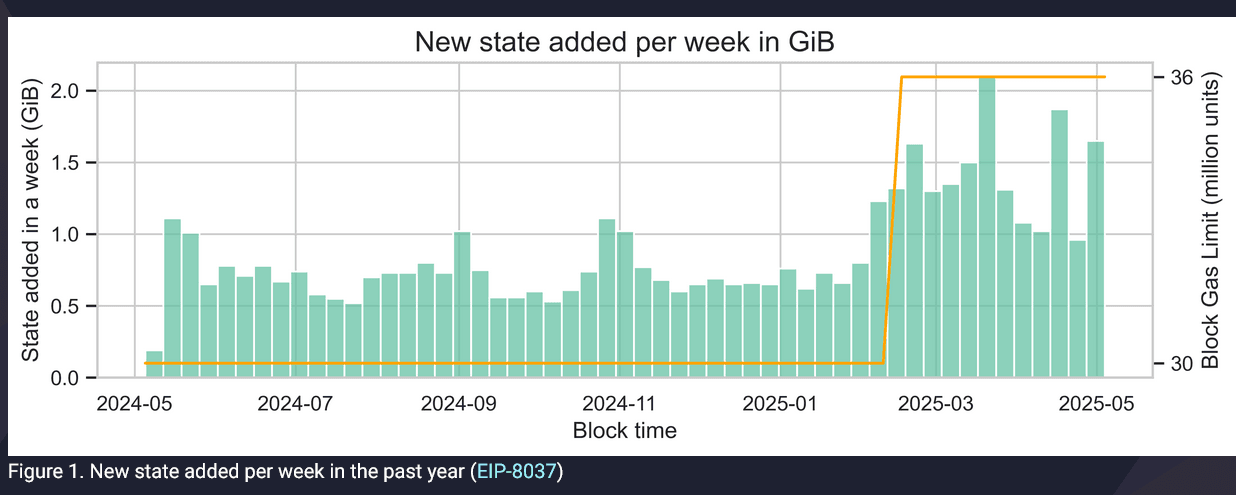
Recent scaling upgrades have unintentionally accelerated this trend. Layer 2 expansion, EIP-4844 proto-danksharding, and higher gas limits all enable more activity on Ethereum. More activity means more contracts, more storage writes, and faster state growth.

The concern is not theoretical. Researchers are actively stress-testing scenarios to understand when state size becomes a bottleneck, when nodes struggle to stay synced with the head of the chain, and when client implementations start failing under extreme storage pressure.

If only a small group of well-funded operators can afford to run full nodes, Ethereum’s censorship resistance and neutrality start to weaken.

Stateless Validation Solves One Problem and Creates Another

Ethereum’s long-term roadmap includes statelessness, where validators can verify blocks without storing the full state. This significantly lowers the burden on validators and opens the door to higher throughput.

But it raises a new question: if validators do not store the state, who does?

In a stateless design, most historical and active state would likely be held by specialized operators such as block builders, RPC providers, MEV searchers, and block explorers. That concentration introduces new risks around censorship, availability during outages, and resilience under regulatory or external pressure.

The Stateless Consensus team is clear about the trade-off. Stateless validation improves scalability, but without careful design, it could push Ethereum toward infrastructure centralization.

Three Proposed Paths to Tackle State Bloat

To address the problem, the Ethereum Foundation researchers outlined three complementary approaches, each attacking state growth from a different angle.

State Expiry

State Expiry focuses on removing inactive data from the active state. The team estimates that roughly 80 percent of Ethereum state has not been touched in over a year, yet every node is still required to store it.

Under this model, inactive data is expired from the active set but can be revived later using cryptographic proofs. Two variants are being explored. One marks and expires rarely used entries with an option to revive them later. The other groups state into eras, freezing older eras while keeping recent data active.

The goal is simple: stop forcing every node to carry data that nobody is using.

State Archive

State Archive separates hot state from cold state. Frequently accessed data remains fast and bounded, while older data is preserved in archival storage for historical verification.

This approach allows node performance to remain relatively stable over time instead of degrading as the chain ages. Even if total state continues to grow, the operational burden on most nodes would stay manageable.

It also creates clearer roles between nodes optimized for performance and nodes optimized for history and research.

Partial Statelessness

Partial Statelessness allows nodes to store only subsets of the state instead of everything. Wallets and light clients would cache the data they rely on, reducing dependence on centralized RPC providers.

This model lowers storage costs, broadens participation, and makes it easier for individuals and smaller operators to run nodes without massive hardware investments.

Across all three approaches, the unifying goal is to reduce state as a performance bottleneck, lower the cost of holding it, and make it easier to serve.

What the Ethereum Foundation Is Doing Next

The Foundation is prioritizing solutions that can deliver real benefits today while remaining compatible with more ambitious protocol changes in the future. Current focus areas include improving archive node tooling, strengthening RPC infrastructure, and making partial stateless nodes easier to run.

These efforts are deliberately practical. The team emphasized that they were chosen because they are immediately useful and forward-compatible with Ethereum’s longer-term roadmap.

Developers, node operators, and infrastructure teams are being invited to participate in testing and discussion. The researchers made it clear that this is not something the Foundation can solve alone.

A Proposal, Not a Final Decision

The Foundation was careful to stress that this work represents a proposal, not a unified organizational stance. Ethereum’s protocol development includes a wide range of opinions, and no single path has been locked in.

That openness is consistent with the Foundation’s recent push to communicate more clearly about long-term protocol direction. Alongside state management research, Ethereum is also working on an Interop Layer to make Layer 2 networks feel like a single chain, rolling out leadership and R&D changes, adjusting its treasury strategy, and moving to a twice-yearly hard-fork schedule with Fusaka.

Why This Matters Long Term

Ethereum State bloat is not a headline-grabbing issue, but it sits at the heart of Ethereum’s decentralization promise. If running a node becomes too costly or complex, the network risks drifting toward infrastructure concentration, even as throughput and usability improve.

The Ethereum Foundation’s message is straightforward. Scaling the chain without scaling its ability to store and serve data safely is not enough. How Ethereum manages its state over the next few years will shape who can participate, who controls infrastructure, and how resilient the network remains under pressure.

The debate is just beginning, and the choices made here will echo far beyond the next upgrade cycle.

Share. Facebook Twitter Pinterest LinkedIn Tumblr Email
NBTC

Related Posts

ETH Coin Targets $2,500 as Bulls Defend a Strong Support

27/04/2026

Ethereum Near Key Zone After 36% Gain – What’s Next?

26/04/2026

What’s Happening Between ETH And The Financial Systems?

26/04/2026

Ethereum Bounces Back Above $2,300 After Bitcoin Opens Above $78,000

26/04/2026
Add A Comment

Comments are closed.

Top Posts
Get Informed

Subscribe to Updates

Get the latest news from NBTC regarding crypto, blockchains and web3 related topics.

Your source for the serious news. This website is crafted specifically to for crazy and hot cryptonews. Visit our main page for more tons of news.

We're social. Connect with us:

Facebook X (Twitter) LinkedIn RSS
Top Insights

Rushed quantum fix may backfire for Bitcoin, Samson Mow warns

27/04/2026

Top NFT Sales of the Week, Flying Tulip on Top

27/04/2026

ETH Coin Targets $2,500 as Bulls Defend a Strong Support

27/04/2026
Get Informed

Subscribe to Updates

Get the latest news from NBTC regarding crypto, blockchains and web3 related topics.

Type above and press Enter to search. Press Esc to cancel.