
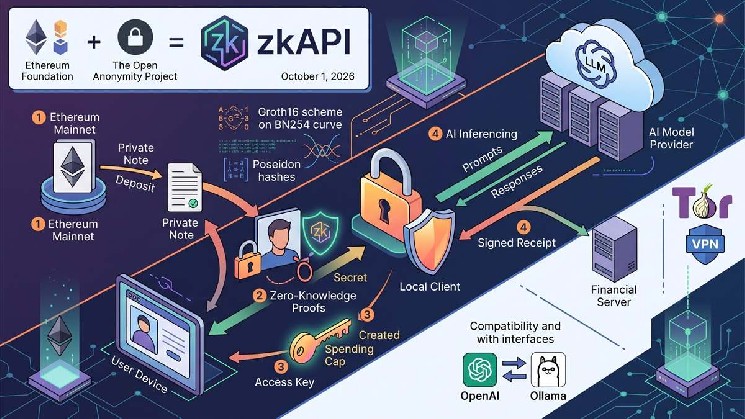

Until now, accessing neural compute services via application programming interfaces required linking credit cards or static API credentials to every request. Official technical documentation points out that this legacy framework exposes users’ prompt histories directly to infrastructure providers. In contrast, the new architecture shifts spending authorization to a local cryptographic balance known as a private note.
Users execute a one-time deposit into a smart contract on the Ethereum mainnet. A local client then generates zero-knowledge proofs certifying available funds without exposing the funding origin or the remaining account balance.
Technical Mechanics and Privacy in Model Consumption
Once the server verifies the cryptographic proof, the system generates a temporary key with a dollar-denominated spending cap. This credential resides exclusively in the volatile memory of the local device, routing queries directly to the inference provider without billing intermediaries.
When the session expires, the provider issues a cryptographically signed receipt reflecting the exact usage to debit it from the deposited balance. Official documentation specifies that the financial server never gains visibility into the content of the prompts, while the platform processing the artificial intelligence inference remains completely unaware of the account or banking identity behind the transaction.
The protocol anchors its security in the Groth16 scheme over the BN254 curve, utilizing Poseidon hashes to verify commitments and nullifiers. According to the engineering team, this design prevents the double-spending of compute credits without compromising user anonymity on-chain.
The local client natively emulates the API specifications of OpenAI and Ollama. Thanks to this compatibility, developers can plug in chat user interfaces, code editors, and autonomous agents simply by redirecting requests to their local host.
The Ethereum Foundation clarified that the protocol does not resolve network-level anonymization on its own. Report data indicates that providers could still log connection IP addresses unless users integrate complementary mixnets such as Tor or dedicated VPNs.
Additionally, the release cautions that the raw text of prompts may contain stylometric identifiers or personal data capable of compromising anonymity if operational precautions are not observed.
The tool’s underlying framework builds on research into ZK credits published by Vitalik Buterin and Davide Crapis. The participating organizations have open-sourced the client code and verification contracts, keeping a test deployment live on the Sepolia testnet alongside the active contract on Ethereum Mainnet for immediate public audit.
