

By Friday afternoon, the mood on commodity trading desks changes.
For the first four days of the week, traders have been trying to profit from their bets. By lunch on Friday, however, they’re thinking about how much risk they can tolerate until markets reopen on Sunday evening.
Anything could happen while markets are closed: news of a new war, an election result, an unexpected OPEC announcement or, as seen recently, a market-moving presidential post. Forty-eight hours can be a long time when traders are holding a position tied to a few of the world’s most actively traded markets, and there’s nothing they can do until trading resumes.
“From about lunchtime, the desk basically stops thinking about making money and starts thinking about what they can live with for roughly forty-eight hours until the Sunday evening reopen,” said Mustafa Al Niama, former Goldman Sachs head of digital assets of the Americas and now head of capital markets at Mysten Labs.
Every commodities options trader knows this ritual. By the end of the week, the question isn’t where the commodity is going — it’s whether they are comfortable living with their position if something happens while markets are closed, as they can’t adjust or rebalance their bets on the weekend.
“Risk, geopolitical or not, does not know what day of the week it is,” said Terry Duffy, chairman and CEO of CME Group.
Markets, however, still largely do. And for decades, planning ahead for potential weekend and after-hours catastrophes has just been part of the job for traders. But earlier this year, something unusual happened in the oil options market, which upended this long-standing routine.
As tensions escalated between Iran and Israel and traders rushed to speculate on prices, oil-linked futures saw a sudden spike in volume over the weekend in March. The catch was that it happened when commodity markets were closed, but the traders didn’t need to wait for the traditional market to reopen before reacting. Instead, they traded elsewhere.
Traders flocked to crypto exchanges over the weekend to trade derivatives contracts called “perpetual futures,” which run around the clock.
The total value of all active contracts on the decentralized exchange Hyperliquid hit a record $1.2 billion on March 8, a Sunday when traditional commodity markets were closed.
While weekend volume is still smaller than on weekdays, at least by Wall Street’s standards, it is no longer just a blip. It highlighted something that barely existed a few years ago: a 24/7 venue for oil derivatives trading, while traditional finance is stuck offline.
“We’re roughly seeing 2-3x more volume on average on weekdays vs weekends for oil perps on Hyperliquid over the last 3 months,” said Martin Lee, market insights lead at DWF Labs. Even so, Lee said that weekend trading’s share of overall volume has grown by roughly 25% since March, despite activity cooling after the spike that followed the Iran conflict.
And this change might be quietly influencing another corner of the oil market.
The weekend problem
Researchers at the energy and macro analytics firm Energy Aspects (EA) said the dynamics of how traders price short-dated West Texas Intermediate (WTI) crude options are set to change, thanks to the rapid growth of similar round-the-clock perpetuals on crypto exchanges.
For years, the implied volatility or how much an underlying asset’s price is likely to fluctuate in the future, for WTI contracts, fell on Fridays. Traders were reluctant to pay for protection through options or derivatives that they couldn’t actively manage while markets were shut. To avoid being exposed through the weekend, many traders reduced their positions before Friday’s close, creating what Energy Aspects describes as a persistent Friday discount in implied volatility.
That discount has begun to narrow, according to Energy Aspects.
“For the first time, traders can hedge options exposure through the weekend, when geopolitical risk has become disproportionately concentrated. This development has implications for the well-documented ‘weekend effect’ in short-dated WTI options, where implied volatility is structurally depressed on Fridays as long gamma holders liquidate positions they cannot hedge over the market closure,” analysts led by Tim Skirrow said in a recent note.
Because perpetual contracts are available, the analysts argued that if traders can hedge oil exposure through perpetual futures over the weekend, they may be willing to hold or even buy options they previously would have sold before Friday’s close.
In theory, this could create an opportunity for traders that didn’t exist before: they can capture profits over the weekend if the market becomes chaotic, rather than just sitting on their positions while the underlying prices of the assets move sharply.
In fact, Energy Aspects estimates that if a continuous futures contract is available, it would create roughly 40% more hedging sessions over the life of a typical contract. And it’s not just due to perps, as CME recently said it plans to add smaller-sized 24/7 contracts for WTI crude and gold. Any continuous futures for commodities would help traders hedge their weekend bets and reduce the Friday selling pressure. (It’s worth noting, however, that the regulator that oversees commodity trading, the Commodity Futures Trading Commission (CFTC), has blocked that contract launch, an action that prompted CME to sue the agency.)
While finding any edge to capture a few basis points of profit sounds like any trader’s dream, for most traders, it’s still likely to remain theoretical until continuous trading becomes more widespread. Even traders who find the strategy plausible are cautious not to overstate its impact.
“Is volatility coming down because of that [availability of perps]? I don’t think so,” said one trader at a proprietary market-making firm active across both traditional and crypto markets, who opted to remain anonymous. “When I’m long volatility or short volatility, all I care about is how much this thing moves. And where it moves or how it moves doesn’t really impact me. So volatility came down on the CME would sort of imply that it was maybe too high before, because there were not that many venues to buy it on,” he added.
But he doesn’t reject the broader idea that hedging bets during the weekend is valuable for traders.
What he agreed with is that, given the ability to hedge over the weekend, a trader may be willing to pay a higher price for volatility on a different venue than the CME. Why? Because now, “You have more touch points for picking up and laying off risk over the weekend than you had before. You had zero [places to hedge] before, and now you have more than zero.”
Getting Wall Street’s buy-in
So, if traders could hedge their prior “dead zone” positions, why aren’t the big banks trading perps?
“There is some interest coming up from the institutional clients, my guess is that the majority of the volume is from the retail market,” said Gracy Chen, CEO of Bitget, a centralized crypto exchange that ranked second in terms of trading volume of commodities and stock perps during the second quarter, followed by Binance, according to TokenInsight data.
“The main issue is not really that they can’t,” Chen said. “It’s probably more like they don’t see it as profitable enough for them to invest … at least not yet.”
Lack of meaningful liquidity is a major reason institutional traders are likely still staying away.
The volume of perps linked to traditional assets such as commodities and stocks has increased meaningfully over the past few months, but still likely isn’t large enough for giant Wall Street trading firms to come in and profit — yet.
For example, in March and April, the average volume of crude oil perps accounted for about just 2% and 4%, respectively, of the primary futures contract equivalents traded on traditional exchanges, according to Binance Research data.
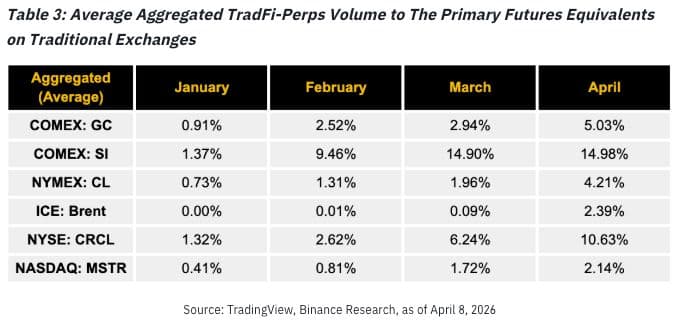
Meanwhile, in 2025, total perps trading volume on centralized exchanges was $62 trillion versus spot volume of roughly $19 trillion, venture capital giant Pantera said, citing data from CryptoQuant. Decentralized exchange (DEX) Hyperliquid has supercharged the use of perps, with monthly perps volume of nearly $200 billion, according to DeFiLlama data.
While those are massive numbers for crypto, they are still relatively small from Wall Street’s perspective.
“The hardest thing about trading is finding someone who wants to take the other side,” said the trader from the proprietary market-making firm. “In the absence of traditional liquidity providers, how are you gonna get that bet on big enough such that you care about the result?”
In TradFi, money takes the weekend off
Then there are issues with the existing infrastructure.
Large institutions, such as banks, already have systems in place for the market’s traditional operating hours. Even if weekend trading has sufficient volume for them to jump in, they will need a different structure for it, according to BitGet’s Chen.
“Especially for those top organizations that never really had the 24/7 infrastructure,” she added.
DWF’s Lee echoed this issue. “Having the option to trade does not mean that people would automatically start doing so. There needs to be a broad shift in operational capacity from institutions and corporations to be able to cater to that.”
One of these structural issues might be how institutions operate (or don’t operate) on weekends. Banks are closed on Saturdays and Sundays, so it would be hard to collect margin for perps trading mid-weekend, said Mysten Labs’ Mustafa Al Niama, adding that these large institutions would need the backing of clearing and settlement rails that actually move money, which is, for now, mostly on weekdays.
Even when weekend trading is available, much of the financial infrastructure that these large institutions rely on still isn’t. Banks don’t move collateral around the clock, clearing systems largely keep weekday hours, and firms can’t simply summon additional capital on a Saturday afternoon.
“You cannot do that until you put the infrastructure in place that you have Monday through Friday,” CME’s Duffy said.
Put simply, the biggest challenge may not be keeping the markets open. It’s keeping the financial system underneath everything open as well.
So, in the meantime, who is actually trading perps? For now, these instruments remain in the domain of crypto-native firms, proprietary trading shops and savvy retail traders.
“Predominantly now, it’s the same typical retail, market makers, prop shops that are trading perps,” said Al Niama, noting that they are probably using perps mostly for basis trading or carry trades, rather than hedging. “Because it is a very lucrative delta-neutral type of trade.”
End of the weekend gap
There is, however, another important role that perps play for traders that didn’t exist before. They give traders a tool to gauge how the market will trade when it opens if news breaks out during the weekend.
Before perps, it was mostly a guess of how an asset would trade once the traditional market opens. But now, because perps trade 24/7, traders at least have a better idea of the bets’ direction after the weekend.
Hein Tibosch, head of digital assets OTC and product at Flow Traders, said perpetual markets have become another source of information before traditional markets reopen.
“The perps… will be a pretty good indicator of where the market is heading,” he said. “You have some direction.”
The trader at the proprietary market-making firm described the same shift.
“It’s not really a surprise anymore by Sunday’s open,” he said, noting that traders increasingly watch crypto markets throughout the weekend to gauge where traditional futures may begin trading once the CME opens.
This might be the first signal that perpetual futures are starting to influence traditional markets — not as a replacement for CME, but as another source of price discovery while the rest of the market sleeps.
Perhaps the biggest impact of perps thus far is that the instrument might be influencing how some traders behave.
“For the crypto industry, it actually is a big deal because for the longest time, we as an industry have always been the student,” said Al Niama. However, perps might become one of the first ideas moving in the opposite direction, where traditional finance is potentially influenced by crypto innovations.
Whether perps can actually reshape the traditional market remains uncertain. Volumes (at least by TradFi measures) are still modest, and big-money institutions are still cautiously watching. Meanwhile, CME’s proposed 24/7 futures contract trading remains uncertain.
But there are signs that on Friday afternoons, old habits are already beginning to change for traders. They will still spend the end of the week worrying about the weekend — the difference is that if there are continuous trading hours, some of them may no longer have to spend time waiting. Now, they can start making money either by trading or tracking these contracts.
“For lots of players, for example, a hedge fund or quant shop, if you can just have your strategies run instead of five days a week, seven days a week, that’s two extra days of trading,” said Flow Traders’ Tibosch.
“So if you can have alpha, bring it on,” he added.
And it seems, at least in the future, one assumption appears less permanent than it once did: that Friday’s closing bell marks the beginning of two days when traders simply have to wait.
“I think that markets will be 24/7 down the road. All markets,” said CME’s Duffy.
Perhaps it’s time for trading desks to start preparing to properly staff for an around-the-clock market, and forget the old routine of the “weekend effect.”
