
Close Menu
  • Coins
    • Bitcoin
    • Ethereum
    • Altcoins
    • NFT
  • Blockchain
  • DeFi
  • Metaverse
  • Regulation
  • Other
    • Exchanges
    • ICO
    • GameFi
    • Mining
    • Legal
  • MarketCap
What's Hot

UNDP Expands Stellar Payment Partnership

13/07/2026

HyperLabs Transfers $32.3M in HYPE to Market Maker Flowdesk, Analyst Flags Sell Pressure

13/07/2026

Trump Using Presidency to ‘Boost’ Family’s Crypto Business While Families ‘Crushed’ by Rising Costs, Says Elizabeth Warren

13/07/2026
Facebook X (Twitter) Instagram
  • Back to NBTC homepage
  • Privacy Policy
  • Contact
X (Twitter) Telegram Facebook LinkedIn RSS
NBTC News
  • Coins
    1. Bitcoin
    2. Ethereum
    3. Altcoins
    4. NFT
    5. View All

    Can Bitcoin’s Next Price Floor Reach $800,000?

    12/07/2026

    Bitcoin demand still unable to outpace issuance as recovery remains fragile

    12/07/2026

    US Bitcoin ETFs See $84.9M Net Outflow, Ending Three-Day Inflow Streak

    12/07/2026

    Bitcoin sits in deep value while ETF outflows keep pressure on BTC

    12/07/2026

    31% of Ethereum Node Activity Concentrated in the US, Raising Centralization Fears

    12/07/2026

    J.P. Morgan Tokenizes $800M on Ethereum — What It Signals

    12/07/2026

    BlackRock Moves 8,700 Ethereum to Coinbase: Why Traders Are Watching

    12/07/2026

    Vitalik’s Single Slot Finality Proposal Puts Ethereum Settlement Speed Back Under The Microscope

    12/07/2026

    HyperLabs Transfers $32.3M in HYPE to Market Maker Flowdesk, Analyst Flags Sell Pressure

    13/07/2026

    Ionet Burns 1 Million IO Tokens in First Month of Revenue-Linked Mechanism

    12/07/2026

    Why Did Shiba Inu (SHIB) On-Chain Transactions Just Collapse by 95%?

    12/07/2026

    Ripple CEO Speaks About Major Sports Partnership

    12/07/2026

    Welcomed by Robinhood Chain — And Why It’s Not Just Hype

    11/07/2026

    BIG3 NFT Buyers Sue Ice Cube’s Basketball League Over Alleged Unfulfilled Promises

    08/07/2026

    Cristiano Ronaldo Retirement Puts Billion-Dollar NFT Market to the Test

    06/07/2026

    Bonk-Owned NFT Marketplace Exchange Art to Shut Down on August 1

    04/07/2026

    UNDP Expands Stellar Payment Partnership

    13/07/2026

    HyperLabs Transfers $32.3M in HYPE to Market Maker Flowdesk, Analyst Flags Sell Pressure

    13/07/2026

    Trump Using Presidency to ‘Boost’ Family’s Crypto Business While Families ‘Crushed’ by Rising Costs, Says Elizabeth Warren

    13/07/2026

    Can Bitcoin’s Next Price Floor Reach $800,000?

    12/07/2026
  • Blockchain

    What are cross-chain bridges? Why they keep getting hacked

    12/07/2026

    The Sam Altman Orb Scans Hit Oxford Street

    12/07/2026

    Solana’s $8.7B RWA surge shows tokenized assets are finally starting to move

    11/07/2026

    Ethereum is losing ownership of crypto payments as Base moves $565B in stablecoins

    11/07/2026

    Mantle Accelerates Tokenized Equities Push with Bending Spoons Listing

    11/07/2026
  • DeFi

    DeFi may be ‘quietly re-rating’ given outperformance against Bitcoin: Bitwise

    11/07/2026

    Abraxas Capital Deposits $140M in Crypto Into DeFi Lending Protocol Spark

    11/07/2026

    Massive $491M USDT Transfer to Aave Sparks DeFi Liquidity Speculation

    11/07/2026

    Here’s why Uniswap is betting on execution over higher LP incentives

    11/07/2026

    Aave Shares Major Whale Deposit — Implications for DeFi Investors

    11/07/2026
  • Metaverse

    Is Solana Gaming Back? Kintara Activity Fuels Renewed Optimism in Onchain MMOs

    24/06/2026

    The Sandbox launches AI game engine ‘The Sandbox Studio’ for next-generation creators

    10/06/2026

    Meta commits $13M in funding for Oversight Board through 2028

    29/05/2026

    Why Animoca’s Yat Siu says the future is 100 billion AI agents

    07/05/2026

    ‘8,000 Jobs’—Polymarket Sees Tech Layoff Surge As Meta AI Push Bites

    18/04/2026
  • Regulation

    UNDP Expands Stellar Payment Partnership

    13/07/2026

    South Korea’s FSS chief warns again on leveraged stock bets as KOSPI swings

    12/07/2026

    AI trade loses steam as infrastructure boom faces reality check

    12/07/2026

    Vanguard opens search for digital assets leader in sign of evolving crypto strategy

    12/07/2026

    Tether to invest $20 million in Mercado Bitcoin

    12/07/2026
  • Other
    1. Exchanges
    2. ICO
    3. GameFi
    4. Mining
    5. Legal
    6. View All

    Coinbase Adds GRVT to Listing Roadmap, Signaling Institutional Shift in DeFi Derivatives

    12/07/2026

    Binance Hiring General Manager for West Africa Business Development Role

    12/07/2026

    Binance to Temporarily Halt MTL Deposits and Withdrawals for Network Upgrade on July 8

    12/07/2026

    Swyftx eyes crypto payments after securing Australian license

    12/07/2026

    ICO market slows sharply with only six completions in 2026

    30/04/2026

    South Korea Poised to Lift Ban on Domestic ICOs After 7 Years

    19/12/2025

    Why 2025’s Token Boom Looks Both Familiar and Dangerous

    31/10/2025

    ICO for bitcoin yield farming chain Corn screams we’re so back

    22/01/2025

    Yield Guild Games Sunsets YGG Play Publishing Unit, Cuts 35 Jobs

    06/07/2026

    GO1 and Xiaohai Set up Potential Rematch at EWC 2026 Fatal Fury Bracket in Paris

    06/07/2026

    Nexus Acquires Homegrown App Marketplace One Store, Expanding into Global Web3 Game Hub

    21/06/2026

    GMATRIXS and Plum Protocol Partner to Blend GameFi with Meme Assets, Driving Multi-Chain Web3 User Experience

    16/06/2026

    Bitdeer Invests $36M in Nevada Mining Rig Factory to Boost SEALMINER Production

    12/07/2026

    American Bitcoin Q2 Results Due August 3 as Investors Watch Mining Margins

    12/07/2026

    Bitdeer Sells All 227.5 BTC Mined Last Week, Holdings Drop to Zero

    11/07/2026

    125 BTC Mined, Holdings Adjust

    11/07/2026

    Trump Using Presidency to ‘Boost’ Family’s Crypto Business While Families ‘Crushed’ by Rising Costs, Says Elizabeth Warren

    13/07/2026

    Central bankers sound alarms over agentic AI finance risks

    12/07/2026

    July Goal Missed, But August Deadline Keeps Crypto Bill Alive

    12/07/2026

    South Korea proposes crypto seizure rules for civil debt enforcement

    12/07/2026

    UNDP Expands Stellar Payment Partnership

    13/07/2026

    HyperLabs Transfers $32.3M in HYPE to Market Maker Flowdesk, Analyst Flags Sell Pressure

    13/07/2026

    Trump Using Presidency to ‘Boost’ Family’s Crypto Business While Families ‘Crushed’ by Rising Costs, Says Elizabeth Warren

    13/07/2026

    Can Bitcoin’s Next Price Floor Reach $800,000?

    12/07/2026
  • MarketCap
NBTC News
Home»Regulation»Are Stablecoins the Hidden Blueprint for a US Digital Dollar?
Regulation

Are Stablecoins the Hidden Blueprint for a US Digital Dollar?

NBTCBy NBTC24/07/2025No Comments6 Mins Read
Share
Facebook Twitter LinkedIn Pinterest Email


Stablecoins, digital currencies pegged to the U.S. dollar, have surged in popularity, but their quiet resilience under slim regulatory scrutiny may signal a deeper role as a testing ground for a central bank digital currency (CBDC).

Stablecoins and the Silent Rise of a Central Bank Digital Dollar

These blockchain-based tokens, designed to maintain a stable value, offer a glimpse into a future where governments could leverage their infrastructure to introduce a state-controlled digital dollar. As the U.S. grapples with the implications of a CBDC, stablecoins like Tether’s USDT and Circle’s USDC, which have thrived with fairly minimal government interference, raise questions about whether they are inadvertent prototypes for a broader, more centralized financial transformation.

Stablecoins operate on a simple premise: they are cryptocurrencies tied to a fiat currency, typically the U.S. dollar, to avoid the volatility plaguing assets like bitcoin or ethereum. Issued by private companies, they are backed by reserves of cash, bonds, or other assets, ensuring a 1:1 peg with the dollar. Tether’s USDT, the largest stablecoin, and USDC, issued by Circle, dominate the market, facilitating billions in daily transactions across decentralized finance (DeFi) platforms, remittances, and global trade.

Their utility lies in their ability to merge the speed and transparency of blockchain with the stability of traditional currency, making them a darling of crypto enthusiasts and a potential blueprint for central banks eyeing digital currencies. The U.S. government has long signaled interest in a CBDC, a digital version of the dollar issued and controlled by the Federal Reserve. Unlike stablecoins, a CBDC would be a direct liability of the central bank, offering unparalleled control over monetary policy, transaction tracking, and financial oversight.

Proponents argue it could streamline payments, reduce costs, and enhance financial inclusion. Critics, however, warn of privacy erosion, surveillance risks, and the potential for governments to exert unprecedented control over individual spending. The Biden administration’s 2022 executive order on digital assets tasked agencies with exploring CBDC feasibility, and the Federal Reserve has been studying its implications through initiatives like Project Hamilton. Yet, deploying a CBDC from scratch is a monumental task—unless the infrastructure already exists.

A few years after BTC was introduced, stablecoins became a prominent fixture. Yet in 2011, before stablecoins, Bernard von NotHaus, creator of the Liberty Dollar, was convicted on counterfeiting charges for making and distributing silver coins that resembled U.S. currency and for conspiracy against the United States.

Enter stablecoins, which have quietly built the scaffolding for a digital dollar. Their blockchain networks, wallet systems, and integration with global exchanges provide a ready-made ecosystem. Tether and USDC, for instance, operate on public blockchains like Ethereum, enabling seamless, near-instantaneous transactions across borders. They’ve also navigated regulatory gray zones since their inception. This resilience suggests a tacit acceptance by regulators, who could be observing how these coins function under real-world conditions—potentially as a dry run for a CBDC.

The parallels between stablecoins and a potential CBDC are striking. Both rely on digital ledgers to track transactions, both aim for dollar parity, and both require trust in the issuer’s backing. A CBDC could theoretically adopt a stablecoin’s architecture, swapping private issuers for the Federal Reserve. This transition would be a backdoor approach, bypassing the need to build a CBDC from the ground up. By leveraging existing stablecoin frameworks, the Fed could deploy a digital dollar with minimal disruption, using familiar technology to ease public and institutional adoption. The question is whether this is already happening in plain sight.
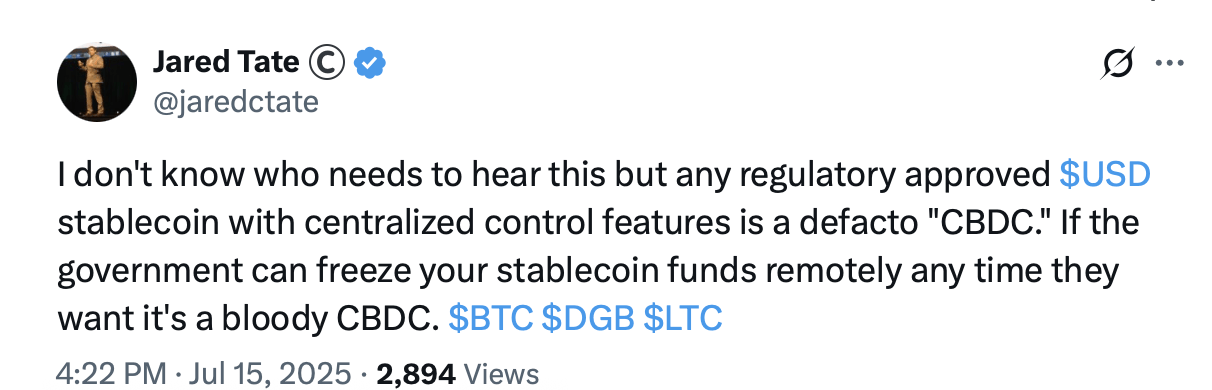
Some critics believe the GENIUS Act serves as a backdoor for a CBDC because it creates a framework for banks to issue dollar-pegged stablecoins that could function similarly to a state-controlled digital dollar, potentially enabling government oversight and control without direct Federal Reserve issuance. By allowing federally chartered banks to issue stablecoins under strict regulatory supervision, the Act could establish an interoperable network of private digital currencies that mirror CBDC capabilities.

Rep. Marjorie Taylor Greene said she voted NO on the GENIUS Act because it left out one key piece: a ban prohibiting a CBDC. The implications of such a move could be profound. A CBDC built on stablecoin rails could give the Federal Reserve unprecedented visibility into transactions, potentially requiring digital wallets linked to verified identities. Unlike cash, which is anonymous, a CBDC could track every dollar’s movement, raising privacy concerns. Stablecoins already collect user data through exchanges and wallet providers, a practice that could scale under a CBDC.
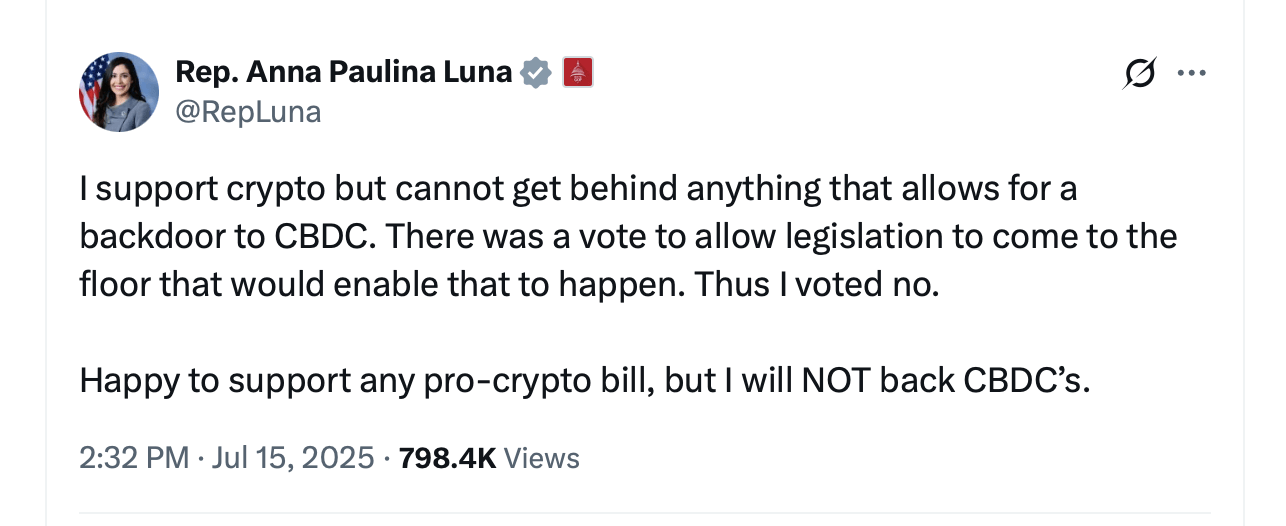
Moreover, a central bank could program a CBDC to enforce policies—like negative interest rates or spending restrictions—directly affecting how individuals use money. Stablecoins’ smart contract capabilities, which allow programmable transactions, could serve as a template for such controls. Skeptics might argue that stablecoins are too decentralized to serve as CBDC prototypes. After all, their blockchains are often permissionless, meaning anyone can participate without gatekeepers.

But this overlooks the centralized choke points: issuers control reserve management, and exchanges enforce KYC (know-your-customer) rules. A CBDC could retain the blockchain’s efficiency while replacing private issuers with the Fed, centralizing control. The government could also mandate interoperability between stablecoins and a future CBDC, creating a hybrid system where private tokens pave the way for state dominance.

The global context adds urgency to this theory. China’s digital yuan is already in trials, and countries like the Bahamas and Nigeria have launched their own CBDCs. The U.S. risks falling behind in the race to define the future of money, especially as stablecoins like Tether dominate cross-border payments in regions with unstable currencies. If the U.S. were to integrate stablecoin infrastructure into a CBDC, it could maintain the dollar’s global dominance while countering foreign digital currencies.
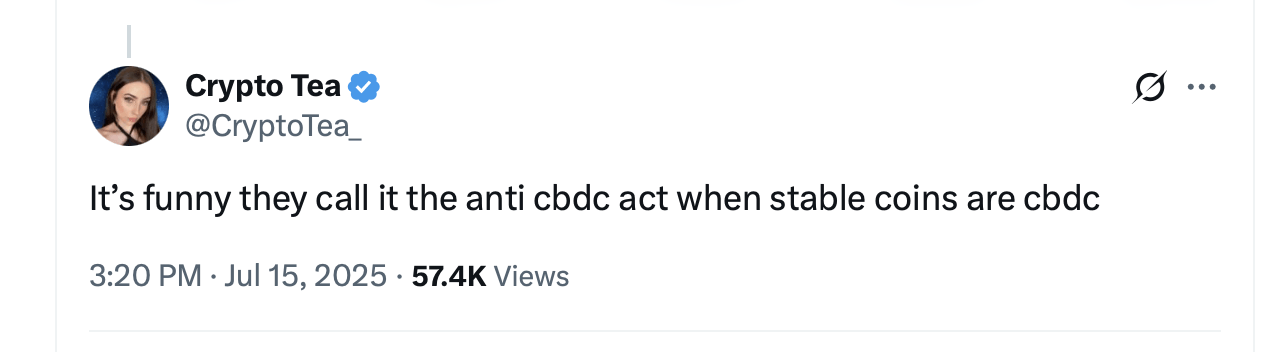
This strategic advantage might explain why regulators have allowed stablecoins to flourish despite their risks. Public perception remains a hurdle. Stablecoins enjoy trust among crypto users, but a CBDC could face backlash over surveillance fears. The government could mitigate this by framing a CBDC as an evolution of stablecoins, emphasizing familiarity and stability. For instance, a popular dollar coin’s transparency and reserve backing could serve as a model to reassure users that a digital dollar is just as reliable.

Meanwhile, stablecoin issuers might welcome integration, as it could cement their role in a government-sanctioned system, shielding them from future regulatory crackdowns. The road to a CBDC is fraught with technical and political challenges, but stablecoins offer a compelling shortcut. Their widespread adoption, battle-tested infrastructure, and regulatory resilience over the last decade make them ideal candidates for a backdoor transition.

Whether intentional or not, the survival of Tether and USDC amid regulatory As the Federal Reserve inches closer to a CBDC, the line between private stablecoins and state-controlled currency blurs, raising a critical question: Are we already using the prototype for the future of money?

Share. Facebook Twitter Pinterest LinkedIn Tumblr Email
NBTC

NBTC is the editorial account for NBTC News, covering Bitcoin, Ethereum, DeFi, blockchain infrastructure, exchanges, mining, regulation and digital asset markets. The editorial team focuses on clear sourcing, timely updates and practical context for crypto readers.

Related Posts

UNDP Expands Stellar Payment Partnership

13/07/2026

South Korea’s FSS chief warns again on leveraged stock bets as KOSPI swings

12/07/2026

AI trade loses steam as infrastructure boom faces reality check

12/07/2026

Vanguard opens search for digital assets leader in sign of evolving crypto strategy

12/07/2026
Add A Comment

Comments are closed.

Top Posts
Get Informed

Subscribe to Updates

Get the latest news from NBTC regarding crypto, blockchains and web3 related topics.

Your source for the serious news. This website is crafted specifically to for crazy and hot cryptonews. Visit our main page for more tons of news.

We're social. Connect with us:

Facebook X (Twitter) LinkedIn RSS
Top Insights

UNDP Expands Stellar Payment Partnership

13/07/2026

HyperLabs Transfers $32.3M in HYPE to Market Maker Flowdesk, Analyst Flags Sell Pressure

13/07/2026

Trump Using Presidency to ‘Boost’ Family’s Crypto Business While Families ‘Crushed’ by Rising Costs, Says Elizabeth Warren

13/07/2026
Get Informed

Subscribe to Updates

Get the latest news from NBTC regarding crypto, blockchains and web3 related topics.

Type above and press Enter to search. Press Esc to cancel.