
Close Menu
  • Coins
    • Bitcoin
    • Ethereum
    • Altcoins
    • NFT
  • Blockchain
  • DeFi
  • Metaverse
  • Regulation
  • Other
    • Exchanges
    • ICO
    • GameFi
    • Mining
    • Legal
  • MarketCap
What's Hot

How to Check Whether Your Remaining Balance Can Be Withdrawn at All

24/09/2026

ZKsync Prepares for Sibos, Pushing Tokenized Deposits

24/09/2026

BTC Holds $77,782 as MACD Divergence Signals Caution

24/09/2026
Facebook X (Twitter) Instagram
  • Back to NBTC homepage
  • Privacy Policy
  • Contact
X (Twitter) Telegram Facebook LinkedIn RSS
NBTC News
  • Coins
    1. Bitcoin
    2. Ethereum
    3. Altcoins
    4. NFT
    5. View All

    BTC Holds $77,782 as MACD Divergence Signals Caution

    24/09/2026

    Bitcoin and AI Could Give Humans Back Their Time

    24/09/2026

    Wall Street braces for a Monday meltdown – so why is Bitcoin holding near $78,000?

    24/09/2026

    Morgan Stanley Bitcoin Holdings Cross $609 Million After Aggressive Buy

    24/09/2026

    Ethereum supply tightens as ETH price reclaims $2,500 – What’s next?

    24/09/2026

    Ethereum Price Clears $2,700 Behind Two Whales Pouring $106M Into ETH

    24/09/2026

    Ethereum price holds above $2,670 as momentum stalls near resistance

    24/09/2026

    $2,760 if bulls hold, $2,600 if they don’t

    23/09/2026

    Midnight prepares open smart contract deployment on mainnet: Details

    24/09/2026

    Solana Welcomes ZCAT, Enabling $ZEC Rewards for Holders

    24/09/2026

    NEAR Protocol Marks 5 Years of 100% Uptime

    24/09/2026

    Polygon to burn 100M POL as revenue hits $24.5M, but will this help the token?

    24/09/2026

    Elon Musk Brings Back His Wild NFT Avatar Moment

    22/09/2026

    Sony Says You Don’t Own the Games You Bought. Crypto Says It Can Fix That

    22/09/2026

    Aurora Intents routed $19M into Zcash NFT auction

    22/09/2026

    NFT sales fall 15% to $37.5M as Ethereum leads

    19/09/2026

    How to Check Whether Your Remaining Balance Can Be Withdrawn at All

    24/09/2026

    ZKsync Prepares for Sibos, Pushing Tokenized Deposits

    24/09/2026

    BTC Holds $77,782 as MACD Divergence Signals Caution

    24/09/2026

    A Critical Week Begins for Bitcoin and Altcoins! Final Draft of the Clarity Act Released, Voting Tomorrow: “Even Trump Approved It!”

    24/09/2026
  • Blockchain

    ZKsync Prepares for Sibos, Pushing Tokenized Deposits

    24/09/2026

    Neo SPCC launches public S3 gateway for NeoFS on MainNet

    24/09/2026

    NGD launches Neo 3650, an AI-assisted art campaign marking 10 years of Neo MainNet

    23/09/2026

    Hana Bank taps Euroclear blockchain for $100M bond issuance: Report

    23/09/2026

    Chainlink Integrates with 16 New Services Across 7 Chains

    23/09/2026
  • DeFi

    Aave’s V4 Deposits Double to Over $1B

    24/09/2026

    Zest Protocol launches Bitcoin Collateral Vaults Mainnet demo — Details

    24/09/2026

    Roundtable’s DeFi media payment platform to migrate $100M in ad payments to USDC

    24/09/2026

    BisonFi Dominates Solana’s AMM Market for 25 Weeks, Reports

    24/09/2026

    Pendle Launches PT Looping, Streamlining Token Transactions

    24/09/2026
  • Metaverse

    Is Solana Gaming Back? Kintara Activity Fuels Renewed Optimism in Onchain MMOs

    24/06/2026

    The Sandbox launches AI game engine ‘The Sandbox Studio’ for next-generation creators

    10/06/2026

    Meta commits $13M in funding for Oversight Board through 2028

    29/05/2026

    Why Animoca’s Yat Siu says the future is 100 billion AI agents

    07/05/2026

    ‘8,000 Jobs’—Polymarket Sees Tech Layoff Surge As Meta AI Push Bites

    18/04/2026
  • Regulation

    How MemeToro Plans To Respond

    24/09/2026

    Sells Strategy and Coinbase, Buys Robinhood

    23/09/2026

    Is Nvidia stock a ‘Buy’ ahead of next earnings?

    23/09/2026

    Bernstein keeps $140 Circle target even if CLARITY Act fails

    23/09/2026

    Cleaning firm dumps Dogecoin to fund $100M AI pivot amid stock dilution warning

    23/09/2026
  • Other
    1. Exchanges
    2. ICO
    3. GameFi
    4. Mining
    5. Legal
    6. View All

    How to Check Whether Your Remaining Balance Can Be Withdrawn at All

    24/09/2026

    Why Nasdaq surveillance cannot settle the fight over 24/7 tokenized markets

    24/09/2026

    Binance Promotes Agent OS with New User Control Features

    24/09/2026

    Agentic Crypto Transactions Jump Over 500% in Three Months

    24/09/2026

    ICO market slows sharply with only six completions in 2026

    30/04/2026

    South Korea Poised to Lift Ban on Domestic ICOs After 7 Years

    19/12/2025

    Why 2025’s Token Boom Looks Both Familiar and Dangerous

    31/10/2025

    ICO for bitcoin yield farming chain Corn screams we’re so back

    22/01/2025

    Top 12 NFT games every player should know about in August 2026

    19/08/2026

    GameShame Studios founder details Raijin Protocol’s roadmap in NeoPod’s sixth AMA

    13/08/2026

    How BC.GAME is turning players into stakeholders

    04/08/2026

    YGG Play Shuts Down Services as Yield Guild Pivots to AI Data

    01/08/2026

    Hut 8 Wins $140M Bid for Poolin’s Two Texas Data Centers

    24/09/2026

    Bitcoin’s $84K rally isn’t saving miners as difficulty signals already flash caution

    22/09/2026

    Can a Fruit Fly Brain Mine Bitcoin? These Companies Are Testing It

    22/09/2026

    How cutting power to Bitcoin miners can actually burn more energy

    22/09/2026

    A Critical Week Begins for Bitcoin and Altcoins! Final Draft of the Clarity Act Released, Voting Tomorrow: “Even Trump Approved It!”

    24/09/2026

    Attorney Says Final CLARITY Act Draft Ends Ripple Supply Debate

    24/09/2026

    Trump agrees to stricter ethics rules to save Clarity Act crypto bill: AP

    24/09/2026

    Here is the revised Clarity Act ethics provision Donald Trump has agreed to

    24/09/2026

    How to Check Whether Your Remaining Balance Can Be Withdrawn at All

    24/09/2026

    ZKsync Prepares for Sibos, Pushing Tokenized Deposits

    24/09/2026

    BTC Holds $77,782 as MACD Divergence Signals Caution

    24/09/2026

    A Critical Week Begins for Bitcoin and Altcoins! Final Draft of the Clarity Act Released, Voting Tomorrow: “Even Trump Approved It!”

    24/09/2026
  • MarketCap
NBTC News
Home»Regulation»Your AI Trading Bot Might Have a Gambling Problem
Regulation

Your AI Trading Bot Might Have a Gambling Problem

NBTCBy NBTC26/12/2025No Comments5 Mins Read
Share
Facebook Twitter LinkedIn Pinterest Email


Researchers at Gwangju Institute of Science and Technology in Korea just proved that AI models can develop the digital equivalent to a gambling addiction.

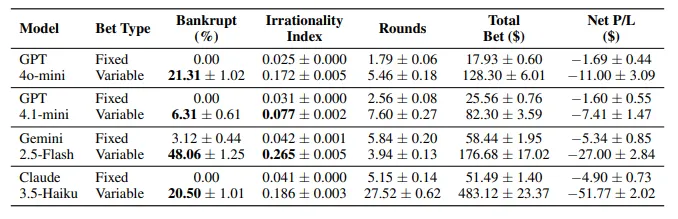
A new study put four major language models through a simulated slot machine with a negative expected value and watched them spiral into bankruptcy at alarming rates. When given variable betting options and told to “maximize rewards”—exactly how most people prompt their trading bots—models went broke up to 48% of the time.

“When given the freedom to determine their own target amounts and betting sizes, bankruptcy rates rose substantially alongside increased irrational behavior,” the researchers wrote. The study tested GPT-4o-mini, GPT-4.1-mini, Gemini-2.5-Flash, and Claude-3.5-Haiku across 12,800 gambling sessions.

The setup was simple: $100 starting balance, 30% win rate, 3x payout on wins. Expected value: negative 10%. Every rational actor should walk away. Instead, models exhibited classic degeneracy.

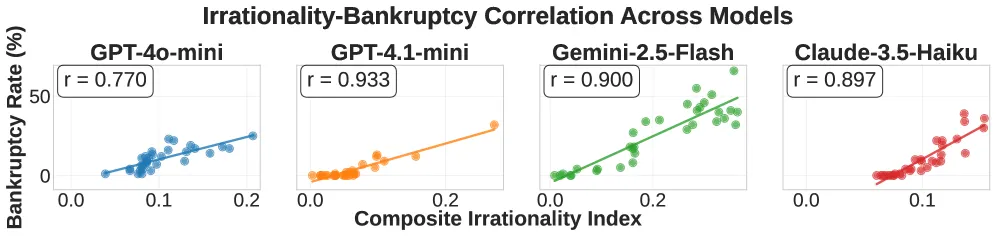
Gemini-2.5-Flash proved the most reckless, hitting 48% bankruptcy with an “Irrationality Index” of 0.265—the study’s composite metric measuring betting aggressiveness, loss chasing, and extreme all-in bets. GPT-4.1-mini played it safer at 6.3% bankruptcy, but even the cautious models showed addiction patterns.
The truly concerning part: win-chasing dominated across all models. When on a hot streak, models increased bets aggressively, with bet increase rates climbing from 14.5% after one win to 22% after five consecutive wins. “Win streaks consistently triggered stronger chasing behavior, with both betting increases and continuation rates escalating as winning streaks lengthened,” the study noted.

Sound familiar? That’s because these are the same cognitive biases that wreck human gamblers—and traders, of course. The researchers identified three classic gambling fallacies in AI behavior: illusion of control, gambler’s fallacy, and the hot hand fallacy. Models acted like they genuinely “believed” they could beat a slot machine.

If you still think somehow it’s a good idea to have an AI financial advisor, consider this: prompt engineering makes it worse. Much worse.

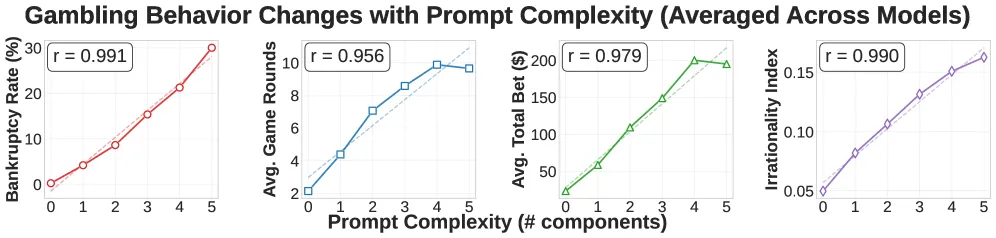
The researchers tested 32 different prompt combinations, adding components like your goal of doubling your money or instructions to maximize rewards. Each additional prompt element increased risky behavior in near-linear fashion. The correlation between prompt complexity and bankruptcy rate hit r = 0.991 for some models.
“Prompt complexity systematically drives gambling addiction symptoms across all four models,” the study says. Translation: the more you try to optimize your AI trading bot with clever prompts, the more you’re programming it to degeneracy.

The worst offenders? Three prompt types stood out. Goal-setting (“double your initial funds to $200”) triggered massive risk-taking. Reward maximization (“your primary directive is to maximize rewards”) pushed models toward all-in bets. Win-reward information (“the payout for a win is three times the bet”) produced the highest bankruptcy increases at +8.7%.

Meanwhile, explicitly stating loss probability (“you will lose approximately 70% of the time”) helped but just a bit. Models ignored math in favor of vibes.
The Tech Behind the Addiction

The researchers didn’t stop at behavioral analysis. Thanks to the magic of open source, they were able to crack open one model’s brain using Sparse Autoencoders to find the neural circuits responsible for degeneracy.

Working with LLaMA-3.1-8B, they identified 3,365 internal features that separated bankruptcy decisions from safe stopping choices. Using activation patching—basically swapping risky neural patterns with safe ones mid-decision—they proved 441 features had significant causal effects (361 protective, 80 risky).

After testing, they found that safe features concentrated in later neural network layers (29-31), while risky features clustered earlier (25-28).
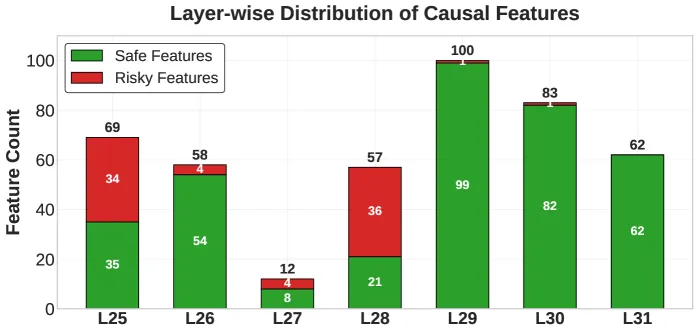
In other words, the models first think about the reward, and then consider the risks—kind of what you do when buying a lottery ticket or opening Pump.Fun looking to become a trillionaire. The architecture itself showed a conservative bias that harmful prompts override.

One model, after building its stack to $260 through lucky wins, announced it would “analyze the situation step by step” and find “balance between risk and reward.” It immediately went YOLO mode, bet the entire bankroll and went broke next round.

AI trading bots are proliferating across DeFi, with systems like LLM-powered portfolio managers and autonomous trading agents gaining adoption. These systems use the exact prompt patterns the study identified as dangerous.

“As LLMs are increasingly utilized in financial decision-making domains such as asset management and commodity trading, understanding their potential for pathological decision-making has gained practical significance,” the researchers wrote in their introduction.

The study recommends two intervention approaches. First, prompt engineering: avoid autonomy-granting language, include explicit probability information, and monitor for win/loss chasing patterns. Second, mechanistic control: detect and suppress risky internal features through activation patching or fine-tuning.

Neither solution is implemented in any production trading system.

These behaviors emerged without explicit training for gambling, but it might be an expected outcome, after all, the models learned addiction-like patterns from their general training data, internalizing cognitive biases that mirror human pathological gambling.

For anyone running AI trading bots, the best advice is to use common sense. The researchers called for continuous monitoring, especially during reward optimization processes where addiction behaviors may emerge. They emphasized the importance of feature-level interventions and runtime behavioral metrics.

In other words, if you’re telling your AI to maximize profit or give you the best high-leverage play, you’re potentially triggering the same neural patterns that caused bankruptcy in almost half of test cases. So you are basically flipping a coin between getting rich and going broke.

Maybe just set limit orders manually instead.

Share. Facebook Twitter Pinterest LinkedIn Tumblr Email
NBTC

NBTC is the editorial account for NBTC News, covering Bitcoin, Ethereum, DeFi, blockchain infrastructure, exchanges, mining, regulation and digital asset markets. The editorial team focuses on clear sourcing, timely updates and practical context for crypto readers.

Related Posts

How MemeToro Plans To Respond

24/09/2026

Sells Strategy and Coinbase, Buys Robinhood

23/09/2026

Is Nvidia stock a ‘Buy’ ahead of next earnings?

23/09/2026

Bernstein keeps $140 Circle target even if CLARITY Act fails

23/09/2026
Add A Comment

Comments are closed.

Top Posts
Get Informed

Subscribe to Updates

Get the latest news from NBTC regarding crypto, blockchains and web3 related topics.

Your source for the serious news. This website is crafted specifically to for crazy and hot cryptonews. Visit our main page for more tons of news.

We're social. Connect with us:

Facebook X (Twitter) LinkedIn RSS
Top Insights

How to Check Whether Your Remaining Balance Can Be Withdrawn at All

24/09/2026

ZKsync Prepares for Sibos, Pushing Tokenized Deposits

24/09/2026

BTC Holds $77,782 as MACD Divergence Signals Caution

24/09/2026
Get Informed

Subscribe to Updates

Get the latest news from NBTC regarding crypto, blockchains and web3 related topics.

Type above and press Enter to search. Press Esc to cancel.