

Close Menu
  • Coins
    • Bitcoin
    • Ethereum
    • Altcoins
    • NFT
  • Blockchain
  • DeFi
  • Metaverse
  • Regulation
  • Other
    • Exchanges
    • ICO
    • GameFi
    • Mining
    • Legal
  • MarketCap
What's Hot

ether.fi Removes Restaking From weETH, Nearing A Full EigenLayer Exit

07/08/2026

Flare makes XRPFi accessible in a single signature with smart accounts v1.3

07/08/2026

VARA Highlights Shift Towards Practical Implementation in Virtual Asset Regulation

07/08/2026
Facebook X (Twitter) Instagram
  • Back to NBTC homepage
  • Privacy Policy
  • Contact
X (Twitter) Telegram Facebook LinkedIn RSS
NBTC News
  • Coins
    1. Bitcoin
    2. Ethereum
    3. Altcoins
    4. NFT
    5. View All

    Bitcoin price climbs above $65K after U.S.-Iran peace deal lifts markets

    07/08/2026

    The Iran deal is done. Why Bitcoin is not celebrating

    07/08/2026

    Expert maps Bitcoin’s path to $38,500 crash

    07/08/2026

    Hoskinson Says Cardano Will Surpass Bitcoin, but Critics Aren’t Convinced

    06/08/2026

    U.S. Spot Ethereum ETFs See $11.9M Net Outflow as BlackRock Staking Fund Bucks Trend

    06/08/2026

    Ethereum Network Is Getting Busier, But Why Isn’t ETH Price Moving?

    06/08/2026

    Why Ethereum’s Scaling Isn’t Boosting Token Value

    06/08/2026

    Ether whales are pulling ETH off exchanges, Here’s why

    06/08/2026

    Flare makes XRPFi accessible in a single signature with smart accounts v1.3

    07/08/2026

    SBI expands beyond Ripple with Canton Network unit

    07/08/2026

    “It Has Nothing to Do With Us”

    07/08/2026

    Sei Labs Outlines SIP‑5 to Keep Network Accounts Safe From Future Quantum Threats

    06/08/2026

    An actual NFT success story? Tascha Labs’ shattered diamond

    06/08/2026

    NFT startup founder charged with misusing funds from $10 million fundraising

    06/08/2026

    What Happens to Your Attendance NFTs?

    04/08/2026

    StonkBrokers NFT on Robinhood hits $12.6K in 2 weeks: Can momentum hold?

    04/08/2026

    ether.fi Removes Restaking From weETH, Nearing A Full EigenLayer Exit

    07/08/2026

    Flare makes XRPFi accessible in a single signature with smart accounts v1.3

    07/08/2026

    VARA Highlights Shift Towards Practical Implementation in Virtual Asset Regulation

    07/08/2026

    Inside the mystery of BitMEX’s insurance fund

    07/08/2026
  • Blockchain

    Kenya moves 30 million academic credentials onto Avalanche blockchain

    06/08/2026

    How Indian Banks Are Using Blockchain While Keeping Crypto at a Distance

    06/08/2026

    LayerZero Has Moved More Than $200 Billion. Now It’s Chasing Global Payments.

    06/08/2026

    Inside Solana’s $1.6 Billion Market for Tokenized Trading Cards

    05/08/2026

    Layer-1 Blockchain Network Aptos Announces the Deployment of Privacy Feature on its Mainnet! Here Are the Details

    05/08/2026
  • DeFi

    ether.fi Removes Restaking From weETH, Nearing A Full EigenLayer Exit

    07/08/2026

    On-chain options close in on crypto’s $21B-a-day perp market to deepen liquidity everywhere

    06/08/2026

    Uniswap Ships A Memecoin Launchpad On Robinhood Chain, Topped By $FRONG Token Minted Six Days Early

    06/08/2026

    Uniswap launches Pools token launchpad for Robinhood Chain

    06/08/2026

    Uniswap Closes in on $100M Monthly Fees as V4 Upgrade Sparks Fresh On-Chain Growth

    06/08/2026
  • Metaverse

    Is Solana Gaming Back? Kintara Activity Fuels Renewed Optimism in Onchain MMOs

    24/06/2026

    The Sandbox launches AI game engine ‘The Sandbox Studio’ for next-generation creators

    10/06/2026

    Meta commits $13M in funding for Oversight Board through 2028

    29/05/2026

    Why Animoca’s Yat Siu says the future is 100 billion AI agents

    07/05/2026

    ‘8,000 Jobs’—Polymarket Sees Tech Layoff Surge As Meta AI Push Bites

    18/04/2026
  • Regulation

    Metaplanet completes Siiibo deal and launches securities subsidiary

    07/08/2026

    XRP Breaks 2-Month ETF Inflow Streak, Misses Out on Massive US Market Rebound

    07/08/2026

    Circle hosts Seoul event to deepen ties with Korean financial firms

    06/08/2026

    Bolivia weighs adding Tether’s USDT to its national payments system

    06/08/2026

    Mizuho says Circle bank approval doesn’t solve USDC growth, stablecoin competition risks

    06/08/2026
  • Other
    1. Exchanges
    2. ICO
    3. GameFi
    4. Mining
    5. Legal
    6. View All

    Inside the mystery of BitMEX’s insurance fund

    07/08/2026

    Electric Capital Confirms Non-Investment in FTX Amid Exchange Crisis

    07/08/2026

    World Liberty Financial Deposits 40.69M TRX into HTX

    07/08/2026

    CFTC Grants Kraken Relief for Derivatives Trading Platform

    06/08/2026

    ICO market slows sharply with only six completions in 2026

    30/04/2026

    South Korea Poised to Lift Ban on Domestic ICOs After 7 Years

    19/12/2025

    Why 2025’s Token Boom Looks Both Familiar and Dangerous

    31/10/2025

    ICO for bitcoin yield farming chain Corn screams we’re so back

    22/01/2025

    How BC.GAME is turning players into stakeholders

    04/08/2026

    YGG Play Shuts Down Services as Yield Guild Pivots to AI Data

    01/08/2026

    why gameplay now beats crypto rewards

    29/07/2026

    From NFT gaming to mining simulators

    29/07/2026

    Canaan can use crypto to buy back nearly 20% of its market value while its core business burns cash

    06/08/2026

    ‘Bitcoin security is bleeding out’ – Why BTC miners are pivoting to AI

    06/08/2026

    Bitcoin miners’ AI pipelines are on trial as Texas freezes 474 GW of data center requests

    06/08/2026

    TeraWulf Q2 Revenue Hits $44.8M as Data Center Leasing Drives Growth

    06/08/2026

    VARA Highlights Shift Towards Practical Implementation in Virtual Asset Regulation

    07/08/2026

    ‘Law Enforcement Wants CLARITY Passed,’ Coinbase’s CLO Asks if Senate Wants the Same

    07/08/2026

    Is Vietnam’s new crypto framework the first step towards a ban?

    06/08/2026

    Massachusetts Senate targets crypto ATMs after $6.8M in losses

    06/08/2026

    ether.fi Removes Restaking From weETH, Nearing A Full EigenLayer Exit

    07/08/2026

    Flare makes XRPFi accessible in a single signature with smart accounts v1.3

    07/08/2026

    VARA Highlights Shift Towards Practical Implementation in Virtual Asset Regulation

    07/08/2026

    Inside the mystery of BitMEX’s insurance fund

    07/08/2026
  • MarketCap
NBTC News
Home»Legal»Why the SEC just gave self custody crypto apps 5 years to get traditional broker licenses
Legal

Why the SEC just gave self custody crypto apps 5 years to get traditional broker licenses

NBTCBy NBTC21/04/2026No Comments6 Mins Read
Share
Facebook Twitter LinkedIn Pinterest Email


The SEC moved the crypto market structure forward on Apr. 13 without waiting for Congress to act.

The agency’s Division of Trading and Markets published a staff statement on Covered User Interfaces, such as websites, browser extensions, wallet-linked apps, and mobile applications that help users in self-custodial setups prepare transactions in crypto asset securities.

Staff said it will not object to these providers operating without broker-dealer registration under Exchange Act Section 15, provided they stay inside a strict set of behavioral and disclosure guardrails.

Why this matters

For the first time, the SEC is telling wallet-linked crypto trading apps how they can operate around securities without full broker licenses, but only if they avoid execution, custody, and anything that looks like DeFi. That opens a thin path for real products to ship now while signaling that bigger, full-service protocols are still stuck in a different regulatory box until Congress or the Commission goes further.

That framing of the conditional, narrow, and deliberately provisional reflects that the SEC is far enough into its own regulatory program to sketch operating conditions for an on-chain securities stack, yet still dependent on Congress for anything that lasts.

What the statement actually does

A Covered User Interface Provider qualifies if it allows users to customize transaction parameters, avoids soliciting specific trades, relies on pre-disclosed and independently verifiable routing logic, and presents execution options based on objective factors such as price or speed, among others.

The statement expressly includes distributed ledger trading systems, such as automated market maker (AMM) liquidity pools and liquidity aggregators, as venues to which these interfaces may connect.

That is the first time the SEC has described, with any operational specificity, how a self-custodial interface layer for crypto asset securities could function while staying outside broker status.

A flowchart outlines the SEC’s two-path test for crypto interfaces, listing seven qualifying conditions for neutral software and eight activities that trigger broker registration.

For tokenized securities builders, the operating picture that emerges is a deliberately thin stack consisting of software that helps users express preferences, inspect routes, compare prices and gas costs, and sign via a self-custodial wallet.

The document draws the outer edge at anything that looks like intermediation, such as no recommendations, no discretionary order routing, no execution, no custody of funds or stablecoins, no settlement, no financing arrangements, and no soliciting specific trades.

Where the lane ends

Any interface that negotiates transaction terms, holds user assets, executes or settles transactions, arranges financing, conducts independent valuations, or processes trade documentation falls outside the scope of the statement.

Compensation tied to specific products, venues, routes, or counterparties also disqualifies a provider.

The SEC’s permitted zone covers objective route display and user-directed parameter settings. Anything involving execution, routing discretion, or custody requalifies a provider as a broker.

The statement explicitly pointed out that an intermediary business model requires broker registration, regardless of whether the wallet is self-custodial. Its scope ends at the interface layer, leaving full-service DeFi products entirely outside its coverage.

Protocols that hold assets in smart contracts, execute swaps on behalf of users, or bundle routing with custody are intermediaries in a different regulatory category.

The relief is specific to a product shape, with the broader on-chain trading economy outside the statement’s scope.

A three-part SEC campaign

The Apr. 13 statement is the third in a deliberate sequence. On Jan. 30, the SEC published a statement on tokenized securities, framing it as part of a broader effort to clarify how federal securities laws apply to crypto assets.

On Mar. 17, the agency described its interpretive work on crypto asset law as a major step toward clarity, complementing Congress’s market structure work.

Commissioner Hester Peirce and Trading and Markets Director Jamie Selway both described the Apr. 13 release as incremental infrastructure for tokenized securities and crypto market structure.

In February, Chairman Paul Atkins and Peirce said staff were working on an exemption for limited trading of certain tokenized securities on novel platforms, including AMMs. Peirce later said the exemption under consideration would be narrow.

The markets these rules address already carry real volume. RWA.xyz currently shows $29.3 billion in distributed real-world assets, over $1 billion in tokenized public equities and ETFs, and $13.4 billion in tokenized US Treasuries.

DTCC has said DTC is preparing a tokenization service for the second half of 2026. The SEC is sketching rules for a market that already has users and transfer activity.
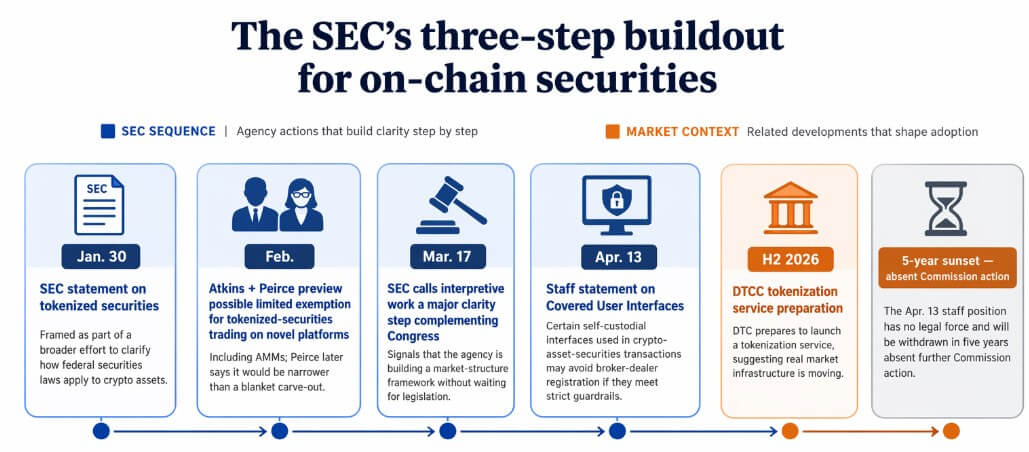
A six-panel timeline charts the SEC’s on-chain securities buildout from January’s tokenized-securities statement through April 13’s Covered User Interfaces release, ending at the five-year sunset.

Two futures for product design

The bull case runs through the narrower exemption arriving before the legislative window closes.

If the SEC follows the Apr. 13 neutral interface statement with a bounded AMM pilot that caps, allowlists, and governs on-chain tokenized securities trading along the lines Atkins described, on-chain tokenized securities trading becomes operational inside a bounded regulatory box.

Builders who designed their interfaces around the neutral software standard would have infrastructure in place when the exemption lands. The payoff is an on-chain securities stack that is functional, if constrained, before Congress finalizes a broader statute.

The bear case is product paralysis at the product edge. Because the statement carries no legal force, creates no enforceable rights, and expires in five years absent Commission action, counsel at cautious organizations may treat the Apr. 13 lane as too fragile for anything ambitious. Interfaces stay informational or routing-light.

Serious tokenized securities trading concentrates in incumbent-led, permissioned pilots, such as DTCC’s tokenization service, large-bank programs, and similar structures built around registered entities, while the product architectures the statement aimed to enable get deferred indefinitely.

The congressional variable

The document’s own disclaimer conveys the fragility as staff views only, without legal force or effect, and short of the Commission’s action that would give it durability.

Senate Banking announced a crypto market structure markup in January and postponed it as bipartisan talks continued. As of Apr. 15, no new public markup date appears in committee materials.

Treasury Secretary Scott Bessent urged Congress to pass the CLARITY Act on Apr. 9.

All three data points converge on the same conclusion: only a statute can keep a lane open established by the SEC.

Galaxy Research and the Blockchain Association pressed the SEC on Apr. 14 for conditional AMM relief, while SIFMA argued new on-chain trading structures should proceed under durable rulemaking with comparable investor-protection standards.

That three-way split between agency staff, crypto-native industry, and incumbent financial infrastructure is precisely the configuration that makes Congressional resolution necessary and politically difficult.

Chairman Atkins has consistently framed Project Crypto as a complement to legislative work. The Apr. 13 statement is the clearest expression of that posture, being real enough to build around now, and contingent enough to require something more durable.

Share. Facebook Twitter Pinterest LinkedIn Tumblr Email
NBTC

NBTC is the editorial account for NBTC News, covering Bitcoin, Ethereum, DeFi, blockchain infrastructure, exchanges, mining, regulation and digital asset markets. The editorial team focuses on clear sourcing, timely updates and practical context for crypto readers.

Related Posts

VARA Highlights Shift Towards Practical Implementation in Virtual Asset Regulation

07/08/2026

‘Law Enforcement Wants CLARITY Passed,’ Coinbase’s CLO Asks if Senate Wants the Same

07/08/2026

Is Vietnam’s new crypto framework the first step towards a ban?

06/08/2026

Massachusetts Senate targets crypto ATMs after $6.8M in losses

06/08/2026
Add A Comment

Comments are closed.

Top Posts
Get Informed

Subscribe to Updates

Get the latest news from NBTC regarding crypto, blockchains and web3 related topics.

Your source for the serious news. This website is crafted specifically to for crazy and hot cryptonews. Visit our main page for more tons of news.

We're social. Connect with us:

Facebook X (Twitter) LinkedIn RSS
Top Insights

ether.fi Removes Restaking From weETH, Nearing A Full EigenLayer Exit

07/08/2026

Flare makes XRPFi accessible in a single signature with smart accounts v1.3

07/08/2026

VARA Highlights Shift Towards Practical Implementation in Virtual Asset Regulation

07/08/2026
Get Informed

Subscribe to Updates

Get the latest news from NBTC regarding crypto, blockchains and web3 related topics.

Type above and press Enter to search. Press Esc to cancel.