

JPMorgan Chase CEO Jamie Dimon told analysts in April that the roughly $1.8 trillion private credit market doesn’t pose a systemic risk. “You have to have very large losses in private credit before, at least it looks like, banks are going to get hit,” he said.
He made that comment the same week executives at Citigroup, Bank of America, and Wells Fargo used nearly identical language to describe their own exposures as “comfortable.”
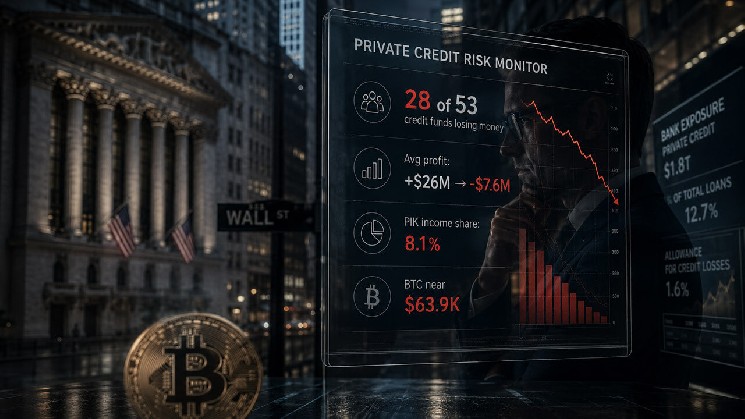
But a Reuters analysis of 53 publicly traded business development companies found that 28 had swung into the red during the first quarter of 2026. Average profit collapsed from positive $26 million a year earlier to negative $7.6 million.
The visible losses may be only the first layer of a funding structure that runs from stressed borrowers through leveraged lenders and back onto the balance sheets of the very banks insisting the danger is contained.
BDC losses, phantom income, and the leverage banks don’t see
Business-development companies, or BDCs, are essentially publicly traded private credit funds. They lend money to mid-sized companies that can’t easily get bank loans, and they pass most of their income back to shareholders as dividends.
Reuters conducted the analysis with S&P Global Market Intelligence, examining standardized financials across 53 of them. Twenty-eight were loss-making in the first quarter of 2026, up from just 12 one year earlier. Average profit fell to negative $7.6 million from positive $26 million, a shift driven largely by loan markdowns and rising borrowing costs.
BDCs often emphasize net investment income in their own reporting, but the standardized approach captures debt expenses and changes in loan valuations that managers sometimes obscure beneath adjusted metrics. It’s a gap that can mislead anyone relying on headline figures alone. When a BDC says it’s earning steady income, it might not be counting the loans that are steadily losing value on its books.
Not all of that income was cash. Payment-in-kind, or PIK, is a way borrowers can add interest to their debt balances rather than pay it in cash. It preserves liquidity today while increasing the amount owed tomorrow.
PIK accounted for an average of 8.1% of BDC interest and dividend income in 2025, roughly twice its pre-2020 share. That doesn’t prove losses are imminent, but it weakens the comfort supplied by headline income figures. A borrower paying in kind is one who can’t pay in cash, and this distinction becomes important when credit conditions tighten. If your tenant keeps saying they’ll pay you next month, you can only believe that for so long.
At the 14 BDCs with complete joint-venture disclosures, off-balance-sheet borrowing increased 80% during 2025 and another 14% in the first quarter of 2026.
Joint ventures and special-purpose structures are legal financing arrangements, yet their effect is to move debt outside the headline balance sheet where casual observers, and sometimes regulators, might miss it.
The Financial Stability Board has warned that hidden or layered leverage can amplify losses when the cycle turns, and private credit remains untested at its current scale through a prolonged downturn. What looks like a modest leverage ratio on paper can expand quickly once these side vehicles are included. Think of it as a credit card opened in your spouse’s name; the debt is there, it just doesn’t show up on your personal statement.
Every dollar of that borrowing traces back to banks. JPMorgan, Citigroup, Bank of America, and Wells Fargo together hold more than $128 billion in exposure to private credit loans, according to their first-quarter earnings presentations. JPMorgan alone carries roughly $50 billion, while Wells Fargo’s “financials except banks” portfolio totals $210.2 billion, including $36.2 billion in direct private credit exposure.
Earlier disclosures from three major US banks had put private-credit-related financing exposure at roughly $108 billion. The FSB’s available member data capture approximately $220 billion in drawn and undrawn bank lines to private credit lenders across member jurisdictions, though commercial estimates run higher.
The Boston Fed has found that banks have become a key source of funding and liquidity for private-credit lenders through subscription facilities, revolving credit lines, net asset value loans, and warehouse financing. In plain English: banks lend money to BDCs, which then lend it to companies. The risk doesn’t stay in the private market; it loops right back to Wall Street.
Why Bitcoin needs to watch the credit squeeze
The biggest question we have to ask now is whether private credit sits outside the banking system or is financed by it.
Banks say their exposures are small relative to total assets, that many funds use locked-up capital, and that loans don’t face daily mark-to-market pressure. Those defenses have merit so far.
Losses have so far been absorbed without broad market disruption, and institutional capital, which comprises roughly 80% of the investor base, is less redemption-sensitive than retail money. The structure of the market, with its long-dated institutional commitments and absence of daily pricing, does provide a buffer against panic. You can’t have a bank run if nobody can withdraw their money on demand.
But the credit-supply signal is flashing anyway. Direct-lending volume in the US fell approximately 55% quarter over quarter, from $74.67 billion to $33.59 billion, even as North American funds raised $16.25 billion. Private debt issuance totaled roughly $87.2 billion through May 2026, down about 24.6% compared with the same period in 2025.
That suggests managers could be conserving capital, becoming more selective, or supporting stressed existing loans rather than expanding lending.
Investors seem to have noticed the strain. They requested more than $20.8 billion in redemptions from the largest semi-liquid private credit funds in the first quarter alone, and managers honored barely half of those requests while capping withdrawals at 5% of net asset value for many vehicles.
The queue isn’t clearing; it’s getting longer. When you tell investors they can only take out a fraction of what they asked for, word gets around.
Weakness in private credit doesn’t directly determine Bitcoin‘s price, but the two are connected. If bank funding lines tighten, private lenders originate fewer loans, corporate financing and buyout activity contract, and investors reduce leverage and raise cash. The resulting drain on dollar liquidity and risk appetite can quickly reach Bitcoin and other risk assets.
The link becomes much stronger if bank shares, BDC shares, and BTC fall together after a major disclosure or default. Bitcoin traded near $63,900 on July 17, down roughly 38% from a year earlier, following rising stress across credit markets.
Traders in the crypto market have begun watching BDC share prices and bank earnings as closely as they watch the Federal Reserve. When credit freezes up, everything risky gets sold at the same time, and Bitcoin is rarely an exception.
Several observable signals would escalate this concern into something systemic. A major bank materially increasing loss provisions tied to the sector would be one. A large fund suspending rather than capping withdrawals would be another. So would multiple lenders marking the same loan at drastically different values, or bank credit lines being reduced or not renewed.
A private-credit default that reaches an insurer, bank, or pension investor would remove any doubt. Direct-lending volume continuing to collapse despite strong fundraising would confirm that capital is retreating from the real economy rather than merely rotating.
Wall Street’s argument that private-credit stress is too small and dispersed to threaten the financial system rests on the assumption that exposures remain measurable and contained. Regulators say the true connections remain difficult to measure. The contradiction between Dimon’s confidence and the BDC losses now piling up is that the system looks stable until the moment funding lines snap shut.
By then, the losses have already traveled from borrower to lender to bank, and the only question left is who gets left holding them.
