

Life embodies evolution, change, adaptation, and the willingness to thrive. Throughout history, we have experienced numerous changes that have forced society to evolve, adapt, and grow. From the inception of trading to the COVID-19 pandemic and beyond, we have witnessed events that have transformed the world. One of the most important and influential sectors in the world is finance. The world of finance has been shaped by pivotal events that have impacted economies, influenced policies, and altered the course of global markets. One of the most exceptional developments in the past 15 years is the invention of Bitcoin and the emergence of the crypto industry.
The crypto industry, while not yet accessible to everyone, has witnessed remarkable growth and evolution since Bitcoin’s launch in 2009. In the following years, the industry became a dynamic and influential force, drawing the attention of investors and enthusiasts worldwide. In this article, I will share my opinion on why crypto will become a very stable market, potentially replacing current financial or banking methods. This discussion will touch on key topics such as safety, circular economy, and sustainability, which combined with current high potential businesses like Data Centers, will shape the new future.
Crypto Infrastructure and Energy Consumption
The servers supporting the cryptocurrency infrastructure are primarily used for cryptocurrency mining, transaction verification, smart contract execution, and decentralized applications (DApps) hosting. These servers typically possess the following specifications:
• High-performance CPUs and GPUs
• Large memory and storage capacity
• Advanced networking capabilities
• Robust security features
These characteristics translate into expensive, high-power consumption servers. Therefore, we need a robust and reliable space to store these servers and ensure they function as expected.
Energy Consumption
Data transmission currently consumes nearly 3% of the total electricity used worldwide. To ensure data is not only transmitted correctly but also stored and processed properly, we rely on physical spaces known as data centers. These data centers are considered mission-critical facilities. But why are data centers deemed mission-critical? Mission-critical facilities are broadly defined as operations that, if interrupted, would negatively impact business activities, ranging from revenue loss and legal non-compliance to, in extreme cases, loss of life. Data centers, hospitals, laboratories, and military installations are just a few examples of such facilities.
Data center facilities are highly regulated by various organizations and standards for both physical and data infrastructure. This stringent regulation is crucial because data loss can result in massive consequences for millions of people, given the sensitivity of the stored information. Gradually, the
blockchain industry along with emerging markets like AI (Artificial Intelligence) is playing an increasingly significant role in the modern world. The demand for distributed facilities to store nodes that validate crypto transactions and execute smart contracts is rising significantly.
Are current Data Centers ready for Blockchain technology?
Blockchain presents challenges not only for Mechanical, Electrical, and Plumbing (MEP) infrastructure but also for enterprise infrastructure. To accommodate the demanding workloads
associated with blockchain technology, facilities will need to enhance both infrastructure security and MEP capabilities. Currently, the average power density in a data center is around 10 kW per rack. For context, according to several reports, the average power consumed by a home in the United States that
uses electricity for heating and hot water is approximately 10,715 kWh per year. A single rack in a data center, by comparison, consumes nearly 9 times more power per year (8,760 kWh per year), with some facilities designed to provide peak power above 100 MW.
Constructing these facilities requires significant investment, and sometimes the efficiency of the facility is not as desired, leading to higher costs for data management. One issue with current data centers is partial loads, meaning that if the facility consumes determined amount of Watts, the original design was for 1.5 times those Watts. This results in lower performance and efficiency. The closer the facility’s consumption is to its designed energy consumption, the easier it is to improve and control overall efficiency.
The key difference between blockchain and traditional data computation is decentralization. In a decentralized system, the failure of a single node does not impact the performance of the entire digital infrastructure, whereas in traditional systems, a node failure can cause significant and irreversible damage to many businesses. This necessity for high reliability and redundancy explains why data centers typically have high initial costs (CAPEX), with multiple layers of security to ensure continued operation even in the event of equipment failure.
However, the decentralization inherent in blockchain technology offers a distinct advantage: it reduces the need for expensive and redundant facilities to accommodate all crypto servers, as the failure of some nodes does not disrupt the entire system. This raises an important question: what is the solution to integrating traditional data transmission methods with new blockchain technology?
Combining current needs with new Crypto needs
In the data center industry, the terminology of “Tiers” as defined by the Uptime Institute is widely used and accepted globally. This classification system is similar to the levels of redundancy specified by TIA or BICSI standards. While those familiar with the data center market are well-versed in these Tiers, here is an explanation for crypto users who may be new to this terminology: There are four Tiers, each representing a different level of redundancy in a facility:
1. Tier I: No redundancy.
2. Tier II: Redundancy.
3. Tier III: Concurrently maintainable.
4. Tier IV: Fault-tolerant.
These Tiers also correlate with the initial investment required to create the facility. Moving from one Tier to the next typically involves doubling the capital expenditure (CAPEX). Most data centers are ranked as Tier III, indicating they are designed to be concurrently maintainable. This ensures the facility can be kept in optimal condition to prevent failures at any time. It is crucial to note that some IT equipment hosted in a data center is essential for the daily operations of our lives; even traffic lights rely on these services.
For blockchain infrastructure, there is no need to significantly increase CAPEX to ensure the proper operation of the equipment. It is essential to accommodate the servers in an environment where they function correctly with minimal downtime. Since the loss of individual servers does not affect the functionality of the entire blockchain, these operations do not require high availability. Although downtime can affect users earning revenue from transaction validation, it is crucial to evaluate whether the cost of reducing downtime justifies the increased CAPEX.
Therefore, the Tier level of these facilities can be reduced. In some areas of the data center that are not critical to powering the crypto nodes, the Tier can be lowered to Tier II or even Tier I. This approach optimizes resources without compromising the overall blockchain infrastructure.
Crypto Mining as a Single Business?
To support our previous discussions and to foster new ones, consider the following data: Following the Bitcoin halving on April 20, 2024, the return on investment (ROI) per miner has decreased by 50%, irrespective of variations in total hashrate or Bitcoin price. This reduction tightens the overall financial outlook. For instance, a miner costing $2,000, producing 120 TH/s, and requiring no additional capital expenditures (CAPEX) beyond the miner itself, now faces this ROI decrease.
For an installation comprising 100 miners, the total CAPEX investment for the entire facility (including land for one container, MEP infrastructure, and miners) is estimated at around $503,000. The following analysis illustrates the approximate ROI over the next four years (until the next halving) for a facility operating 100 miners, each consuming 3.3 kW and with a price per kilowatt hour equal to 0.08$. To try to make it more accurate, this analysis assumes the hashrate increases by 50% annually, and uses traditional air cooling solutions. The projected future Bitcoin price used in this analysis is $250,000, based on various studies and speculations.
The projected ROI over the next four years, considering a future Bitcoin price of $300,000, shows that crypto mining alone might not be a highly profitable business. This raises the question of why companies continue to invest in crypto mining. The answer is speculation. In bullish times, crypto facilities were highly profitable, but now these facilities need additional revenue streams.
Heat Reuse: A Disruptive Side Hustle
One innovative side hustle is converting these facilities into heating power facilities. Most power consumed by miners/servers is converted into heat. What if we could capture that heat and sell it as energy? For example, selling this energy to a nearby farm for greenhouses at $0.03/kWh makes the business model more viable. Considering a supposed extra investment of $750,000 (please bear in mind that the extra investment has to be calculated according to facility limitations and in this case a ball park number was taken into account for the exercise).
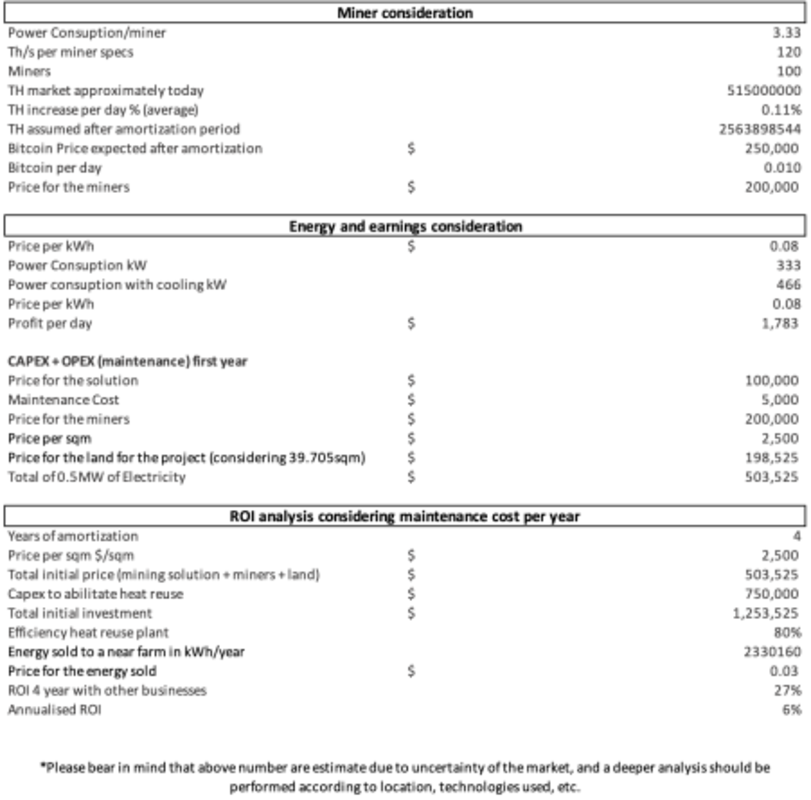
Upon initial analysis, the business model appears to be viable. The integration of a heat reuse side business has effectively doubled the return on investment (ROI). It is important to note that the ROI calculation is based on a four-year period, coinciding with the next Bitcoin halving event. While the facilities may no longer be optimal for the same cryptocurrency operations post-halving, the infrastructure will remain valuable for selling the generated heat.
Moreover, if we consider combining this model with the data center market, the ROI extends beyond the next four years. This represents a long-term investment where the efficient use of electricity could become increasingly significant.
Conclusion
The crypto industry is gaining more importance in our lives. Several companies are adding stablecoins to their portfolios as financial assets, and new technologies are emerging on the blockchain that will require specialized facilities like current data centers (like BlockDAG architecture, Ordinals/NFTs, BRC20 and, most importantly, Runes).
We are at the beginning of a market that will stay and change the current scenario. Combining legacy data centers with crypto-specific areas to facilitate additional businesses like heat reuse is likely just a matter of time, a run to become sustainable. Those who lead this transformation will be the ones to benefit the most.
This is a guest post by Jose Farrona. Opinions expressed are entirely their own and do not necessarily reflect those of BTC Inc or Bitcoin Magazine.
