
Close Menu
  • Coins
    • Bitcoin
    • Ethereum
    • Altcoins
    • NFT
  • Blockchain
  • DeFi
  • Metaverse
  • Regulation
  • Other
    • Exchanges
    • ICO
    • GameFi
    • Mining
    • Legal
  • MarketCap
What's Hot

How Does World Liberty Financial’s USD1 Stablecoin Work And Who Is It Built For?

28/06/2026

US Treasury targets Huione workaround as FinCEN moves against H-Pay in crypto scam crackdown

28/06/2026

CZ, Binance founder, wants to clear up ‘misunderstandings’ about who he is

28/06/2026
Facebook X (Twitter) Instagram
  • Back to NBTC homepage
  • Privacy Policy
  • Contact
X (Twitter) Telegram Facebook LinkedIn RSS
NBTC News
  • Coins
    1. Bitcoin
    2. Ethereum
    3. Altcoins
    4. NFT
    5. View All

    Metaplanet Bleeds 87%, But Triples Bitcoin Stack in ‘Gift’ Valuation

    28/06/2026

    Michael Saylor Reveals Why Strategy Is Not Changing Course on Bitcoin

    28/06/2026

    Is Bitcoin’s Four-Year Cycle Still Intact, or Is It a Thing of the Past?

    28/06/2026

    Bitcoin’s fall to $60K changes things, but what does the data say?

    28/06/2026

    Extreme Fear at 17, one breakdown from $1,500

    28/06/2026

    BitMine wants 5% of all Ethereum. What if treasuries corner ETH?

    28/06/2026

    $1,460 Drop or $4,850 Rally?

    28/06/2026

    Why whales are buying Ethereum’s dip despite weak price action and ETF outflows

    28/06/2026

    How Does World Liberty Financial’s USD1 Stablecoin Work And Who Is It Built For?

    28/06/2026

    A Web Without Big Tech Gatekeepers

    28/06/2026

    Monad Introduces Unlink, a Privacy Infrastructure for Confidential On-Chain Transactions

    28/06/2026

    Did Ryan Fugger Create XRP? Ripple CTO Emeritus David Schwartz Ends Speculation

    28/06/2026

    Element NFT Marketplace Expands Reach to Ink to Enhance NFT Accessibility

    27/06/2026

    Why is Pudgy Penguins (PENGU) Trending? What You Need to Know

    22/06/2026

    Top 10 NFT Performers by Trading Volume, Courtyard Outshines

    22/06/2026

    Pudgy Penguins expands retail footprint with Target trading card rollout

    20/06/2026

    How Does World Liberty Financial’s USD1 Stablecoin Work And Who Is It Built For?

    28/06/2026

    US Treasury targets Huione workaround as FinCEN moves against H-Pay in crypto scam crackdown

    28/06/2026

    CZ, Binance founder, wants to clear up ‘misunderstandings’ about who he is

    28/06/2026

    Metaplanet Bleeds 87%, But Triples Bitcoin Stack in ‘Gift’ Valuation

    28/06/2026
  • Blockchain

    Continental Partners With Securitize for Digital Securities

    27/06/2026

    Funton.ai Partners with Echobit Exchange, Expanding Blockchain Gaming Experience with Crypto Applications

    27/06/2026

    B.AI Taps imToken for Seamless TRON Top-Ups and Usage of AI Models for Web3 Users

    27/06/2026

    CertiK joins XDC Network as institutional masternode validator

    27/06/2026

    What is a modular blockchain? Rollups, data availability, and the new stack

    27/06/2026
  • DeFi

    Aave Advances Automated AAVE Buyback Overhaul With Aavenomics 3.0

    28/06/2026

    What Is Wrapped Bitcoin? How WBTC brings BTC to Ethereum and DeFi

    28/06/2026

    Developers Halt New Token Issuance for an Altcoin: Price Rises in Response

    28/06/2026

    Global Financial Giants Standard Chartered and Grayscale Announce 2030 Price Prediction for Popular DeFi Project!

    27/06/2026

    Can the AAVE Token Really Hit $3,500?

    26/06/2026
  • Metaverse

    Is Solana Gaming Back? Kintara Activity Fuels Renewed Optimism in Onchain MMOs

    24/06/2026

    The Sandbox launches AI game engine ‘The Sandbox Studio’ for next-generation creators

    10/06/2026

    Meta commits $13M in funding for Oversight Board through 2028

    29/05/2026

    Why Animoca’s Yat Siu says the future is 100 billion AI agents

    07/05/2026

    ‘8,000 Jobs’—Polymarket Sees Tech Layoff Surge As Meta AI Push Bites

    18/04/2026
  • Regulation

    Stablecoins are becoming a central bank problem hiding in T-bill markets

    28/06/2026

    Crypto Project Shutdowns Surge Past 60 in 2026 as a16z-Backed Names Top the List

    28/06/2026

    Polymarket Traders Wager on Strategy’s STRC Reclaiming Par as Critics Call It a ‘Junk Bond’

    28/06/2026

    ARK-backed Solmate crashes 98% as board faces self-dealing lawsuit

    28/06/2026

    Chief Economist and Analyst Says, “The Fed Won’t Raise Interest Rates This Year,” and Explains Why

    28/06/2026
  • Other
    1. Exchanges
    2. ICO
    3. GameFi
    4. Mining
    5. Legal
    6. View All

    CZ, Binance founder, wants to clear up ‘misunderstandings’ about who he is

    28/06/2026

    Binance Alpha Adds Arcium (ARX) to Its Listing Roster

    28/06/2026

    Bybit Opens Walled AI Trading Accounts as Agent Wave Hits Crypto Exchanges

    28/06/2026

    SBI Slashes XRP/JPY Spread by 78% to Boost XRP Leverage Activity

    28/06/2026

    ICO market slows sharply with only six completions in 2026

    30/04/2026

    South Korea Poised to Lift Ban on Domestic ICOs After 7 Years

    19/12/2025

    Why 2025’s Token Boom Looks Both Familiar and Dangerous

    31/10/2025

    ICO for bitcoin yield farming chain Corn screams we’re so back

    22/01/2025

    Nexus Acquires Homegrown App Marketplace One Store, Expanding into Global Web3 Game Hub

    21/06/2026

    GMATRIXS and Plum Protocol Partner to Blend GameFi with Meme Assets, Driving Multi-Chain Web3 User Experience

    16/06/2026

    Crypto game studio Uncharted to shutdown along with Fishing Frenzy

    15/06/2026

    Pudgy Penguins Halts Web3 Mobile Game Pudgy Party to Focus on Pudgy World

    14/06/2026

    Russia Plans Wider Crypto Mining Ban Across Key Regions From July

    28/06/2026

    Bitdeer Sells Entire Weekly Bitcoin Production, Now Holds Zero BTC

    28/06/2026

    Miners Absorb 18% Hashprice Crash as Bitcoin Difficulty Jumps 7.15%

    28/06/2026

    Bitcoin’s broken production cost floor is splitting miners into survivors and sellers

    28/06/2026

    US Treasury targets Huione workaround as FinCEN moves against H-Pay in crypto scam crackdown

    28/06/2026

    Crypto isn’t the problem with the US economy, says senator

    28/06/2026

    Michael Selig draws line between crypto perps and corn futures

    28/06/2026

    Don’t Claim It Is The Wild Wild West, When There’s No Sheriff

    28/06/2026

    How Does World Liberty Financial’s USD1 Stablecoin Work And Who Is It Built For?

    28/06/2026

    US Treasury targets Huione workaround as FinCEN moves against H-Pay in crypto scam crackdown

    28/06/2026

    CZ, Binance founder, wants to clear up ‘misunderstandings’ about who he is

    28/06/2026

    Metaplanet Bleeds 87%, But Triples Bitcoin Stack in ‘Gift’ Valuation

    28/06/2026
  • MarketCap
NBTC News
Home»Regulation»Stablecoins are becoming a central bank problem hiding in T-bill markets
Regulation

Stablecoins are becoming a central bank problem hiding in T-bill markets

NBTCBy NBTC28/06/2026No Comments7 Mins Read
Share
Facebook Twitter LinkedIn Pinterest Email


Stablecoin flows have crossed from crypto liquidity into the market map central banks use to track dollar funding.

The Bank for International Settlements, in its June 23 Annual Economic Report chapter on innovation beyond stablecoins, argued that private dollar tokens still fall short of the core tests of money. The same official-sector push now sits alongside a working paper estimate that a $3.5 billion, five-day stablecoin inflow can move three-month Treasury bill yields by about four basis points within 10 days.

The consequence is practical. Stablecoins are becoming a measurable channel between on-chain dollar demand and the front end of sovereign debt markets.

For crypto, stablecoin growth now carries a funding-market signal. For central banks, reserve management, redemption behavior, and tokenized settlement design sit inside the same policy conversation.

The money tests behind the market risk

The BIS chapter starts from a basic monetary test. Money works because users can treat one unit as equal to another, because the system can supply liquidity when payments need to settle, and because the network can control financial crime and preserve trust.

Stablecoins can move fast and can be programmed into public blockchains. BIS acknowledges that utility. Its argument is that current arrangements lack the institutional support needed for bank deposits and central bank money to function as no-questions-asked settlement assets.

In the BIS framework, the weak points are singleness, liquidity elasticity, and integrity. Stablecoins may trade near par most of the time, but they lack the same access to central bank settlement or system-wide liquidity backstops. They can also fragment across chains and venues, making interoperability and financial integrity harder to enforce at scale.

Adoption changes the policy question. A stablecoin used primarily as a crypto quote asset is another. A stablecoin that becomes a large reserve-backed dollar instrument held across exchanges, wallets, and offshore markets is another.

The issuer then has to decide where reserves are held, how redemptions are met, and which assets are bought or sold as demand changes.

The clearest number comes from the BIS working paper on stablecoins and safe asset prices. The paper estimates that a $3.5 billion aggregate stablecoin inflow, about two standard deviations in its sample, lowers three-month Treasury bill yields by roughly 0.71 basis points on impact and up to four basis points within 10 days.

The paper frames the effect as sample-specific rather than a rule for every stablecoin flow. It uses daily data from January 2021 to March 2026, local projections, and an instrument designed to isolate shocks to stablecoin flows.

It also says the estimate is strongest in the maturity bucket where issuers are most likely to hold reserves, and that effects are amplified when Treasury-market intermediaries are under stress or as the stablecoin sector grows.

That is the policy signal in the evidence. A four-basis-point move in a single short-rate instrument is small in isolation. It is still a sign that stablecoin issuers have become large enough for their reserve allocation to show up in the market used to price safe dollar liquidity.

The companion BIS paper on making stablecoins stable(r) adds the other side of the same mechanism. Large redemptions can force issuers to lean on cash buffers or sell short-dated bonds.

The paper models how liquidity and capital thresholds can reduce default and spillover risks when they work as usable buffers, while rigid rules can also push issuers into bond sales too early during stress.
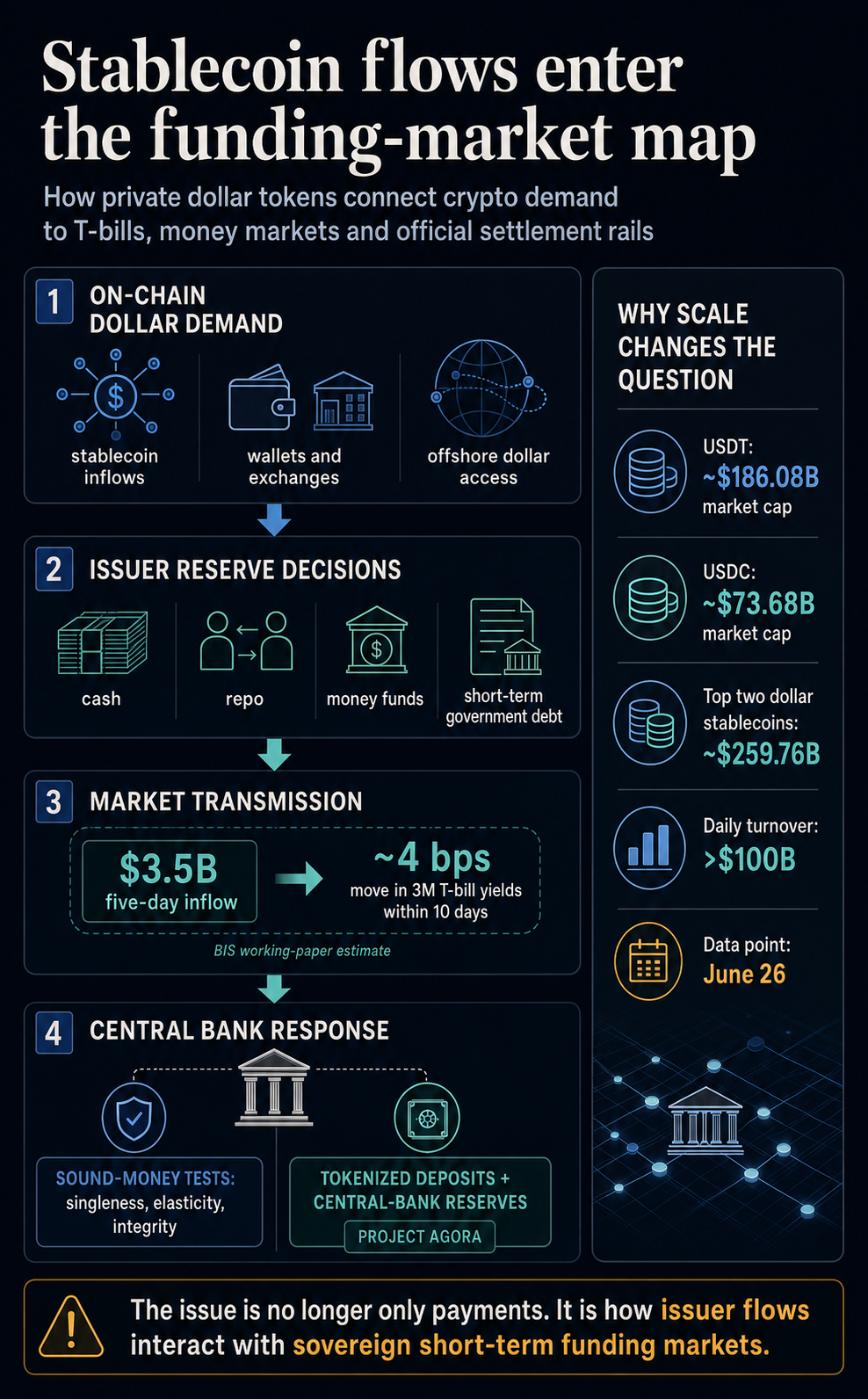
Separate BIS research on stablecoin flows and FX markets extends the point beyond T-bills. It finds that shocks to net stablecoin inflows can widen deviations from stablecoin-dollar parity, affect local currency values, and change short-term dollar funding premiums.

The finding stops short of turning every stablecoin transfer into a macro event. It shows why central banks are studying these flows as part of dollar and FX plumbing.

Scale makes the spillover question harder to ignore

CryptoSlate market data on June 26 showed Tether with a market capitalization of about $186.08 billion and a 24-hour trading volume of about $84.95 billion. USDC stood at a market cap of nearly $73.68 billion and a daily trading volume of $15.54 billion.
Together, the two largest dollar-stablecoins represented roughly $259.76 billion in market value and more than $100 billion in daily trading volume. Stablecoins remain far smaller than the Treasury market, but their reserve portfolios are concentrated in cash, repo, money funds, and short-duration government debt.

The US and European policy backdrop helps explain why the reserve question is arriving now. The White House framed the GENIUS Act around 100% liquid backing, monthly reserve disclosures, and the idea that regulated stablecoins could support demand for Treasuries and the dollar.

That is a policy claim, rather than a market certainty, but it explains why reserve composition has become central.

Europe is asking a similar question from the other side. The European Commission opened a 2026 review of MiCA’s crypto-asset framework, including asset-referenced and e-money tokens.

The ECB has also argued that stablecoins have moved to the center of the policy debate as dollar-denominated tokens raise questions about monetary sovereignty and sovereign bond demand.

The live issue is the kind of financial institution issuers become once regulation pushes them toward specific reserve assets, disclosures, redemption rules, and supervisory reporting.

That policy mix leaves central banks with a harder task than approving or rejecting a product category. Reserve rules can improve disclosure, liquidity discipline, and redemption confidence, yet they can also make issuer portfolios easier to read as large funding-market positions.

A regulated stablecoin issuer that buys bills in size during growth and sells or runs down liquid assets during stress is more than a payment company in market terms. It is also a balance sheet whose flows can interact with the instruments used to transmit dollar liquidity.

Tokenized bank money is the official alternative

The chapter’s preferred path is to integrate tokenized finance into the existing two-tier monetary system, in which central bank money anchors settlement and regulated private institutions provide services to users.

That is where Project Agora fits. The BIS Innovation Hub project brings together central banks and more than 40 regulated financial institutions to test wholesale cross-border payments using tokenized commercial bank deposits and tokenized central bank reserves on a shared platform.

In a May 27 announcement, BIS said the project has already shown that atomic multi-currency settlement can be executed using tokenized deposits and central bank reserves while preserving the legal character of those instruments.

The next phase is intended to move toward real-value testing.

That is the institutional answer to the stablecoin question. Private stablecoins have shown that users want programmable dollar instruments that move across digital venues. Central banks are now testing whether the same functions can be delivered through tokenized deposits and central bank settlement assets without losing the safeguards that make money work under stress.

For crypto markets, the consequence reaches beyond tighter stablecoin regulation. If issuers are large reserve managers, then inflows, redemptions, and asset allocation become funding-market signals.

If tokenized deposits gain traction, stablecoins face competition from a model that offers programmability without leaving the banking and central-bank settlement perimeter.

The next thing to watch is whether stablecoin growth comes mainly from new offshore demand for digital dollars or from balances that would otherwise sit in banks and money funds.

The first path could deepen demand for short-end dollar assets while extending the dollar’s reach. The second could make redemptions, reserve sales, and bank-funding shifts more important in stress.

Either way, the debate has moved. Stablecoins are still payment tokens for users and liquidity rails for crypto venues. They are also becoming part of the machinery through which dollar demand reaches sovereign debt markets.

That is why central banks are treating them as more than crypto plumbing.

Share. Facebook Twitter Pinterest LinkedIn Tumblr Email
NBTC

NBTC is the editorial account for NBTC News, covering Bitcoin, Ethereum, DeFi, blockchain infrastructure, exchanges, mining, regulation and digital asset markets. The editorial team focuses on clear sourcing, timely updates and practical context for crypto readers.

Related Posts

Crypto Project Shutdowns Surge Past 60 in 2026 as a16z-Backed Names Top the List

28/06/2026

Polymarket Traders Wager on Strategy’s STRC Reclaiming Par as Critics Call It a ‘Junk Bond’

28/06/2026

ARK-backed Solmate crashes 98% as board faces self-dealing lawsuit

28/06/2026

Chief Economist and Analyst Says, “The Fed Won’t Raise Interest Rates This Year,” and Explains Why

28/06/2026
Add A Comment

Comments are closed.

Top Posts
Get Informed

Subscribe to Updates

Get the latest news from NBTC regarding crypto, blockchains and web3 related topics.

Your source for the serious news. This website is crafted specifically to for crazy and hot cryptonews. Visit our main page for more tons of news.

We're social. Connect with us:

Facebook X (Twitter) LinkedIn RSS
Top Insights

How Does World Liberty Financial’s USD1 Stablecoin Work And Who Is It Built For?

28/06/2026

US Treasury targets Huione workaround as FinCEN moves against H-Pay in crypto scam crackdown

28/06/2026

CZ, Binance founder, wants to clear up ‘misunderstandings’ about who he is

28/06/2026
Get Informed

Subscribe to Updates

Get the latest news from NBTC regarding crypto, blockchains and web3 related topics.

Type above and press Enter to search. Press Esc to cancel.