

For a coin with a large market capitalization, such a quick reaction is a direct economic effect of opening a cheaper trading route: the average fee on Solana is just 0.000005 SOL, making frequent transactions profitable for retail traders. The supply of the original ERC-20 token remains unchanged.
The domino effect, but with frogs and dogs
Sunrise’s technological solutions had already demonstrated their effectiveness two weeks earlier. The launch of the canonical $PEPE bridge on Solana on September 18 showed how cross-chain integration can give tokens lasting market momentum. In the first 48 hours after the integration, $PEPE rose by 5–8%, breaking out of the 0.0000036–0.0000038 range.
A subsequent short squeeze liquidated more than $2 million in short positions. At the rally’s peak on September 21–22, $PEPE reached 0.0000051–0.0000054, gaining as much as 40% since the start of the month and pushing its market capitalization back above $2 billion.
Despite the natural October correction to the 0.0000043–0.0000045 range, $PEPE remains well above its pre-listing levels.
Sunrise’s successful cases set a precedent for systematic capital inflows. Canonical tokens deployed under the Wormhole NTT standard receive immediate, seamless integration with key Solana platforms: the Jupiter aggregator, Raydium DEX, Phantom wallets, and the Kamino DeFi protocol.
card
The arrival of major tokens with established communities of millions leads to a natural redistribution of Solana’s trading volume, crowding out native projects on the host blockchain. BONK is one example: its volume declined after it was delisted from several Asian exchanges.
The $SHIB community succinctly described the move as opening a “second front,” backing it with the official slogan: “Different chain. Same dog.”
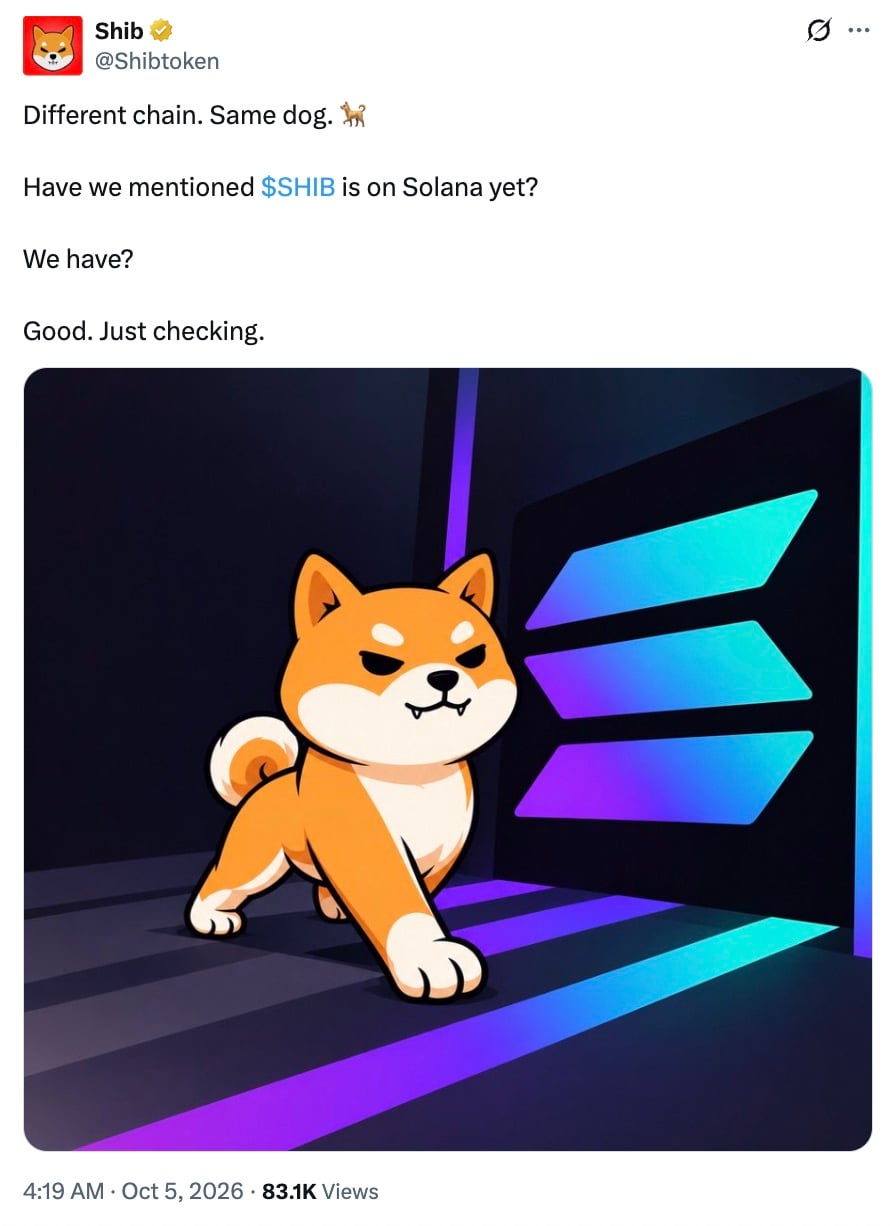
Fake pools flooded Solana’s decentralized exchanges amid the excitement. The developers remind users that the only verified address for the canonical smart contract (CA) is shib5gSoVKPjwkXrxRk7SbQFzb2R9rQB3TgQWYX4RwW.
