

Close Menu
  • Coins
    • Bitcoin
    • Ethereum
    • Altcoins
    • NFT
  • Blockchain
  • DeFi
  • Metaverse
  • Regulation
  • Other
    • Exchanges
    • ICO
    • GameFi
    • Mining
    • Legal
  • MarketCap
What's Hot

Bitcoin Is in a Fight at $60K—Here’s What the Charts Say

04/07/2026

F2Pool Co-Founder Wang Chun Deposits $30.5M in ETH and WBTC to Binance Amid Broader $220M Withdrawal Pattern

04/07/2026

USDC and USDT Supply Both Contracted This Week as Stablecoin Bills Dominate Headlines

04/07/2026
Facebook X (Twitter) Instagram
  • Back to NBTC homepage
  • Privacy Policy
  • Contact
X (Twitter) Telegram Facebook LinkedIn RSS
NBTC News
  • Coins
    1. Bitcoin
    2. Ethereum
    3. Altcoins
    4. NFT
    5. View All

    Bitcoin Is in a Fight at $60K—Here’s What the Charts Say

    04/07/2026

    El Salvador Says It Is Buying Bitcoin Daily, But IMF Disagrees

    04/07/2026

    Death Spiral? Schiff Says Falling BTC Will Force Strategy to Sell More

    04/07/2026

    Experienced Analyst Claims to Have Detected a Bullish Signal for Bitcoin, Ethereum, XRP, and Solana

    04/07/2026

    F2Pool Co-Founder Wang Chun Deposits $30.5M in ETH and WBTC to Binance Amid Broader $220M Withdrawal Pattern

    04/07/2026

    Ethereum price targets $1,800 after rare TD buy signal

    04/07/2026

    Is Ethereum losing the L1 race to Solana?

    04/07/2026

    Vitalik Buterin Sends 79 ETH to Privacy Protocol Railgun in Latest On-Chain Move

    04/07/2026

    Shiba Inu Burn Rate Rises 434% With Millions of SHIB Torched

    04/07/2026

    Hyperliquid demand deepens as institutions chase staking yields – Just a fad?

    04/07/2026

    Hoskinson Says “I’m the Guy Who Has Been Here Since Day One,” Reaffirms Commitment to Lead Cardano

    04/07/2026

    XRP ETF Demand Persists as Bitwise Surpasses $500 Million Inflow Milestone

    04/07/2026

    Bonk-Owned NFT Marketplace Exchange Art to Shut Down on August 1

    04/07/2026

    Element NFT Marketplace Expands Reach to Ink to Enhance NFT Accessibility

    27/06/2026

    Why is Pudgy Penguins (PENGU) Trending? What You Need to Know

    22/06/2026

    Top 10 NFT Performers by Trading Volume, Courtyard Outshines

    22/06/2026

    Bitcoin Is in a Fight at $60K—Here’s What the Charts Say

    04/07/2026

    F2Pool Co-Founder Wang Chun Deposits $30.5M in ETH and WBTC to Binance Amid Broader $220M Withdrawal Pattern

    04/07/2026

    USDC and USDT Supply Both Contracted This Week as Stablecoin Bills Dominate Headlines

    04/07/2026

    Shiba Inu Burn Rate Rises 434% With Millions of SHIB Torched

    04/07/2026
  • Blockchain

    Pharos Network Incubation Program Selects Faroo as First Investment, Unlocks RWA Staking Rewards

    04/07/2026

    Securitize tokenizes $295 million of its own stock on Solana and Avalanche amid NYSE debut

    04/07/2026

    Institutional Focus on On-Chain Infrastructure — And Why It’s Not Just Hype

    04/07/2026

    Base Launches Open USD on Ethereum Layer 2 — Here’s What Changes

    04/07/2026

    Polygon posts record 743M transactions in strong Q2 2026 showing

    04/07/2026
  • DeFi

    Aave Sees a Major Surge in New Wallets and Marks Its Strongest Growth Day Since 2021

    03/07/2026

    What Is DeFi? A Complete Beginner’s Guide to Decentralized Finance

    03/07/2026

    Anchorage Digital Integrates Lido, Giving Institutions Direct Access to wstETH Staking

    03/07/2026

    Aave V3 Deploys on Monad Mainnet, Bringing Lending Support for 12 Assets

    03/07/2026

    Privy Teams With Stripe to Let Developers Issue Debit Cards Tied to DeFi Vaults

    03/07/2026
  • Metaverse

    Is Solana Gaming Back? Kintara Activity Fuels Renewed Optimism in Onchain MMOs

    24/06/2026

    The Sandbox launches AI game engine ‘The Sandbox Studio’ for next-generation creators

    10/06/2026

    Meta commits $13M in funding for Oversight Board through 2028

    29/05/2026

    Why Animoca’s Yat Siu says the future is 100 billion AI agents

    07/05/2026

    ‘8,000 Jobs’—Polymarket Sees Tech Layoff Surge As Meta AI Push Bites

    18/04/2026
  • Regulation

    USDC and USDT Supply Both Contracted This Week as Stablecoin Bills Dominate Headlines

    04/07/2026

    Crypto’s Liquidity Outlook Darkens as Fed Hawkish Pivot Pushes Hike Odds to 77%

    04/07/2026

    SpaceX raises $25 million in debt sale

    04/07/2026

    Hundreds of Millions of Dollars Withdrawn in Four Days!

    04/07/2026

    South Korea deepens CBDC push – All about the new phase of ‘Project Hangang’

    04/07/2026
  • Other
    1. Exchanges
    2. ICO
    3. GameFi
    4. Mining
    5. Legal
    6. View All

    XRP Whale Suffers $28,000,000 Liquidation as Token Slides Toward $1

    04/07/2026

    X Money Rolls Out to Premium Plus Subscribers With Rent and Transfer Features

    04/07/2026

    Sei-Based DEX Oxium Announces Closure, Citing Financial Strain

    04/07/2026

    China’s mBridge CBDC Platform Settled $69bn in 18 Months, PBOC Official Says

    04/07/2026

    ICO market slows sharply with only six completions in 2026

    30/04/2026

    South Korea Poised to Lift Ban on Domestic ICOs After 7 Years

    19/12/2025

    Why 2025’s Token Boom Looks Both Familiar and Dangerous

    31/10/2025

    ICO for bitcoin yield farming chain Corn screams we’re so back

    22/01/2025

    Nexus Acquires Homegrown App Marketplace One Store, Expanding into Global Web3 Game Hub

    21/06/2026

    GMATRIXS and Plum Protocol Partner to Blend GameFi with Meme Assets, Driving Multi-Chain Web3 User Experience

    16/06/2026

    Crypto game studio Uncharted to shutdown along with Fishing Frenzy

    15/06/2026

    Pudgy Penguins Halts Web3 Mobile Game Pudgy Party to Focus on Pudgy World

    14/06/2026

    KuMining Launches Zcash Cloud Mining as ZEC Surges 58%

    04/07/2026

    SBI Crypto shuts Bitcoin mining pool after five-year run

    02/07/2026

    Is Riot Platforms’ 500 BTC sale an early warning for Bitcoin’s Q3?

    02/07/2026

    Empery Digital Shifts From Bitcoin Treasury Strategy With $65M AI Data Center Deal

    01/07/2026

    Trump Jr. could cash in big as Kalshi targets $40B amid ethics scrutiny

    04/07/2026

    GOP Ramps Up Push to Pass CLARITY Act Before August Recess

    04/07/2026

    Hyperliquid Explains Its Placement on Singapore’s Investor Alert List

    04/07/2026

    The CLARITY Act’s real obstacle is not crypto. It is Trump’s crypto business

    04/07/2026

    Bitcoin Is in a Fight at $60K—Here’s What the Charts Say

    04/07/2026

    F2Pool Co-Founder Wang Chun Deposits $30.5M in ETH and WBTC to Binance Amid Broader $220M Withdrawal Pattern

    04/07/2026

    USDC and USDT Supply Both Contracted This Week as Stablecoin Bills Dominate Headlines

    04/07/2026

    Shiba Inu Burn Rate Rises 434% With Millions of SHIB Torched

    04/07/2026
  • MarketCap
NBTC News
Home»Regulation»How BlackRock just lost control of the $10B tokenized Treasury market to Circle for one simple, mechanical reason
Regulation

How BlackRock just lost control of the $10B tokenized Treasury market to Circle for one simple, mechanical reason

NBTCBy NBTC26/01/2026No Comments6 Mins Read
Share
Facebook Twitter LinkedIn Pinterest Email


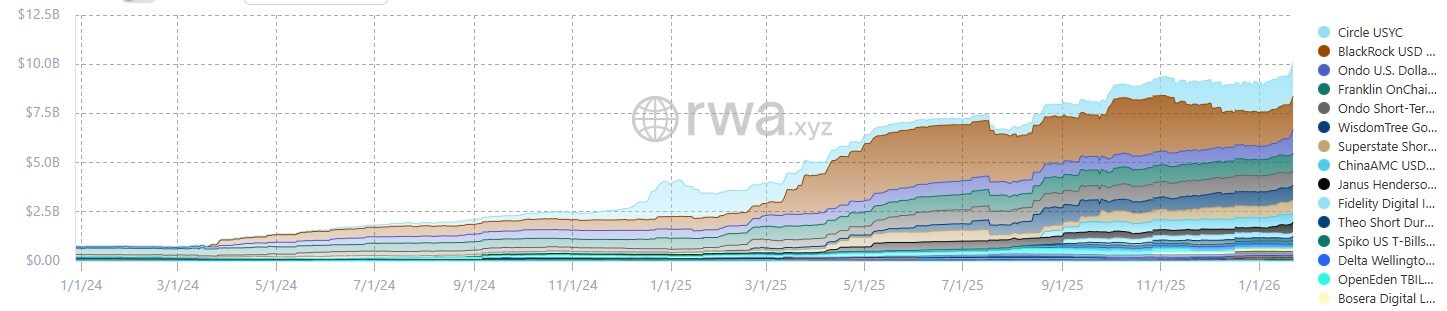
Tokenized US Treasuries crossed $10 billion in total value this week, a milestone that confirms the category has moved from proof-of-concept to operational infrastructure.

Yet, something happening underneath this achievement is just as important: Circle’s USYC has edged past BlackRock’s BUIDL as the largest tokenized Treasury product, signaling that distribution rails and collateral mechanics now matter more than brand recognition in determining which on-chain cash equivalents win.

As of Jan. 22, USYC holds $1.69 billion in assets under management compared to BUIDL’s $1.684 billion, a gap of roughly $6.14 million, or 0.36%.

Over the past 30 days, USYC’s assets grew 11% while BUIDL’s contracted 2.85%, a divergence that reads less like marketing success and more like net creation flowing in one direction while redemptions drain the other.

This isn’t a story about Circle beating BlackRock in a brand war. It’s about collateral workflow design outperforming logo recognition.

Additionally, it maps directly onto the infrastructure question that regulators and institutions are now asking out loud: who shapes the stack that turns idle crypto capital into productive, yield-bearing collateral?

Distribution plus collateralization beats brand

USYC’s clearest structural advantage is distribution through exchange collateral rails.

On July 24, Binance announced that institutional customers could hold USYC and use it as off-exchange collateral for derivatives, with custody handled through Banking Triparty or Ceffu and near-instant redemption into USDC.

Binance added BUIDL to its off-exchange collateral list on Nov. 14, four months after USYC.

That sequencing matters. If the cash collateral stack is built first inside prime brokerage and derivatives workflows, the product that integrates earlier captures the flow.

USYC didn’t just get listed, it got embedded into the operational layer where institutions manage margin and collateral automation.

Circle positioned USYC explicitly as yield-bearing collateral that travels alongside USDC rails, meaning institutions that already route stablecoin flows through Circle’s ecosystem can onboard USYC without building new operational pathways.

BlackRock’s BUIDL entered the market with brand authority but without the same plug-and-play integration into crypto-native collateral systems.

Product mechanics suit trading collateral

RWA.xyz labels the two products differently under “Use of Income.” USYC is marked as “Accumulates,” meaning interest accrues within the token balance. BUIDL is marked as “Distributes,” meaning returns are paid out separately.

This distinction is mechanical, not cosmetic. Collateral systems, especially automated margin and derivatives infrastructure, prefer set-and-forget balances where value compounds without requiring operational handling of payouts.

An accumulating structure integrates more cleanly into collateral automation than a distributing one.

For institutions building collateral rails that need to scale across multiple venues and counterparties, the simpler the structure, the lower the operational drag.

RWA.xyz lists materially different entry requirements for the two products.

BUIDL restricts access to US Qualified Purchasers, requiring a minimum investment of $5 million in USDC. USYC targets non-US investors with a minimum of $100,000 USDC.

The funnel difference is structural. Qualified Purchaser status in the US requires $5 million in investable assets for individuals or $25 million for entities, a narrow gate that excludes most crypto-native funds, prop desks, and smaller institutional players.

USYC’s $100,000 minimum and non-US eligibility open access to a broader set of offshore institutions, family offices, and trading firms that operate outside US regulatory perimeters but still need dollar-denominated, yield-bearing collateral.

BlackRock’s brand carries weight, but the brand doesn’t override access constraints. If a fund can’t meet the Qualified Purchaser threshold or operates outside the US, BUIDL isn’t an option. USYC is.

The addressable market for on-chain collateral skews heavily toward non-US entities and smaller institutions, exactly the segment USYC is designed to serve.

Net creation versus net redemption

The simplest explanation for the flip is the cleanest: flows moved.

USYC grew by 11% over the past 30 days, while BUIDL shrank by 2.85%. That’s not a marketing differential. It’s net issuance into one product, offset by net outflows from the other.

The recent flip suggests a discrete event or allocation decision rather than gradual drift. USYC’s Binance integration, its accumulating income structure, and its lower entry threshold all reduce friction. BUIDL hasn’t added comparable distribution momentum in the same window.

Tokenized Treasuries at $10 billion remain a small fraction of the $310 billion stablecoin market, but their role is shifting from niche experiment to operational default.
The International Organization of Securities Commissions (IOSCO) noted in recent guidance that tokenized money market funds are increasingly used as stablecoin reserve assets and as collateral for crypto-related transactions. This is precisely the interlinkages driving USYC’s growth.

JPMorgan framed tokenized money market funds as the next frontier after stablecoins, centered on portability and collateral efficiency.

The bank’s analysis treats tokenized Treasuries not as an alternative to stablecoins but as an evolution of them. They are programmable cash equivalents that settle faster, move across blockchains more easily, and integrate into collateral systems with less operational overhead than traditional custody arrangements.

With stablecoin yields near zero, tokenized Treasuries offer a risk-free on-chain rate without requiring users to exit crypto rails.

Instead of parking cash in non-yielding stablecoins or moving it off-chain to earn returns, institutions can now hold yield-bearing collateral on-chain that functions like cash but compounds like Treasuries.

What happens next

The $10 billion milestone is less important than the capture rate it represents.

Tokenized Treasuries currently account for roughly 3% to 4% of the stablecoin float. If that rate doubles over the next 12 months, which is a conservative assumption given current flow momentum and collateral integrations, tokenized Treasuries could reach $20 billion to $25 billion.

If collateral flywheels accelerate and more venues replicate Binance-style off-exchange rails, the range stretches to $40 billion to $60 billion.

The metrics that matter are all measurable: net issuance trends, collateral integration announcements, changes to eligibility requirements, and shifts in income-handling preferences.

USYC’s 30-day growth rate and BUIDL’s contraction are early signals. The Binance integration timeline is another. The funnel gap is a third.

USYC didn’t flip BUIDL because Circle outspent BlackRock on marketing. It flipped because distribution, mechanics, and access constraints aligned with how institutions actually use on-chain collateral.

The category crossed $10 billion not because one flagship product dominated, but because multiple products are now competing on infrastructure terms: who integrates faster, who reduces friction, who widens the funnel.

Brand recognition opened doors. Collateral workflow design is keeping them open.

Share. Facebook Twitter Pinterest LinkedIn Tumblr Email
NBTC

NBTC is the editorial account for NBTC News, covering Bitcoin, Ethereum, DeFi, blockchain infrastructure, exchanges, mining, regulation and digital asset markets. The editorial team focuses on clear sourcing, timely updates and practical context for crypto readers.

Related Posts

USDC and USDT Supply Both Contracted This Week as Stablecoin Bills Dominate Headlines

04/07/2026

Crypto’s Liquidity Outlook Darkens as Fed Hawkish Pivot Pushes Hike Odds to 77%

04/07/2026

SpaceX raises $25 million in debt sale

04/07/2026

Hundreds of Millions of Dollars Withdrawn in Four Days!

04/07/2026
Add A Comment

Comments are closed.

Top Posts
Get Informed

Subscribe to Updates

Get the latest news from NBTC regarding crypto, blockchains and web3 related topics.

Your source for the serious news. This website is crafted specifically to for crazy and hot cryptonews. Visit our main page for more tons of news.

We're social. Connect with us:

Facebook X (Twitter) LinkedIn RSS
Top Insights

Bitcoin Is in a Fight at $60K—Here’s What the Charts Say

04/07/2026

F2Pool Co-Founder Wang Chun Deposits $30.5M in ETH and WBTC to Binance Amid Broader $220M Withdrawal Pattern

04/07/2026

USDC and USDT Supply Both Contracted This Week as Stablecoin Bills Dominate Headlines

04/07/2026
Get Informed

Subscribe to Updates

Get the latest news from NBTC regarding crypto, blockchains and web3 related topics.

Type above and press Enter to search. Press Esc to cancel.