

Ethereum remains the legacy venue for stablecoin payments, while Solana expands adoption with a growing number of user addresses.
Crypto payment cards grew slowly, starting out as a novelty item. Now, using stablecoins as a form of payment has turned into a consumer staple. Recently, Stripe’s new Privy of crypto and stablecoins, Henri Stern, announced the platform will expand its stablecoin tools to boost global adoption.
Growth also came from adoption through Revolut, which expanded its selection with a native EURR stablecoin based on the Euro.
$USDC drives crypto card expansion
Stablecoin usage shifted following the mandatory MiCAR adoption in the EU, as well as the regulations of the US Genius Act, which is still being rolled out in practice.
In the past two years, regulated stablecoin $USDC started displacing $USDT, which is even more clearly visible in card payments. While $USDT transfers, supply and ownership are still higher for internal crypto transactions and P2P payments, card volumes grew with the adoption of a regulated asset.
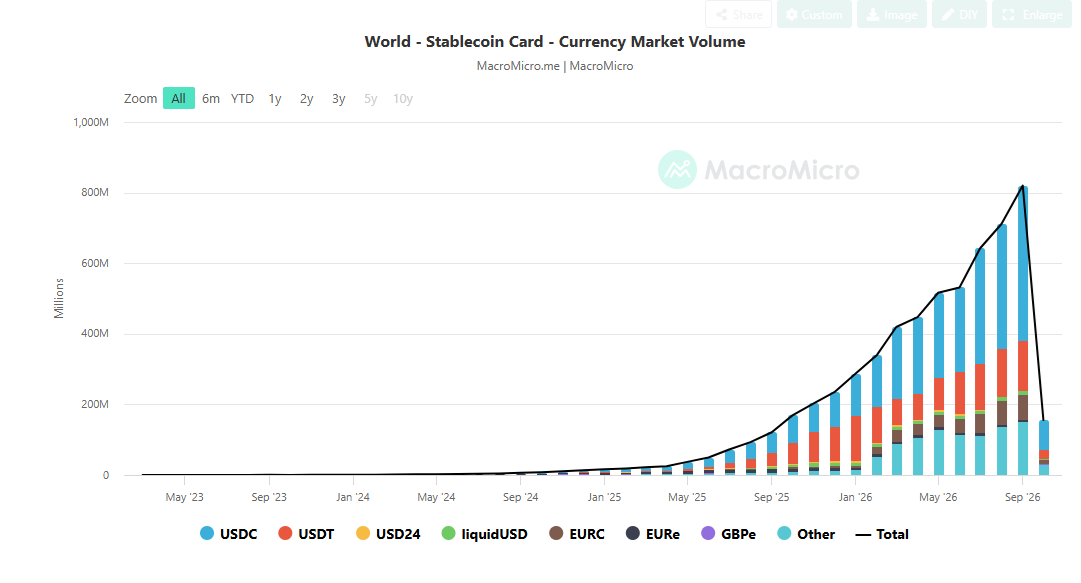
$USDC retains a supply of around $75B, of which $6.75B is minted on the Solana chain, with faster adoption for trading and DeFi. In September, $USDC card payments reached a volume of over $439M, more than three times the usage of $USDT.
Payments are becoming a growing use case for stablecoins. Adjusted volumes report over $54B in payments for September. Other major use cases include DeFi, DEX routing, and general usage within crypto protocols. As a result, $USDC is filling the gap left by $USDT, which has been divested by brokerages, exchanges, and other financial service providers.
Payment apps boost crypto fundraising
Payments as a use case expanded in 2026, following a period of adapting to the new regulations.
This has been reflected by funding activity, based on Cryptorank’s tracking of VC investments. In Q3, payments, exchange and brokerage accounted for 71.6% of VC funding. In total, companies raised $2.26B for the past quarter, with a total of 127 rounds. Payments and fintech displaced the previous waves of investment in user-directed crypto, such as memes and NFTs.
In the past quarter, funding activity declined, with more funds flowing to already established payment ecosystems like Crypto.com.
For the past two quarters, payment projects raised $1B, becoming the second-biggest category in crypto VC funding. Prediction markets came in first with $2B in funding, but payments may continue to grow based on the recent growth in transaction counts and value transfers.
