
Close Menu
  • Coins
    • Bitcoin
    • Ethereum
    • Altcoins
    • NFT
  • Blockchain
  • DeFi
  • Metaverse
  • Regulation
  • Other
    • Exchanges
    • ICO
    • GameFi
    • Mining
    • Legal
  • MarketCap
What's Hot

Which Altcoins Are the Most Popular in the Cryptocurrency Market? Here’s the Latest List

20/05/2026

DV8 Becomes First Bitcoin Treasury Company in Southeast Asia with Digital Asset License

20/05/2026

Why Tokenized Deposits Are Becoming the Institutional Standard for On-Chain Cash

20/05/2026
Facebook X (Twitter) Instagram
  • Back to NBTC homepage
  • Privacy Policy
  • Contact
X (Twitter) Telegram Facebook LinkedIn RSS
NBTC News
  • Coins
    1. Bitcoin
    2. Ethereum
    3. Altcoins
    4. NFT
    5. View All

    DV8 Becomes First Bitcoin Treasury Company in Southeast Asia with Digital Asset License

    20/05/2026

    How Bitcoin evolved from ‘safe haven’ to become the market’s real-time geopolitical risk indicator

    20/05/2026

    Shares His Predictions – “Not BTC, But Two Altcoins…”

    20/05/2026

    Morgan Stanley is Pushing Bitcoin and Crypto, But Says Wall Street Isn’t Chasing FOMO

    20/05/2026

    ETH Profit-Taking Climbs to 3-Week High Even as Prices Slide

    19/05/2026

    Ethereum’s ‘buy-the-dip’ crowd stays active – But bears still circle ETH

    19/05/2026

    Ethereum Price Trapped Below $2,320, Recovery Hopes Start Fading

    19/05/2026

    Ethereum Crushes Rivals With Nearly 900000 Validators Worldwide, Leaves SOL And ADA Behind

    19/05/2026

    Gensyn Foundation Plans Transfer of Locked Tokens to New Wallet for Internal Operations

    20/05/2026

    Solana launches P-Token upgrade with 20x efficiency boost on mainnet, price to $150?

    20/05/2026

    Why Largest XRP Treasury Is Stuck in Losses

    20/05/2026

    Analyst Reveals Whether Ripple Making Billions Actually Benefit XRP Holders

    20/05/2026

    Pudgy Penguins Deepens Ties With Manchester City in Expanded Partnership

    20/05/2026

    We’re building one app for NFTs, meme coins, perps, and major cryptos

    20/05/2026

    Courtyard, ATMC BRC-20 NFTs, X@AGI BRC-20 NFTs, CryptoPunks Dominate Collectible Market

    18/05/2026

    OpenSea CMO sees tokenized Pokémon cards, Rolexes and tickets driving next NFT wave

    16/05/2026

    Which Altcoins Are the Most Popular in the Cryptocurrency Market? Here’s the Latest List

    20/05/2026

    DV8 Becomes First Bitcoin Treasury Company in Southeast Asia with Digital Asset License

    20/05/2026

    Why Tokenized Deposits Are Becoming the Institutional Standard for On-Chain Cash

    20/05/2026

    Gensyn Foundation Plans Transfer of Locked Tokens to New Wallet for Internal Operations

    20/05/2026
  • Blockchain

    Which Altcoins Are the Most Popular in the Cryptocurrency Market? Here’s the Latest List

    20/05/2026

    DGrid AI Partners with AltLLM to Drive Crypto AI Framework and Web3 Growth

    20/05/2026

    Lido Selects Chainlink CCIP for Cross-Chain Expansion, Citing Security Principles

    20/05/2026

    Bridging Innovation – ENI and XBIT Partner to Architect the Next Generation of Web3 Infrastructure

    20/05/2026

    Top 10 Fastest Growing Crypto Ecosystems in 2026

    20/05/2026
  • DeFi

    Stripe-backed Tempo taps $7.5 billion DeFi lender Morpho to expand beyond payments

    20/05/2026

    The $30 billion RWA tokenization boom is barely reaching DeFi

    20/05/2026

    Aave Upgrades SavingsGHO to New Vault With 4.25% APR — Migration Required Within Seven Weeks

    20/05/2026

    ZonaLend Debuts on Pharos Mainnet, Unlocking Liquidity for Real-World Asset Tokens

    20/05/2026

    A New Non-Custodial DeFi Vault Platform for Tailored Lending Strategies

    20/05/2026
  • Metaverse

    Why Animoca’s Yat Siu says the future is 100 billion AI agents

    07/05/2026

    ‘8,000 Jobs’—Polymarket Sees Tech Layoff Surge As Meta AI Push Bites

    18/04/2026

    Planet Hares Partners With Magne.AI To Bridge Web3 Metaverse With Smartphone Mobile-Ready Applications For Mass Adoption

    08/04/2026

    Mark Zuckerberg’s Meta launches new AI initiative after metaverse retreat

    25/03/2026

    Meta partners with Arm to develop new CPUs for AI deployments

    24/03/2026
  • Regulation

    Why Tokenized Deposits Are Becoming the Institutional Standard for On-Chain Cash

    20/05/2026

    Euro stablecoins explode 1200% under MiCA as capital pours into regulated assets

    20/05/2026

    SpaceX’s $75 billion IPO could drain the liquidity that’s helping lift bitcoin and crypto

    20/05/2026

    How Will the Suspension of the Investigation Against Fed Chair Jerome Powell Affect Interest Rate Decisions?

    20/05/2026

    Europe’s banks are going all in on crypto

    20/05/2026
  • Other
    1. Exchanges
    2. ICO
    3. GameFi
    4. Mining
    5. Legal
    6. View All

    Legend Decentralized Exchange to Shut Down on July 12, Users Urged to Withdraw Funds

    20/05/2026

    Bitfinex El Salvador licence expands CNAD coverage across spot, derivatives

    20/05/2026

    Wirex Card Now Works With Google Pay for Android Users

    20/05/2026

    Half-Billion Dollar USDT Transfer to Binance Sparks Market Speculation

    20/05/2026

    ICO market slows sharply with only six completions in 2026

    30/04/2026

    South Korea Poised to Lift Ban on Domestic ICOs After 7 Years

    19/12/2025

    Why 2025’s Token Boom Looks Both Familiar and Dangerous

    31/10/2025

    ICO for bitcoin yield farming chain Corn screams we’re so back

    22/01/2025

    RealGo Partners With Bitget Wallet To Expand User Access To DeFi And Advance Web3 Gaming Adoption

    18/05/2026

    NUMINE Joins Outer Ring MMO for the Expansion of Web3 Gaming Experiences

    13/05/2026

    GMatrixs And MiniverseCore Join Forces To Unlock Web3 Gaming Experience With Cross-Chain DApp, DeFi Applications

    11/05/2026

    MetaOne Joins MetYa to Boost SocialFi Gaming with Exclusive Rewards

    10/05/2026

    Russia Approves Ban on Crypto Mining in Kursk Border Region Amid Energy Crisis

    20/05/2026

    Ionic Digital Mined 20.45 BTC in April, Production Declines 27% Month-Over-Month

    20/05/2026

    American Bitcoin Adds 200 BTC, Now Holds Over 7,500 as Mining Fleet Expands

    20/05/2026

    Bitcoin miner Canaan posts $88.7M net loss in Q1 amid BTC decline

    20/05/2026

    Expert Claims XRP Looks Strong In The Details

    20/05/2026

    Cynthia Lummis highlights CLARITY Act’s protections for developers and law enforcement tools

    20/05/2026

    Congress members to discuss Bitcoin and crypto market structure Tuesday

    20/05/2026

    Senate Flooded With 100 Amendments as Thursday Markup Arrives

    20/05/2026

    Which Altcoins Are the Most Popular in the Cryptocurrency Market? Here’s the Latest List

    20/05/2026

    DV8 Becomes First Bitcoin Treasury Company in Southeast Asia with Digital Asset License

    20/05/2026

    Why Tokenized Deposits Are Becoming the Institutional Standard for On-Chain Cash

    20/05/2026

    Gensyn Foundation Plans Transfer of Locked Tokens to New Wallet for Internal Operations

    20/05/2026
  • MarketCap
NBTC News
Home»Bitcoin»A simple explainer on what quantum computing actually is, and why it is terrifying for bitcoin
Bitcoin

A simple explainer on what quantum computing actually is, and why it is terrifying for bitcoin

NBTCBy NBTC29/04/2026No Comments6 Mins Read
Share
Facebook Twitter LinkedIn Pinterest Email


This week, Google published a paper describing how a quantum computer could theoretically derive a bitcoin private key in 9 minutes, with ramifications that stretch to Ethereum, other tokens, private banking, and potentially everything in the world.

Quantum computing is easy to mistake for a faster version of a regular computer. But it is not a more powerful chip or a bigger server farm. It is a fundamentally different kind of machine, different at the level of the atom itself.

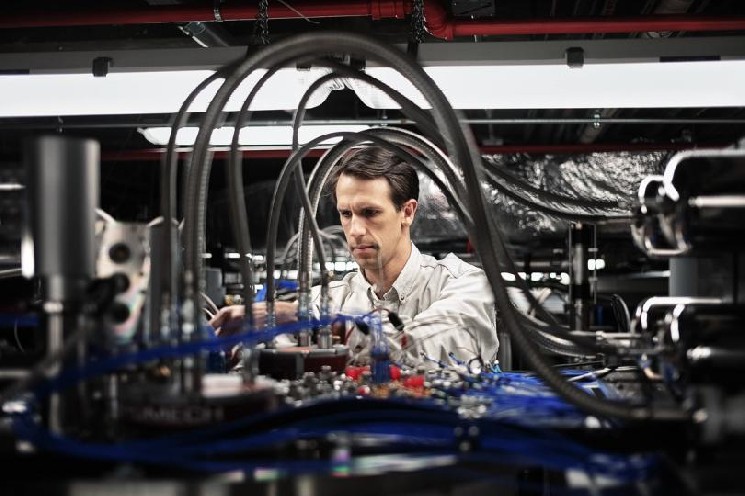
A quantum computer starts with a very cold, very small loop of metal where particles begin to behave in ways they do not behave under normal conditions on Earth, ways that alter what we think of as the basic rules of physics.

Understanding what that means, physically, is the difference between reading about the quantum threat and actually grasping it.

How computers and quantum computers actually work

Regular computers store information as bits — each is either a 0 or a 1. A bit is a tiny switch. Physically, it’s a transistor on a “chip” — a microscopic gate that either lets electricity through (1) or doesn’t (0).

Every photo, every bitcoin transaction, every word you’ve ever typed is stored as patterns of these switches being on or off. There is nothing mysterious about a bit; it is a physical object in one of the two definite states.

Every calculation is just shuffling these 0s and 1s around really fast. A modern chip can do billions of these per second, but it still does them one at a time, in sequence.

Quantum computers use something known as qubits instead of bits. A qubit can be 0, 1, or — and this is the weird part — both at the same time!

This is possible as a qubit is a completely different kind of physical object. The most common version, and the one Google uses, is a tiny loop of superconducting metal cooled to about 0.015 degrees above absolute zero, colder than outer space but here on Earth.

At that temperature, electricity flows through the loop without any resistance, and the current is said to exist in a quantum state.

In the superconducting loop, current can flow clockwise (call that 0) or counterclockwise (call that 1). But at quantum scales, the current does not have to pick one direction and actually flows in both directions simultaneously.

Don’t mistake it for switching between the two really fast. The current is measurably, experimentally and verifiably in both states simultaneously.

Mind-bending physics

With us so far? Great, because here’s where it gets genuinely strange, because the physics behind how it works isn’t immediately intuitive, and it is not supposed to be.

Everything someone interacts with in daily life obeys classical physics, which assumes that things are in one place at one time. But particles do not behave this way at the subatomic scale.

An electron does not have a definite position until you look at it. A photon does not have a definite polarization until you measure it. A current in a superconducting loop does not flow in a definite direction until you force it to pick.

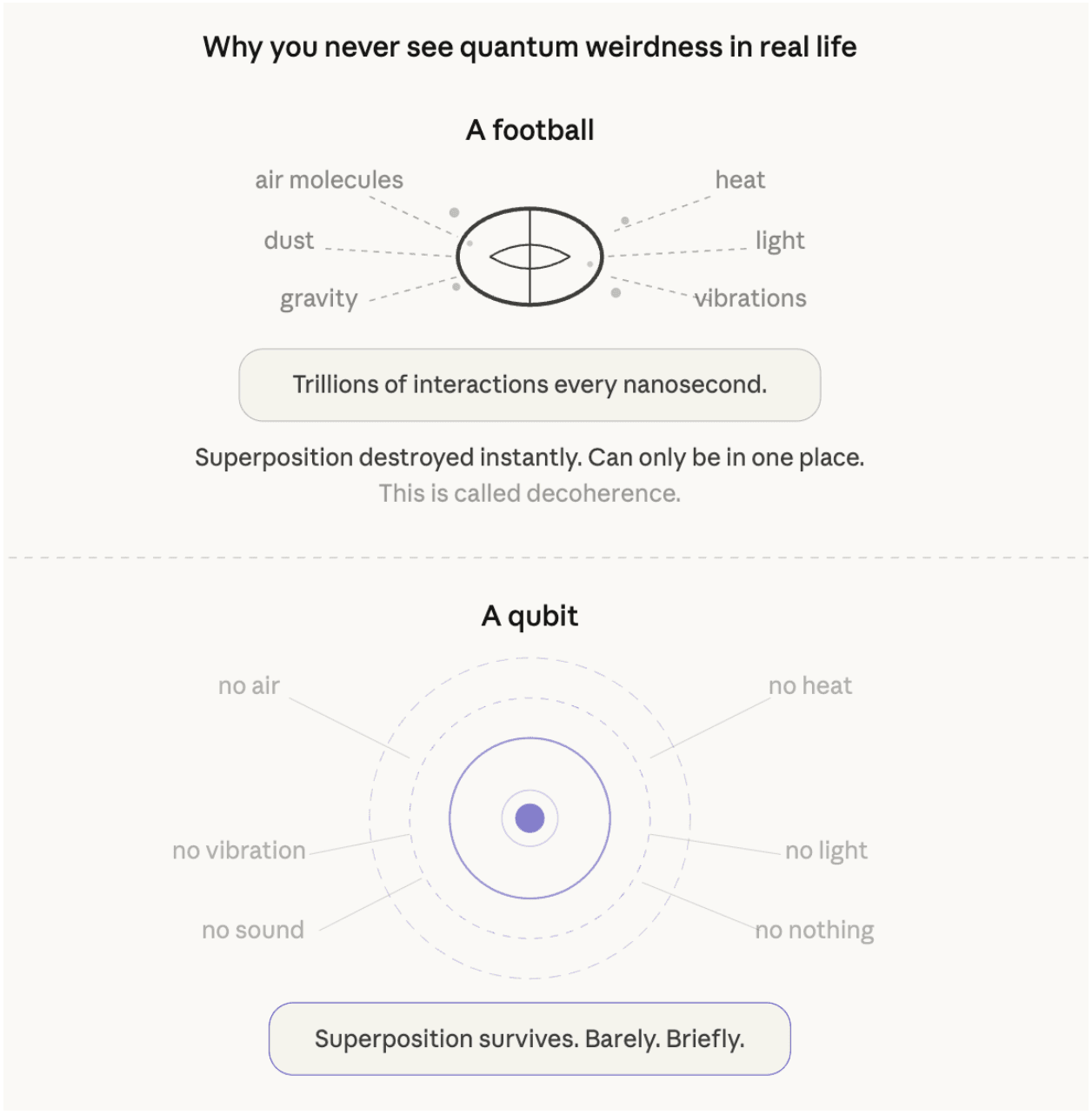
The reason we don’t experience this in everyday life is decoherence. When a quantum system interacts with its environment, air molecules, heat, vibrations and light, the superposition collapses almost instantly.

A football cannot be in two places at once because it is interacting with trillions of air molecules, dust, sound, heat, gravity, etc., every nanosecond. But isolate a tiny current in a near-absolute-zero vacuum, shield it from every possible disturbance, and the quantum behavior survives long enough to compute with.

That’s why quantum computers are so hard to build. People are engineering physical environments where the laws of physics that normally prevent this stuff from happening are held at bay for just long enough to run a calculation.

Google’s machines operate in dilution refrigerators the size of huge rooms, colder than anything in the natural universe, surrounded by layers of shielding against electromagnetic noise, vibration, and thermal radiation.

And the qubits are fragile even then. They lose their quantum state constantly, which is why “error correction” dominates every conversation about scaling up.

So quantum computing is not a faster version of classical computing. It is exploiting a different set of physical laws that only apply at extremely small scales, extremely low temperatures, and extremely short timeframes.
Now stack that up.

Two regular bits can be in one of four states (00, 01, 10, 11), but only one at a time (since current flows in only one direction). Two qubits can represent all four states at once, as the current is flowing in all directions at the same time.

Three qubits represent eight states. Ten qubits represent 1,024. Fifty qubits represent over a quadrillion. The number doubles with every qubit that is added, which is why the scaling is so exponential.

The second trick is something called entanglement. When two qubits are entangled, measuring one instantly tells an observer something about the other, no matter how far apart they are. This lets a quantum computer coordinate across all those simultaneous states in a way that regular parallel computing cannot.

And these quantum computers are set up so that wrong answers cancel each other out (like overlapping waves that flatten) and right answers reinforce each other (like waves that stack higher). By the end of the computation, the correct answer has the highest probability of being measured.

So it’s not brute-force speed. It’s a fundamentally different approach to calculation — one that lets nature explore an exponentially large space of possibilities and then collapses to the right answer through physics rather than logic.

A monumental threat to cryptography

This mind-bending physics is why it is terrifying for encryption.

The math protecting bitcoin relies on the assumption that checking every possible key would take longer than the age of the universe.

But a quantum computer doesn’t check every key. It explores all of them simultaneously and uses interference to surface the right one.

That is where it ties into Bitcoin. Going one direction, from private key to public key, takes milliseconds. Going the other direction, from public key back to private key, would take a classical computer a million years, or even longer than the age of the universe. That asymmetry is the only thing proving that a person is holding their coins.
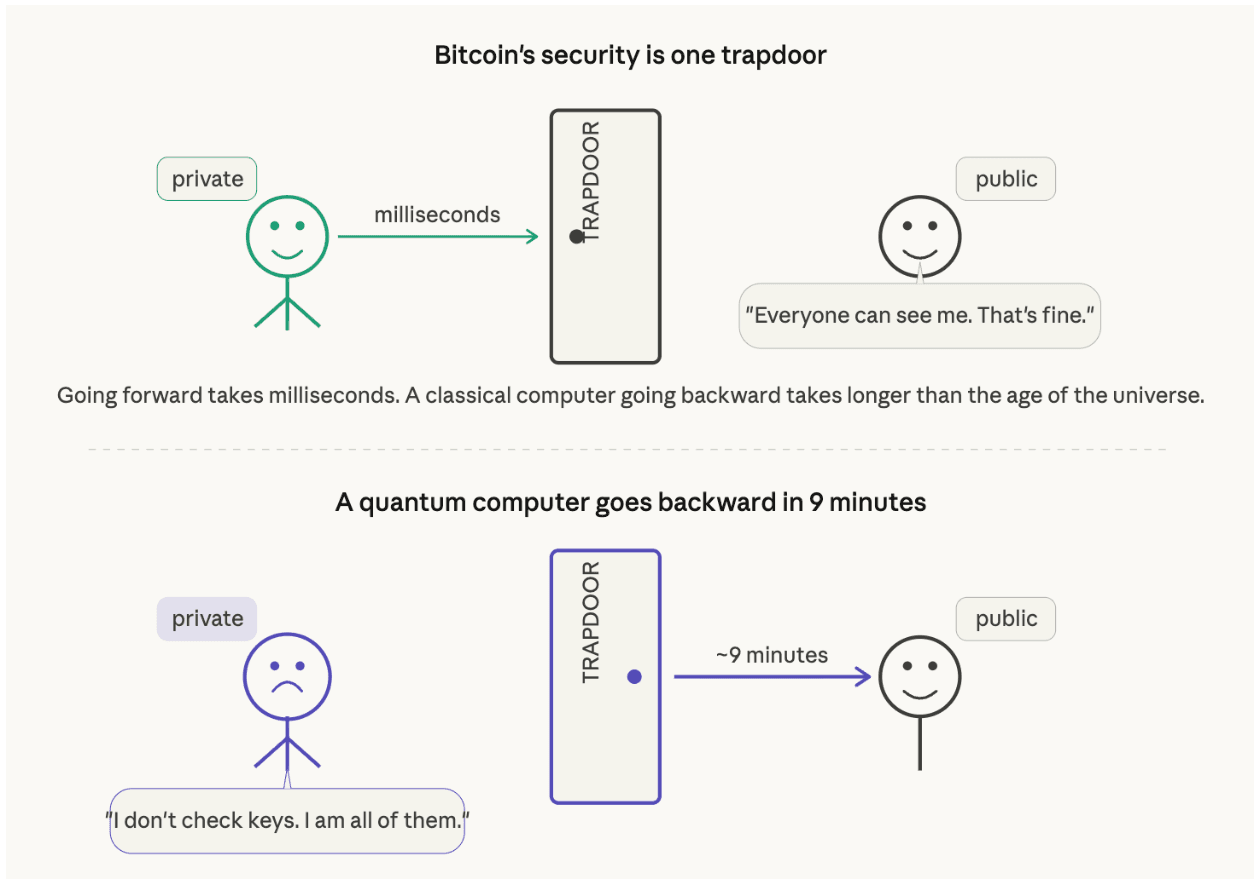
A quantum computer running an algorithm called Shor’s can go through that trapdoor in reverse. Google’s paper this week showed it could do so with far fewer resources than anyone previously estimated, and within a timeframe that races against bitcoin’s own block confirmations.

This is why the threat of quantum computers breaking blockchain encryption is genuinely making everyone very worried.

How that attack works step by step, what Google’s paper specifically changed, and what it means for the 6.9 million bitcoin already exposed, is the subject of the next piece in this series.

Share. Facebook Twitter Pinterest LinkedIn Tumblr Email
NBTC

NBTC is the editorial account for NBTC News, covering Bitcoin, Ethereum, DeFi, blockchain infrastructure, exchanges, mining, regulation and digital asset markets. The editorial team focuses on clear sourcing, timely updates and practical context for crypto readers.

Related Posts

DV8 Becomes First Bitcoin Treasury Company in Southeast Asia with Digital Asset License

20/05/2026

How Bitcoin evolved from ‘safe haven’ to become the market’s real-time geopolitical risk indicator

20/05/2026

Shares His Predictions – “Not BTC, But Two Altcoins…”

20/05/2026

Morgan Stanley is Pushing Bitcoin and Crypto, But Says Wall Street Isn’t Chasing FOMO

20/05/2026
Add A Comment

Comments are closed.

Top Posts
Get Informed

Subscribe to Updates

Get the latest news from NBTC regarding crypto, blockchains and web3 related topics.

Your source for the serious news. This website is crafted specifically to for crazy and hot cryptonews. Visit our main page for more tons of news.

We're social. Connect with us:

Facebook X (Twitter) LinkedIn RSS
Top Insights

Which Altcoins Are the Most Popular in the Cryptocurrency Market? Here’s the Latest List

20/05/2026

DV8 Becomes First Bitcoin Treasury Company in Southeast Asia with Digital Asset License

20/05/2026

Why Tokenized Deposits Are Becoming the Institutional Standard for On-Chain Cash

20/05/2026
Get Informed

Subscribe to Updates

Get the latest news from NBTC regarding crypto, blockchains and web3 related topics.

Type above and press Enter to search. Press Esc to cancel.