
Close Menu
  • Coins
    • Bitcoin
    • Ethereum
    • Altcoins
    • NFT
  • Blockchain
  • DeFi
  • Metaverse
  • Regulation
  • Other
    • Exchanges
    • ICO
    • GameFi
    • Mining
    • Legal
  • MarketCap
What's Hot

Stablecoin payments, not trading, drove Tron past 400 million accounts

28/08/2026

Donald Trump’s Company Has Sold Another Large Amount of Bitcoin

28/08/2026

Ethena diversifies USDe backing with $1 billion FalconX facility

28/08/2026
Facebook X (Twitter) Instagram
  • Back to NBTC homepage
  • Privacy Policy
  • Contact
X (Twitter) Telegram Facebook LinkedIn RSS
NBTC News
  • Coins
    1. Bitcoin
    2. Ethereum
    3. Altcoins
    4. NFT
    5. View All

    Donald Trump’s Company Has Sold Another Large Amount of Bitcoin

    28/08/2026

    Why a sudden 5,500 BTC drop in leveraged short positions failed to deliver the bullish confirmation Bitcoin traders wanted

    28/08/2026

    Self-Proclaimed Satoshi Says Bitcoin’s Rules Should Never Change

    28/08/2026

    Michael Saylor says BIP-110 lacks miner consensus

    28/08/2026

    ETH, XRP, MemeToro And HYPE Lead July Momentum As Smaller Tokens Struggle For Liquidity

    28/08/2026

    Bitcoin’s Next Rally Could Send Ethereum Toward $20K: Analyst

    27/08/2026

    Ethereum Developer Proposes ERC-8391 to Standardize Market State Data for Tokenized Stocks

    27/08/2026

    ERC-8391 proposes asset status checks for tokenized stocks

    27/08/2026

    GTA VI leaker’s token crashes despite ‘first true spoiler’

    28/08/2026

    51.2% for miners, 20.4% airdrop, no VC allocation

    28/08/2026

    Ripple’s RLUSD Surpasses $2 Billion Milestone Amid XRP Buzz

    28/08/2026

    Mastercard Makes Surprise XRP Ledger Move

    28/08/2026

    32 NFT predictions that aged like milk

    25/08/2026

    A 2026 Filing Guide for Creators

    24/08/2026

    NFT sales surge 170% to $95.5M on $55M Pandora trade

    22/08/2026

    How StonkBrokers Turned a JPEG Into a Brokerage Account

    18/08/2026

    Stablecoin payments, not trading, drove Tron past 400 million accounts

    28/08/2026

    Donald Trump’s Company Has Sold Another Large Amount of Bitcoin

    28/08/2026

    Ethena diversifies USDe backing with $1 billion FalconX facility

    28/08/2026

    GTA VI leaker’s token crashes despite ‘first true spoiler’

    28/08/2026
  • Blockchain

    Stablecoin payments, not trading, drove Tron past 400 million accounts

    28/08/2026

    Injective joins x402 Foundation to advance AI payment standards

    28/08/2026

    Blockchain networks pivot to specialist use cases to lead 2026 growth

    28/08/2026

    PenguinSwap Launchpad Goes Live on Creditcoin, MINI Token Sale Raises $1.22M

    28/08/2026

    Postquant Labs launches the first quantum cross-chain swaps

    28/08/2026
  • DeFi

    PancakeSwap security audit clears shared liquidity hook for multiple pairs

    28/08/2026

    Chainlink unlocks DeFi lending for Coinbase tokenized stocks

    27/08/2026

    Aave Opens iOS Early Access, Keeps Android and Web Waitlisted

    27/08/2026

    AMM Fee Optimization Study Finds Traditional Pools Capture Just 50% of Value

    27/08/2026

    Lower Management Fee, Higher Performance Cut

    27/08/2026
  • Metaverse

    Is Solana Gaming Back? Kintara Activity Fuels Renewed Optimism in Onchain MMOs

    24/06/2026

    The Sandbox launches AI game engine ‘The Sandbox Studio’ for next-generation creators

    10/06/2026

    Meta commits $13M in funding for Oversight Board through 2028

    29/05/2026

    Why Animoca’s Yat Siu says the future is 100 billion AI agents

    07/05/2026

    ‘8,000 Jobs’—Polymarket Sees Tech Layoff Surge As Meta AI Push Bites

    18/04/2026
  • Regulation

    Ethena diversifies USDe backing with $1 billion FalconX facility

    28/08/2026

    The Much-Anticipated Fed Meeting Minutes Have Been Released—Here’s What You Need to Know

    28/08/2026

    AsiaStrategy’s Astra deal lets insider-linked buyers take ownership before $8 million comes due

    28/08/2026

    Tokenized Equities Onchain Volume Hits $9B, Up 800% Since January

    28/08/2026

    Treasury Doubles Long-End Buybacks as Bitcoin and US Stocks Advance

    27/08/2026
  • Other
    1. Exchanges
    2. ICO
    3. GameFi
    4. Mining
    5. Legal
    6. View All

    Robinhood Memecoins Drive Volume As MemeToro AI Presale Builds Real Utility

    28/08/2026

    MemeToro AI Agent Presale Makes The List

    28/08/2026

    Robinhood brings crypto trading to UK in AI-powered all-in-one app

    27/08/2026

    Bithumb Blocks Transfers Involving Three OFAC-Sanctioned Exchanges

    26/08/2026

    ICO market slows sharply with only six completions in 2026

    30/04/2026

    South Korea Poised to Lift Ban on Domestic ICOs After 7 Years

    19/12/2025

    Why 2025’s Token Boom Looks Both Familiar and Dangerous

    31/10/2025

    ICO for bitcoin yield farming chain Corn screams we’re so back

    22/01/2025

    Top 12 NFT games every player should know about in August 2026

    19/08/2026

    GameShame Studios founder details Raijin Protocol’s roadmap in NeoPod’s sixth AMA

    13/08/2026

    How BC.GAME is turning players into stakeholders

    04/08/2026

    YGG Play Shuts Down Services as Yield Guild Pivots to AI Data

    01/08/2026

    Bitcoin miner Sphere 3D faces $2.2M tariff claim equal to 77% of its cash

    26/08/2026

    Sphere 3D Faces $2.2M Tariff Bill on China-Made Bitcoin Miners

    26/08/2026

    Iran’s Rial Crashes to a Record Low as New Sanctions Target Its Bitcoin Mining Lifeline

    26/08/2026

    Zcash Rally Widens Mining Revenue Lead Over Bitcoin and AI HPC

    26/08/2026

    Where the Interest Comes From and Which Risks You Carry

    28/08/2026

    Trump Urges Senate to Pass Crypto’s CLARITY Act, Teases More Bitcoin Buys

    28/08/2026

    AI Safety Rules and Copyright Laws Pose Threat to Free Speech

    28/08/2026

    XRP Rises 10% As Garlinghouse Joins Trump at White House Crypto Summit

    27/08/2026

    Stablecoin payments, not trading, drove Tron past 400 million accounts

    28/08/2026

    Donald Trump’s Company Has Sold Another Large Amount of Bitcoin

    28/08/2026

    Ethena diversifies USDe backing with $1 billion FalconX facility

    28/08/2026

    GTA VI leaker’s token crashes despite ‘first true spoiler’

    28/08/2026
  • MarketCap
NBTC News
Home»Exchanges»96% wiped as U.S., EU, and U.K. sanctions hit
Exchanges

96% wiped as U.S., EU, and U.K. sanctions hit

NBTCBy NBTC02/08/2026No Comments7 Mins Read
Share
Facebook Twitter LinkedIn Pinterest Email


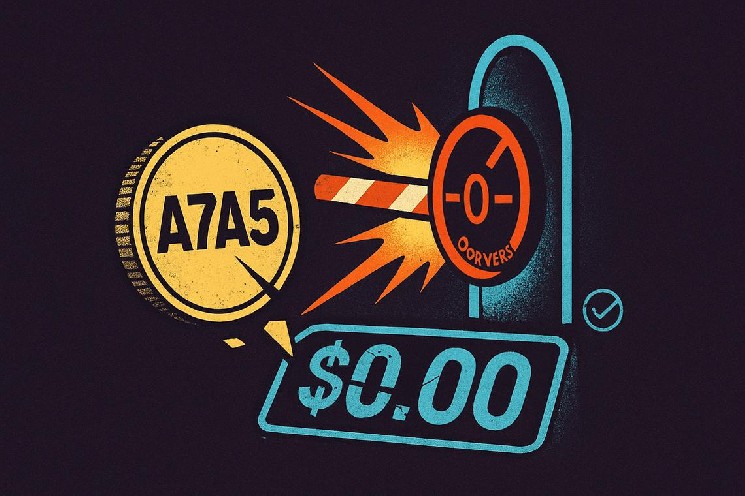
A stablecoin that once processed over $100 billion in transactions in a single year now trades at exactly zero. The A7A5 stablecoin collapse demonstrates what happens when geopolitical sanctions hit a crypto asset at its foundation — not gradually, but all at once.

Key takeaways

  • The A7A5 stablecoin, linked to a sanctioned Russian state bank, has lost 96% of its value and currently trades at $0 with no recorded trading volume.
  • Its smart contracts remain technically operational, but conversion is fully blocked following sanctions imposed by the U.S., U.K., and E.U.
  • The A7 network, on which A7A5 operates, has processed nearly $120 billion to date and was specifically built for Russian sanctions evasion, according to Chainalysis.
  • Mainstream exchanges are now actively screening deposits originating from A7A5’s network.
  • The EU’s 21st sanctions package directly targets the A7 cross-border payments network and 14 unnamed crypto-related platforms across multiple jurisdictions.

Collapse of the A7A5 Stablecoin Amid Sanctions

The numbers tell a brutal story. A token that once moved capital at scale — reportedly handling more than $100 billion in its first year of operation — has been effectively wiped out. The A7A5 stablecoin collapse has erased 96% of the token’s value, and market data shows it trading at $0 with zero volume recorded in the past 24 hours.

Linkage to a Sanctioned Russian State Bank

A7A5 is a ruble-backed stablecoin tied to a sanctioned Russian state bank, and that connection turned out to be its fatal vulnerability. The token operated within the broader A7 cross-border payments network, which Chainalysis identified as having processed nearly $120 billion to date — a network it described as purposely built for Russia’s sanctions evasion.

The European Union’s 21st sanctions package targeted the A7 network, including its newer connections to Africa. EU High Representative Kaja Kallas described the scope: “We’re hitting over a hundred banks and crypto operators, 40+ vessels in Russia’s shadow fleet, and several oil refineries in Russia and Belarus.”

96% Value Decline and Market Status

When sanctions cut off the conversion pathways that give a stablecoin its practical value, the market reprices fast. A7A5 now trades at $0. No bids. No volume. The peg is gone not because the underlying smart contracts failed, but because the real-world infrastructure needed to actually use the token has been severed.

That distinction matters enormously. A stablecoin with no conversion avenue is functionally worthless, regardless of what the code says it’s worth.

Operational Status and Utility Restrictions

The smart contracts underpinning A7A5 are still running. Technically, the token exists on-chain. But existence on-chain and usability in the real world are two very different things, and A7A5 is now firmly in the first category only.

Smart Contracts Functional but Conversion Blocked

Sanctions imposed by the U.S., U.K., and E.U. have systematically closed off every meaningful conversion pathway. Users holding A7A5 cannot exchange it for other currencies or assets through any compliant venue. The token is stranded — technically alive, economically dead.

This is a critical lesson in how stablecoin risk works differently from traditional crypto volatility. Bitcoin can drop 50% and still be traded globally. A sanctions-hit stablecoin tied to a blocked entity can go from $100 billion in volume to zero trades in a matter of weeks, with no recovery mechanism available while the sanctions hold.

Exchange Measures and Deposit Screening

The compliance wall is hardening in real time. Mainstream exchanges are now screening deposits that originate from A7A5’s network. This kind of proactive filtering — driven by blockchain analytics firms like Elliptic — effectively quarantines the token from the broader crypto ecosystem even beyond what the sanctions themselves mandate.

Once major exchanges flag a network at the deposit level, even users who may not fully understand the sanctions picture find themselves locked out. The practical effect is a total market freeze.

The EU’s 21st Sanctions Package and Its Crypto Reach

The A7A5 situation didn’t happen in a vacuum. It’s the downstream consequence of an escalating sanctions campaign that has grown significantly more sophisticated in its targeting of crypto infrastructure.

The EU’s latest package goes further than any previous action in one important respect: it introduces a legal instrument that could enable a full ban on crypto-asset services used by Russia. This new tool allows the EU to prohibit any transaction between an EU operator and any crypto provider used for Russian purposes — a sweeping potential reach that extends well beyond A7A5 itself.

Alongside the digital asset measures, the EU is freezing assets and blocking transactions for 94 banks and major financial institutions, and extending its transaction ban to 33 additional Russian credit and financial institutions. The 21st package also widens its transaction ban to 14 unnamed crypto-related platforms based in Georgia, Panama, the UAE, the Marshall Islands, Kyrgyzstan, and Belarus.

What the A7A5 Collapse Signals for Stablecoin Regulation

The failure of A7A5 surfaces a question the crypto industry hasn’t fully resolved: how should stablecoins with sovereign or state-adjacent backing be treated under international sanctions law?

Unlike decentralized tokens, stablecoins derive their value from a promise — a backing entity, a peg, a conversion mechanism. When the backing entity is sanctioned, that promise collapses. The A7A5 stablecoin collapse makes the risks of sanctioned cryptocurrencies concrete in a way that abstract regulatory warnings never quite managed.

Calls for enhanced regulatory frameworks around stablecoins are growing louder as a result. The case for clearer rules about what constitutes an acceptable backing entity, and how stablecoin issuers must respond to sanctions on their reserve holders, is now harder to dismiss. Traders operating in this space are being strongly advised to monitor evolving stablecoin regulations closely, as scrutiny on similar assets is likely to intensify.

A7A5 processed more than $100 billion before enforcement caught up. That scale shows just how much capital can flow through a sanctioned network before sanctions take effect — and why regulators on all sides are now treating stablecoin infrastructure as a first-tier geopolitical priority, not an afterthought.

FAQ

What caused the collapse of the A7A5 stablecoin?

The A7A5 stablecoin collapsed primarily due to sanctions imposed by the U.S., U.K., and E.U. targeting the Russian state bank to which it was linked. These sanctions cut off conversion pathways, making the token effectively unusable despite its smart contracts remaining technically operational.

Are the smart contracts of A7A5 still operational?

Yes, the smart contracts behind A7A5 remain operational on-chain. However, the token’s utility has been entirely blocked — users cannot convert it through any compliant exchange or platform, leaving it economically worthless even though it technically still exists on the blockchain.

How has the market responded to A7A5’s collapse?

A7A5 currently trades at $0 with no trading volume recorded in the last 24 hours. Mainstream exchanges have begun screening deposits originating from A7A5’s network, effectively quarantining the token from the broader crypto market.

What does the collapse of A7A5 imply for stablecoin regulation?

The collapse highlights the systemic risks associated with stablecoins backed by sanctioned entities, and has intensified calls for enhanced regulatory frameworks. The EU’s 21st sanctions package introduced a new legal instrument capable of banning any crypto-asset service used by Russia — marking a significant escalation in how Western regulators are approaching crypto and sanctions compliance.

Article produced with the assistance of artificial intelligence and reviewed by the editorial team.

Share. Facebook Twitter Pinterest LinkedIn Tumblr Email
NBTC

NBTC is the editorial account for NBTC News, covering Bitcoin, Ethereum, DeFi, blockchain infrastructure, exchanges, mining, regulation and digital asset markets. The editorial team focuses on clear sourcing, timely updates and practical context for crypto readers.

Related Posts

Robinhood Memecoins Drive Volume As MemeToro AI Presale Builds Real Utility

28/08/2026

MemeToro AI Agent Presale Makes The List

28/08/2026

Robinhood brings crypto trading to UK in AI-powered all-in-one app

27/08/2026

Bithumb Blocks Transfers Involving Three OFAC-Sanctioned Exchanges

26/08/2026
Add A Comment

Comments are closed.

Top Posts
Get Informed

Subscribe to Updates

Get the latest news from NBTC regarding crypto, blockchains and web3 related topics.

Your source for the serious news. This website is crafted specifically to for crazy and hot cryptonews. Visit our main page for more tons of news.

We're social. Connect with us:

Facebook X (Twitter) LinkedIn RSS
Top Insights

Stablecoin payments, not trading, drove Tron past 400 million accounts

28/08/2026

Donald Trump’s Company Has Sold Another Large Amount of Bitcoin

28/08/2026

Ethena diversifies USDe backing with $1 billion FalconX facility

28/08/2026
Get Informed

Subscribe to Updates

Get the latest news from NBTC regarding crypto, blockchains and web3 related topics.

Type above and press Enter to search. Press Esc to cancel.