
Close Menu
  • Coins
    • Bitcoin
    • Ethereum
    • Altcoins
    • NFT
  • Blockchain
  • DeFi
  • Metaverse
  • Regulation
  • Other
    • Exchanges
    • ICO
    • GameFi
    • Mining
    • Legal
  • MarketCap
What's Hot

Chainlink ($LINK) Lead the Pack of Top RWA Projects by Market Capitalization

21/06/2026

US government watchdog urges FDIC coordinate on crypto oversight

21/06/2026

Bybit Private Wealth Posts 50%+ APR, But the Real Story Is Risk

21/06/2026
Facebook X (Twitter) Instagram
  • Back to NBTC homepage
  • Privacy Policy
  • Contact
X (Twitter) Telegram Facebook LinkedIn RSS
NBTC News
  • Coins
    1. Bitcoin
    2. Ethereum
    3. Altcoins
    4. NFT
    5. View All

    Bitcoin bull cycle indicator flashes green for the first time in 3 years: Is $100k next?

    21/06/2026

    $82K Breakout May Open $86,582

    21/06/2026

    BTC Maintains Key Support Levels, Will the Rebound Continue?

    21/06/2026

    Bitcoin’s bull-bear cycle indicator turns green for first time since March 2023

    21/06/2026

    Ethereum trader scores $5mln in 10 days – But here’s a catch…

    19/06/2026

    Crypto Whale Jeffrey Huang Expands Ethereum Long Position Past 10,000 ETH

    19/06/2026

    Ethereum jumps on US-Iran optimism – Can $1,820 come next?

    19/06/2026

    Volume Back at Bullish Level

    19/06/2026

    Chainlink ($LINK) Lead the Pack of Top RWA Projects by Market Capitalization

    21/06/2026

    Cardano Ecosystem’s Lead Developer Makes Radical Decision for the Project’s Future! Here Are the Details

    21/06/2026

    Shiba Inu’s Shytoshi Kusama Confirms New Date for Key Discussion After Brief Silence

    21/06/2026

    GraniteShares Delays 3x Leveraged XRP ETF Until May 7

    21/06/2026

    Pudgy Penguins expands retail footprint with Target trading card rollout

    20/06/2026

    Collectible NFTs in focus during nations 250th anniversary

    12/06/2026

    NFTfi Shuts Down After $737M in Loans as NFT Market Contraction Makes Operations Unsustainable

    11/06/2026

    Dogecoin Notes Shibes Have Been ‘Quiet Lately’ And Then The Internet Showed Off What Everyone Has Been Silently Building

    09/06/2026

    Chainlink ($LINK) Lead the Pack of Top RWA Projects by Market Capitalization

    21/06/2026

    US government watchdog urges FDIC coordinate on crypto oversight

    21/06/2026

    Bybit Private Wealth Posts 50%+ APR, But the Real Story Is Risk

    21/06/2026

    NNT’s Dylan Grabowski talks governance, ecosystem strategy in NeoPod’s first AMA

    21/06/2026
  • Blockchain

    NNT’s Dylan Grabowski talks governance, ecosystem strategy in NeoPod’s first AMA

    21/06/2026

    Hashgraph and Truesense File CITI Patent

    21/06/2026

    CiDi Games Earns Mainnet Verified Badge

    21/06/2026

    Ghana and the UK Use Blockchain to Recover $15.1M From Cross-Border Scam

    21/06/2026

    The Decentralized Infrastructure Layer for Scalable AI Inference

    21/06/2026
  • DeFi

    Liquify DAO Joins AstroX to Explore New Opportunities

    21/06/2026

    DeFi’s next institutional wave may come from users who never see “behind the scenes” – CEO of Katana

    20/06/2026

    Ledn adds Tether Gold as loan collateral, expanding Bitcoin-backed lending model

    20/06/2026

    Curve Launches LlamaLend V2 — Is This a Game Changer for Lending?

    20/06/2026

    Creek Finance Launches XAUm Token on Sui Network, Expanding Yield-Bearing Tokenized Gold Access on DeFi

    20/06/2026
  • Metaverse

    The Sandbox launches AI game engine ‘The Sandbox Studio’ for next-generation creators

    10/06/2026

    Meta commits $13M in funding for Oversight Board through 2028

    29/05/2026

    Why Animoca’s Yat Siu says the future is 100 billion AI agents

    07/05/2026

    ‘8,000 Jobs’—Polymarket Sees Tech Layoff Surge As Meta AI Push Bites

    18/04/2026

    Planet Hares Partners With Magne.AI To Bridge Web3 Metaverse With Smartphone Mobile-Ready Applications For Mass Adoption

    08/04/2026
  • Regulation

    State Street targets stablecoin reserve boom with new money market fund

    21/06/2026

    Ripple invests in Flutterwave, pushing its stablecoin and XRP Ledger into payments across Africa

    21/06/2026

    Nexo Stablecoin Balance Climbs to $8.4 Million as Capital Inflows Accelerate

    21/06/2026

    Solana treasury firms resist Forward Industries’ consolidation push

    21/06/2026

    Musk’s SpaceX Is About to Cost as Much as Two Bitcoins

    21/06/2026
  • Other
    1. Exchanges
    2. ICO
    3. GameFi
    4. Mining
    5. Legal
    6. View All

    Bybit Private Wealth Posts 50%+ APR, But the Real Story Is Risk

    21/06/2026

    NeoRedPill signs first centralized exchange listing agreement with BiFinance

    21/06/2026

    Binance Wallet Unveils Web3 API for Trading, Analytics, and dApps

    21/06/2026

    Bitcoin Exchange Binance Announces It Will Add 4 Altcoin Projects to Its Watch Tag List! Here Are Those Altcoins

    21/06/2026

    ICO market slows sharply with only six completions in 2026

    30/04/2026

    South Korea Poised to Lift Ban on Domestic ICOs After 7 Years

    19/12/2025

    Why 2025’s Token Boom Looks Both Familiar and Dangerous

    31/10/2025

    ICO for bitcoin yield farming chain Corn screams we’re so back

    22/01/2025

    Nexus Acquires Homegrown App Marketplace One Store, Expanding into Global Web3 Game Hub

    21/06/2026

    GMATRIXS and Plum Protocol Partner to Blend GameFi with Meme Assets, Driving Multi-Chain Web3 User Experience

    16/06/2026

    Crypto game studio Uncharted to shutdown along with Fishing Frenzy

    15/06/2026

    Pudgy Penguins Halts Web3 Mobile Game Pudgy Party to Focus on Pudgy World

    14/06/2026

    Ford capitalizes on AI boom with new energy storage division

    21/06/2026

    Bitdeer Sells All 218 BTC Mined This Week, Returns to Zero Bitcoin Balance

    20/06/2026

    rare event or miner strategy?

    20/06/2026

    Texas Power Grid Reform Could Boost Bitcoin Miners Turned Data Center Operators

    19/06/2026

    US government watchdog urges FDIC coordinate on crypto oversight

    21/06/2026

    Dubai’s VARA tightens crypto AML rules, forcing firms to track FATF blacklists in real time

    21/06/2026

    South Korea arrests 23 over USDT laundering for Cambodian fraud network

    21/06/2026

    Nigeria’s Stablecoin Surge Strains Monetary Policy as Naira Weakens

    21/06/2026

    Chainlink ($LINK) Lead the Pack of Top RWA Projects by Market Capitalization

    21/06/2026

    US government watchdog urges FDIC coordinate on crypto oversight

    21/06/2026

    Bybit Private Wealth Posts 50%+ APR, But the Real Story Is Risk

    21/06/2026

    NNT’s Dylan Grabowski talks governance, ecosystem strategy in NeoPod’s first AMA

    21/06/2026
  • MarketCap
NBTC News
Home»Altcoins»XRPL’s May 27 upgrade shows how validators and markets decide a blockchain split
Altcoins

XRPL’s May 27 upgrade shows how validators and markets decide a blockchain split

NBTCBy NBTC24/05/2026No Comments6 Mins Read
Share
Facebook Twitter LinkedIn Pinterest Email


XRPL’s known amendments page lists fixCleanup3_1__3 for activation on May 27, and by design the event is a maintenance upgrade.

Version 3.1.3 of rippled bundles fixes for NFTs, Permissioned Domains, Vaults, and the Lending Protocol, and the XRPL blog set the default vote to Yes because of the importance of those fixes.

The amendment process requires more than 80% support from trusted validators sustained for two weeks before the new rules become permanent.

What makes the episode worth examining beyond the deadline is what XRPL co-creator David Schwartz said about what a real fork would actually require, because his answer reveals how protocol legitimacy works on any blockchain.

Schwartz’s central point is that raw node count is a poor proxy for consensus power. A system where nodes vote in proportion to their number creates an attack surface where anyone can spin up thousands of machines at low cost.

In the XRPL model, each server operator maintains a curated set of validators the server trusts not to collude, the Unique Node List, and the UNL determines which validation votes the server counts during consensus.

The XRPL amendment process requires support from more than 80% of trusted validators sustained for two weeks before new rules become permanent, blocking non-upgraded servers.

A server receives validation messages from many nodes across the network, and the validators on its UNL determine which of those messages shape the server’s view of the ledger.

Schwartz explained that consensus legitimacy on XRPL flows through trust lists and validator coordination, producing a system in which UNL alignment and economic adoption determine which ledger survives a split.

Why a real fork requires a full coordination campaign

For the XRPL vote on May 27, servers that become amendment-blocked lose the ability to determine ledger validity, submit or process transactions, participate in consensus, or vote on future amendments.

That makes the deadline operationally important for any exchange, wallet, explorer, or infrastructure operator still running pre-3.1.3 software, as those servers become non-participants in the canonical ledger until the operator updates.

Amendment-blocked infrastructure loses access to the upgraded chain and lacks the coordination infrastructure to anchor a functional rival.

To produce a credible fork, a dissenting group would need validators willing to keep producing ledgers under the old rules, and without validators, there is no ledger stream to follow.

They would then need a competing Unique Node List that servers can configure or software can default to, because without a trusted validator list, nodes have no mechanism for coordinating around the old rules.

On top of that, they would need a code distribution that preserves the old rules and ships with defaults pointing to the rival UNL, and they would need infrastructure support from wallets, exchanges, explorers, and apps sufficient to make the old-rule ledger accessible and tradable.
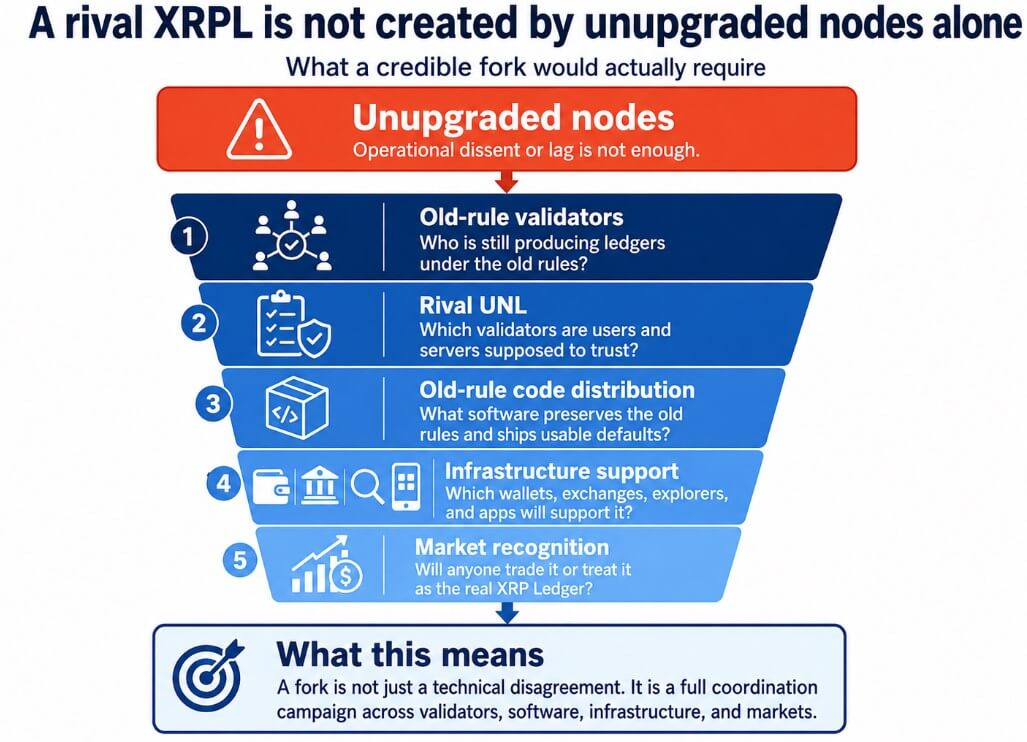
A credible XRPL fork requires five layers beyond unupgraded nodes: old-rule validators, a rival UNL, old-rule code, infrastructure support, and market recognition.

XRPL documentation cites research showing that competing UNLs may need 90% overlap in the worst case to prevent a fork, meaning any rival UNL would need to share nearly the entire trusted validator set with the canonical one to maintain internal coherence.

A fork forming around a radically different validator set risks producing a ledger that cannot sustain its own consensus, let alone attract market adoption.

What the amendment process actually tracks is validator support, and the 80%-for-two-weeks threshold ensures that the entities the network trusts have reached a durable agreement before new rules become permanent.

A large share of unupgraded non-validator nodes can reflect infrastructure lag without implying anything about the canonical ledger’s trajectory.

The distance between infrastructure lag and a rival chain

In the bear case, exchanges, wallets, or infrastructure operators that lag behind the May 27 activation become amendment-blocked and stop functioning as ledger participants.

Users routing through those providers encounter service disruptions, such as transactions that cannot be submitted, explorers that cannot confirm ledger validity, and apps that cannot process payments.

That operational cost falls on operators who deprioritized the upgrade, and it is worth tracking, particularly for any major exchange or custodian still running pre-3.1.3 nodes at activation.

Sustained infrastructure lag across enough providers would create real user-facing friction even as the canonical ledger continues under the new rules.

In the bull case, fixCleanup3_1_3 activates on schedule with the validator supermajority intact, infrastructure operators update without major incident, and the episode becomes a routine amendment activation.

The fixes to NFTs, Permissioned Domains, Vaults, and the Lending Protocol take effect, and the network moves on. The governance debate the upgrade surfaces survives either outcome, because Schwartz’s explanation of what a real split would require applies to any future amendment.

Sustaining old rules requires a dissenting group running old software, recruiting validators around a competing UNL, and convincing wallets, exchanges, and market makers to recognize their ledger as the canonical $XRP Ledger, against a default configuration pointing everyone else to the upgraded chain.

Every blockchain has a governance layer

Schwartz drew a comparison to Stellar, whose Protocol 24 upgrade is itself a stability fix for a state-archival bug in Stellar Core, which was a maintenance event requiring the same kind of coordinated validator adoption.

Bitcoin’s equivalent legitimacy layer runs through miners, economic nodes, client implementations, and exchange listings. Ethereum’s runs through validators, staking infrastructure, client diversity, core developers, and app-layer adoption.

What XRPL makes explicit through UNLs, other networks embed in mining power distribution, staking economics, or the social consensus around which client software developers trust.

The mechanisms differ across Bitcoin, Ethereum, and XRPL, while the dependence on coordinated human decisions to make rule changes permanent runs through all three.
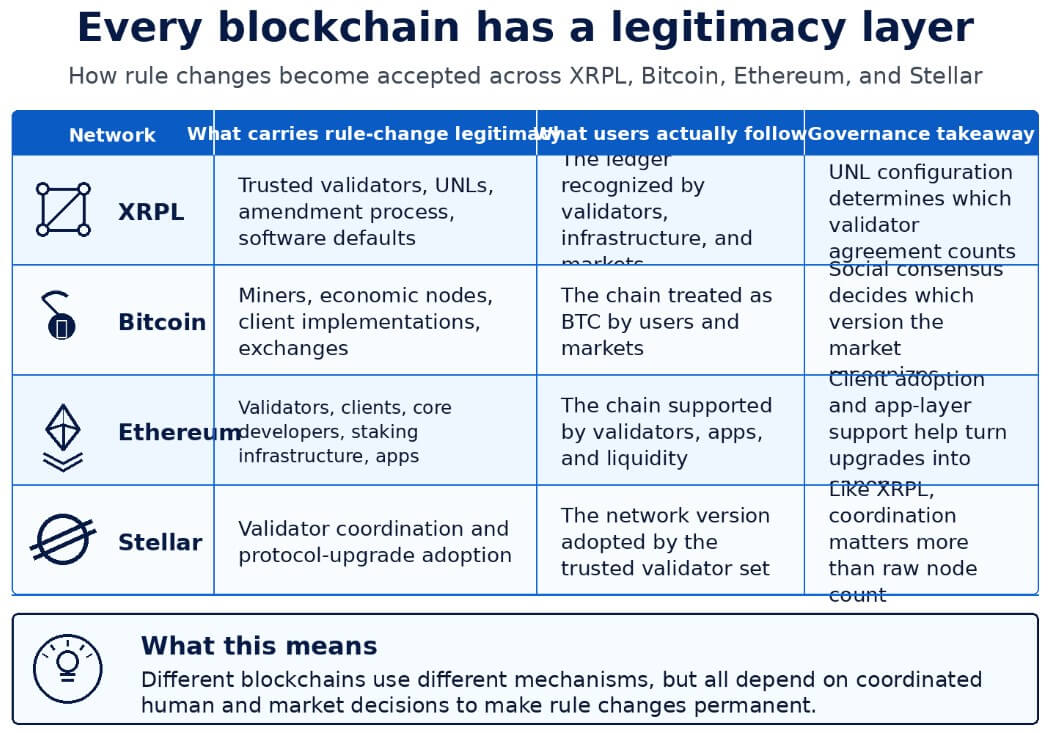
Across XRPL, Bitcoin, Ethereum, and Stellar, rule changes become permanent through coordinated validator, miner, developer, and market decisions rather than raw node count.

The May 27 activation illustrates how XRPL’s governance layer converts validator agreement into ledger permanence, with UNL configuration determining which agreements count.

An operator who disagrees with fixCleanup3_1_3 has the technical freedom to run old software and configure a rival UNL.

Whether any exchange lists the resulting token, any wallet supports it, or any market maker provides liquidity is a question the protocol cannot answer for them.

That coordination disconnect is why protocol upgrades on well-adopted networks rarely produce durable forks: the economics of following the canonical chain almost always outweigh the economics of building a parallel chain from scratch, and the canonical chain is whichever the market decides is real.

Share. Facebook Twitter Pinterest LinkedIn Tumblr Email
NBTC

NBTC is the editorial account for NBTC News, covering Bitcoin, Ethereum, DeFi, blockchain infrastructure, exchanges, mining, regulation and digital asset markets. The editorial team focuses on clear sourcing, timely updates and practical context for crypto readers.

Related Posts

Chainlink ($LINK) Lead the Pack of Top RWA Projects by Market Capitalization

21/06/2026

Cardano Ecosystem’s Lead Developer Makes Radical Decision for the Project’s Future! Here Are the Details

21/06/2026

Shiba Inu’s Shytoshi Kusama Confirms New Date for Key Discussion After Brief Silence

21/06/2026

GraniteShares Delays 3x Leveraged XRP ETF Until May 7

21/06/2026
Add A Comment

Comments are closed.

Top Posts
Get Informed

Subscribe to Updates

Get the latest news from NBTC regarding crypto, blockchains and web3 related topics.

Your source for the serious news. This website is crafted specifically to for crazy and hot cryptonews. Visit our main page for more tons of news.

We're social. Connect with us:

Facebook X (Twitter) LinkedIn RSS
Top Insights

Chainlink ($LINK) Lead the Pack of Top RWA Projects by Market Capitalization

21/06/2026

US government watchdog urges FDIC coordinate on crypto oversight

21/06/2026

Bybit Private Wealth Posts 50%+ APR, But the Real Story Is Risk

21/06/2026
Get Informed

Subscribe to Updates

Get the latest news from NBTC regarding crypto, blockchains and web3 related topics.

Type above and press Enter to search. Press Esc to cancel.