
Close Menu
  • Coins
    • Bitcoin
    • Ethereum
    • Altcoins
    • NFT
  • Blockchain
  • DeFi
  • Metaverse
  • Regulation
  • Other
    • Exchanges
    • ICO
    • GameFi
    • Mining
    • Legal
  • MarketCap
What's Hot

Are NFTs Dead in 2026? What Happened to the Market

29/07/2026

Did Claude Just Kill Zcash (ZEC)?

29/07/2026

Polymarket traders cut Clarity Act passage odds to record low as Senate delay drags on

29/07/2026
Facebook X (Twitter) Instagram
  • Back to NBTC homepage
  • Privacy Policy
  • Contact
X (Twitter) Telegram Facebook LinkedIn RSS
NBTC News
  • Coins
    1. Bitcoin
    2. Ethereum
    3. Altcoins
    4. NFT
    5. View All

    Bitcoin ETFs in Red for 6 Weeks in a Row Amid Major Filings From Franklin Templeton

    29/07/2026

    Bitcoin Analysts Split Between Buyer Demand And Resistance Ceiling Near $65,000

    29/07/2026

    Michael Saylor Makes Today’s Anticipated Bitcoin Announcement

    29/07/2026

    Satoshi’s Lost-Coin Quote Hits 16-Year Mark as Millions of BTC Are Deemed Lost

    29/07/2026

    Ethereum Price Faces Bearish Sentiment as History Points to Rebounds

    29/07/2026

    Ethereum Price Is Cooling, but Its Network Is Waking Up: 5 Key Metrics

    29/07/2026

    Polymarket Bettors Give Ethereum Just a 17% Shot at Reaching $3,000 in 2026

    29/07/2026

    Ethereum ETFs lose $70.7M as BlackRock leads withdrawals – What’s next for ETH?

    29/07/2026

    Did Claude Just Kill Zcash (ZEC)?

    29/07/2026

    Solana proposal SIMD-0550 aims to cut $1.5B in future SOL emissions by doubling disinflation rate

    29/07/2026

    Cardano active addresses hit a 4-month high

    29/07/2026

    Winklevoss-Backed Zcash Treasury Plunges Nearly 40% on ZEC Privacy Bug Concerns

    29/07/2026

    Are NFTs Dead in 2026? What Happened to the Market

    29/07/2026

    NFT Gacha Protocol Fake World Assets Trails Only Sky in Ethereum Daily Revenue

    28/07/2026

    Tensor HQ Declares NFTs Are Forever as Community Engagement Grows

    26/07/2026

    Jupiter Gacha Hits $20M in Volume, Signaling Strong Collector Interest

    26/07/2026

    Are NFTs Dead in 2026? What Happened to the Market

    29/07/2026

    Did Claude Just Kill Zcash (ZEC)?

    29/07/2026

    Polymarket traders cut Clarity Act passage odds to record low as Senate delay drags on

    29/07/2026

    Bitcoin ETFs in Red for 6 Weeks in a Row Amid Major Filings From Franklin Templeton

    29/07/2026
  • Blockchain

    XRP Ledger Gears Up for the Trillion-Dollar Tokenization Era Amid Eying 1.5 Million Users Through Stellar Wallet Integration

    28/07/2026

    ZKsync digital advisory targets enterprise blockchain

    28/07/2026

    Cardano Emerges as Fifth Fastest-Growing Blockchain for Real-World Assets

    28/07/2026

    Chainlink’s CCIP Surges Past $7B in Q2

    28/07/2026

    Solana’s COO Addresses Wall Street Concerns About Open Systems

    28/07/2026
  • DeFi

    Why Uniswap liquidity providers say the protocol fee switch ‘can’t work’

    29/07/2026

    HTX Research Maps the RWA-DeFi Convergence as Tokenized Assets Surge Past $20 Billion

    28/07/2026

    Aave Accounts for 47.8% of Onchain Active Loans, Says Token Terminal

    28/07/2026

    AI may pose bigger threat to DeFi than Bitcoin, Capriole’s Charles Edwards warns

    28/07/2026

    1inch opens Aqua liquidity protocol across 13 chains

    28/07/2026
  • Metaverse

    Is Solana Gaming Back? Kintara Activity Fuels Renewed Optimism in Onchain MMOs

    24/06/2026

    The Sandbox launches AI game engine ‘The Sandbox Studio’ for next-generation creators

    10/06/2026

    Meta commits $13M in funding for Oversight Board through 2028

    29/05/2026

    Why Animoca’s Yat Siu says the future is 100 billion AI agents

    07/05/2026

    ‘8,000 Jobs’—Polymarket Sees Tech Layoff Surge As Meta AI Push Bites

    18/04/2026
  • Regulation

    It’s time for tokenization to get to work

    29/07/2026

    “Hot Stock Summer” Brings Tokenized U.S. Stocks to Everyone

    29/07/2026

    Why Africa Is Quietly Becoming the Next Global Capital of Crypto

    29/07/2026

    BTC treasury firm Empery Digital invests $20M in AI data center developer Cardinal Data Power

    29/07/2026

    Crypto market loses nearly $27 billion as NASDAQ 100 falls

    29/07/2026
  • Other
    1. Exchanges
    2. ICO
    3. GameFi
    4. Mining
    5. Legal
    6. View All

    Binance’s USDC reserves fall 40% while USDT holds firm – Here’s why

    29/07/2026

    Crypto Exchange Knaken Declared Bankrupt

    29/07/2026

    Kalshi’s Daily Crypto Contract Volume Hits Record $217.98 Million

    29/07/2026

    Tether adds 30M USDT wallets every quarter as user base hits 500M

    29/07/2026

    ICO market slows sharply with only six completions in 2026

    30/04/2026

    South Korea Poised to Lift Ban on Domestic ICOs After 7 Years

    19/12/2025

    Why 2025’s Token Boom Looks Both Familiar and Dangerous

    31/10/2025

    ICO for bitcoin yield farming chain Corn screams we’re so back

    22/01/2025

    why gameplay now beats crypto rewards

    29/07/2026

    From NFT gaming to mining simulators

    29/07/2026

    Top 11 NFT games to play in July 2026

    16/07/2026

    Yield Guild Games Sunsets YGG Play Publishing Unit, Cuts 35 Jobs

    06/07/2026

    Bitcoin miners pour billions into AI – but the pivot could leave them regretting it within a year

    29/07/2026

    How will the Beshkala Mining Valley operate?

    29/07/2026

    Core Scientific lands AMD AI deal as bitcoin mining operation winds down

    29/07/2026

    Zcash 10X’d in a year but DCG’s Zcash miner kept losing money

    29/07/2026

    Polymarket traders cut Clarity Act passage odds to record low as Senate delay drags on

    29/07/2026

    Senator Warren requests 2026 reporting for Trump’s crypto earnings after $1.4B disclosure

    29/07/2026

    Solana Lobbyist Weighs In on Clarity Act Mayhem

    29/07/2026

    Public comments pushback on SEC plan to relax quarterly earning requirement

    29/07/2026

    Are NFTs Dead in 2026? What Happened to the Market

    29/07/2026

    Did Claude Just Kill Zcash (ZEC)?

    29/07/2026

    Polymarket traders cut Clarity Act passage odds to record low as Senate delay drags on

    29/07/2026

    Bitcoin ETFs in Red for 6 Weeks in a Row Amid Major Filings From Franklin Templeton

    29/07/2026
  • MarketCap
NBTC News
Home»Altcoins»What is Sonic Blockchain and How Does it Work? Full Guide
Altcoins

What is Sonic Blockchain and How Does it Work? Full Guide

NBTCBy NBTC02/03/2025No Comments6 Mins Read
Share
Facebook Twitter LinkedIn Pinterest Email


What Is the Sonic Blockchain?

Sonic is a relatively new Layer-1 blockchain created by Sonic Labs, formerly known as Fantom. The network was co-founded and architected by Andre Cronje, a well-known figure in the blockchain industry who previously contributed to numerous DeFi protocols like Yearn and Keep3r. Under his technical leadership, Sonic focuses on two main things: very fast speeds and helping developers earn money from their work. Sonic works with Ethereum-based apps and can handle up to 10,000 transactions every second. It confirms these transactions in less than one second, which makes it a powerful platform for moving digital assets quickly.

The team behind Sonic designed it to solve common problems that slow down other blockchains. Many networks struggle with either speed, security, or letting developers make money. Sonic tries to fix all three issues at once.

Key Features That Make Sonic Different

Transaction Speed and Confirmation Time

Sonic’s Proof-of-Stake consensus mechanism processes transactions much faster than many competing blockchains. It can handle 10,000 transactions per second, many times faster than networks like Ethereum or Bitcoin. When you send tokens or use an app on Sonic, your transaction completes in less than one second.

This speed makes Sonic useful for:

  • Trading digital assets when prices change quickly
  • Running games that need fast responses
  • Processing payments without waiting
  • Supporting apps with many users at once

Sonic aims to deliver a highly scalable blockchain environment to developers and users alike (official website)

Ethereum Compatibility Through Gateway Bridge

Sonic connects to Ethereum through its native Gateway bridge. This means that users can move their tokens between Sonic and Ethereum without complicated steps. Developers who built apps for Ethereum can bring them to Sonic without rewriting their code.

The Gateway bridge lets people use Ethereum’s security while enjoying Sonic’s speed. This matters because Ethereum has the most users and developers in blockchain, but Sonic offers better performance for everyday use.

Fee Monetization for Developers

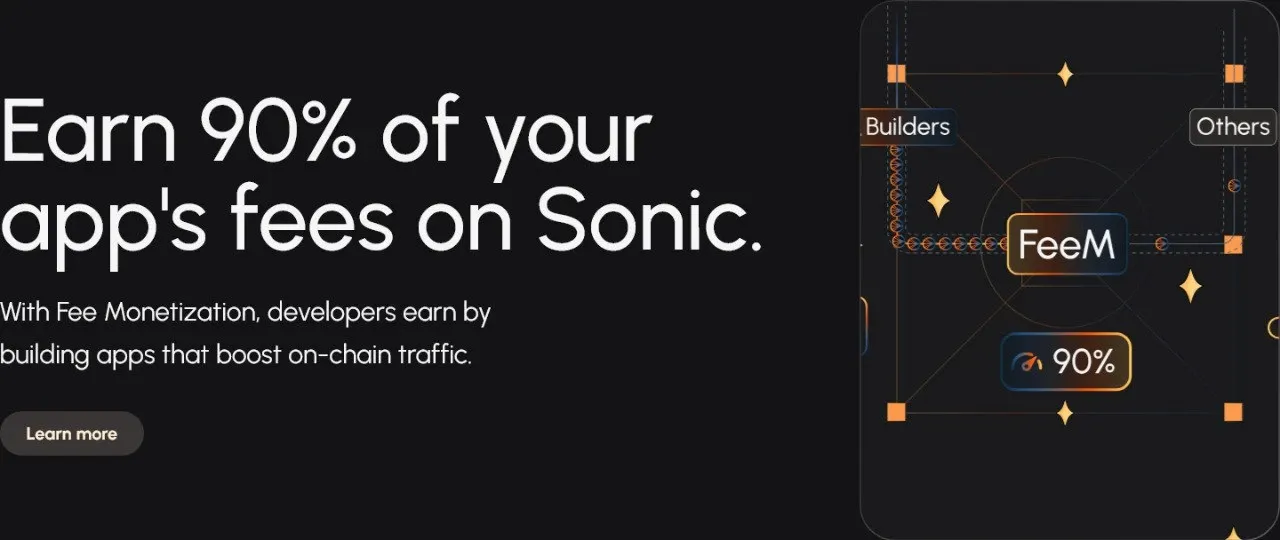
Perhaps the most unusual feature of Sonic is how it handles transaction fees. On most blockchains, when users pay fees, the money goes to validators or the network itself. Sonic does something different with its Fee Monetization system (FeeM).

When users pay fees while using an app on Sonic, up to 90% of those fees go back to the developers who built the app. This creates a new way for builders to earn money without constantly asking for investments or charging users extra fees.

This means that if half of all network transactions come from apps using FeeM and the average transaction costs are $0.01, and with 10 million daily transactions, the revenue would be about:

  • $36.5 million in yearly revenue
  • $9.125 million burned yearly (reducing supply)
  • $10.0375 million paid to validators yearly
  • $16.425 million distributed to Sonic developers yearly

This approach could transform how blockchain apps make money. Instead of focusing only on token sales or advertising, developers can earn from regular usage of their products. Even at just a fraction of the network’s technical capacity, this creates a sustainable economic model for the Layer-1 blockchain.
Sonic has various initiatives to encourage development

Sonic is structured to encourage development and participation in its ecosystem (official website)

S Token: Supply and Distribution

The Sonic network uses a token called “S” for various functions. Understanding how these tokens are distributed helps explain how the network will grow over time.

Total and Circulating Supply

The total number of S tokens is 3.175 billion. When the network launched, about 2.88 billion tokens were already in circulation. Many of these were from FTM token holders who swapped their tokens for S tokens at a 1:1 ratio. Unlike many cryptocurrencies, S does not have a fixed maximum supply cap.

The approach helped Sonic start with an active community with many holders instead of building from zero. People who supported Fantom could move to the new network with equivalent value.

User Airdrop Details

About 6% of the initial supply (approximately 190.5 million S tokens) will be given to users who were active on the Opera and Sonic networks. These tokens will be distributed six months after the network launch. Recipients won’t get all their tokens at once – instead, the tokens will unlock gradually over nine months.

This gradual release helps prevent people from selling all their tokens immediately, which could cause price instability.

Growth Funding Mechanism

Starting in June 2025, Sonic will create new tokens to fund network growth. Each year for ten years, the network will issue 1.5% of the total supply (about 47.6 million S tokens annually). These tokens will support development, marketing, and other activities that help the network expand.

Importantly, if the network doesn’t use all these new tokens, it will destroy the extras. This “burning” mechanism helps control the total supply and prevents unnecessary inflation.

Validator Rewards Structure

During the first four years of operation, Sonic will distribute approximately 70,067,224 tokens annually as rewards to validators. These rewards come from the existing token supply, not from newly minted tokens. This approach allows Sonic to avoid creating new S tokens for block rewards during this initial four year period.

From the fourth year onward, Sonic will start creating additional tokens to reward validators. These rewards will add 1.75% to the token supply each year, with a maximum of 70 million new S tokens annually.

This phased approach gives the network time to establish itself before increasing the token supply.

Supporting Developers Beyond Fee Sharing

While the Fee Monetization system provides immediate income to developers, Sonic also offers another incentive program called Sonic Gems.

The Sonic Gems Program

The Sonic Gems Program rewards applications based on how many people use them and how often. Developers receive S tokens when their apps show strong engagement metrics. This approach helps new projects grow without constantly raising money from investors.

For users, this means they might see more free apps and fewer subscription fees. For developers, it means they can focus on building useful products rather than monetization strategies.

Conclusion

Sonic represents a technical evolution in blockchain design with its 10,000 TPS performance and sub-second finality. By combining high transaction speeds, Ethereum compatibility, and strong economic incentives, Sonic aims to accelerate mainstream adoption of Web3 technologies.

Its most distinctive feature remains the Fee Monetization system, which redirects transaction fees to developers rather than validators. This focus on developer earnings could attract talent from traditional tech companies, as programmers can earn directly from their work without middlemen taking most profits. Combined with the Sonic Gems program and careful tokenomics planning, the platform creates a comprehensive economic system for sustainable blockchain application development.

The success of this approach depends on adoption from both developers and users. For developers, the economic incentives provide a clear path to sustainability. For users, the benefits include faster transactions, lower costs, and better applications. The sub-second finality means users receive immediate confirmation of their transactions, creating a smoother experience compared to networks with longer wait times.

With its Ethereum and EVM compatibility and performance advantages, Sonic has positioned itself to compete effectively in the increasingly crowded Layer-1 blockchain market, offering benefits for all ecosystem participants.

Share. Facebook Twitter Pinterest LinkedIn Tumblr Email
NBTC

NBTC is the editorial account for NBTC News, covering Bitcoin, Ethereum, DeFi, blockchain infrastructure, exchanges, mining, regulation and digital asset markets. The editorial team focuses on clear sourcing, timely updates and practical context for crypto readers.

Related Posts

Did Claude Just Kill Zcash (ZEC)?

29/07/2026

Solana proposal SIMD-0550 aims to cut $1.5B in future SOL emissions by doubling disinflation rate

29/07/2026

Cardano active addresses hit a 4-month high

29/07/2026

Winklevoss-Backed Zcash Treasury Plunges Nearly 40% on ZEC Privacy Bug Concerns

29/07/2026
Add A Comment

Comments are closed.

Top Posts
Get Informed

Subscribe to Updates

Get the latest news from NBTC regarding crypto, blockchains and web3 related topics.

Your source for the serious news. This website is crafted specifically to for crazy and hot cryptonews. Visit our main page for more tons of news.

We're social. Connect with us:

Facebook X (Twitter) LinkedIn RSS
Top Insights

Are NFTs Dead in 2026? What Happened to the Market

29/07/2026

Did Claude Just Kill Zcash (ZEC)?

29/07/2026

Polymarket traders cut Clarity Act passage odds to record low as Senate delay drags on

29/07/2026
Get Informed

Subscribe to Updates

Get the latest news from NBTC regarding crypto, blockchains and web3 related topics.

Type above and press Enter to search. Press Esc to cancel.