

Close Menu
  • Coins
    • Bitcoin
    • Ethereum
    • Altcoins
    • NFT
  • Blockchain
  • DeFi
  • Metaverse
  • Regulation
  • Other
    • Exchanges
    • ICO
    • GameFi
    • Mining
    • Legal
  • MarketCap
What's Hot

HSBC Expands Orion Network to UAE, Enabling Real-Time Dirham Liquidity Flows

28/06/2026

Is the Four-Year Cycle Dead, or Just Running Late?

28/06/2026

Tokenization’s Next Phase Is Lending, Says RedStone Co-Founder

28/06/2026
Facebook X (Twitter) Instagram
  • Back to NBTC homepage
  • Privacy Policy
  • Contact
X (Twitter) Telegram Facebook LinkedIn RSS
NBTC News
  • Coins
    1. Bitcoin
    2. Ethereum
    3. Altcoins
    4. NFT
    5. View All

    Is the Four-Year Cycle Dead, or Just Running Late?

    28/06/2026

    $14B loss raises fears of a deeper BTC fall

    28/06/2026

    What’s the Latest on Bitcoin? What Can We Expect Next? An Analysis Firm Explains

    28/06/2026

    Bitcoin Hits New Cycle Low After Bull Trap Plays Out, but Breakdown Is Not Over

    28/06/2026

    UBS and Nethermind Strengthen Ethereum’s Institutional Case With Successful Compliance Trials

    28/06/2026

    Wallets Tied to Bitmine Move 35,000 ETH Worth $58M Off Exchanges

    28/06/2026

    Can Ethereum bulls defend $1,611 as ETH selloff gathers pace?

    28/06/2026

    Ethereum price weakens near $1,670 as ETF outflow and low open interest bite

    28/06/2026

    Solana Decouples from Broader Market as Tokenized Stock Hype Fuels 15% SOL Rally

    28/06/2026

    OpenAI sparks crypto frenzy with GPT-5.6 Sol, Terra and Luna names

    28/06/2026

    Tether Briefly Overtakes Ethereum As Stablecoin Market Cap Tops ETH During Sell-Off

    28/06/2026

    Fragmetric Assures Protocol Continuity as Points Program Fallout Continues

    28/06/2026

    Element NFT Marketplace Expands Reach to Ink to Enhance NFT Accessibility

    27/06/2026

    Why is Pudgy Penguins (PENGU) Trending? What You Need to Know

    22/06/2026

    Top 10 NFT Performers by Trading Volume, Courtyard Outshines

    22/06/2026

    Pudgy Penguins expands retail footprint with Target trading card rollout

    20/06/2026

    HSBC Expands Orion Network to UAE, Enabling Real-Time Dirham Liquidity Flows

    28/06/2026

    Is the Four-Year Cycle Dead, or Just Running Late?

    28/06/2026

    Tokenization’s Next Phase Is Lending, Says RedStone Co-Founder

    28/06/2026

    UBS and Nethermind Strengthen Ethereum’s Institutional Case With Successful Compliance Trials

    28/06/2026
  • Blockchain

    Continental Partners With Securitize for Digital Securities

    27/06/2026

    Funton.ai Partners with Echobit Exchange, Expanding Blockchain Gaming Experience with Crypto Applications

    27/06/2026

    B.AI Taps imToken for Seamless TRON Top-Ups and Usage of AI Models for Web3 Users

    27/06/2026

    CertiK joins XDC Network as institutional masternode validator

    27/06/2026

    What is a modular blockchain? Rollups, data availability, and the new stack

    27/06/2026
  • DeFi

    Tokenization’s Next Phase Is Lending, Says RedStone Co-Founder

    28/06/2026

    Wanchain Joins Forces with Rango Exchange, Supporting Cross-Chain Transactions with DEX Aggregator

    28/06/2026

    Shibarium DEX Volume Drops to Zero as DeFi Activity Nearly Vanishes

    28/06/2026

    Xyra Labs Integrates TON to Expand Multi-Chain Trading Via Xyra Swap

    28/06/2026

    Maple Finance rallies 20% after Kraken partnership – Will SYRUP’s rise continue?

    28/06/2026
  • Metaverse

    Is Solana Gaming Back? Kintara Activity Fuels Renewed Optimism in Onchain MMOs

    24/06/2026

    The Sandbox launches AI game engine ‘The Sandbox Studio’ for next-generation creators

    10/06/2026

    Meta commits $13M in funding for Oversight Board through 2028

    29/05/2026

    Why Animoca’s Yat Siu says the future is 100 billion AI agents

    07/05/2026

    ‘8,000 Jobs’—Polymarket Sees Tech Layoff Surge As Meta AI Push Bites

    18/04/2026
  • Regulation

    BlackBerry is making a massive comeback as an ‘uncrashable’ software layer for AI and robotics

    28/06/2026

    Here Are the Latest Data – Be Even More Careful Tomorrow

    28/06/2026

    During Today’s Drop, a Stablecoin That Should Be Pegged to $1 Lost Its Peg and Is Falling

    28/06/2026

    Trump Says America’s 250th Year Is Set for an Economic Boom

    28/06/2026

    Stablecoins are becoming a central bank problem hiding in T-bill markets

    28/06/2026
  • Other
    1. Exchanges
    2. ICO
    3. GameFi
    4. Mining
    5. Legal
    6. View All

    HSBC Expands Orion Network to UAE, Enabling Real-Time Dirham Liquidity Flows

    28/06/2026

    Circle Publishes Official USDC Spec for Machine Payments Protocol, Enabling Crosschain Agent-to-Agent Commerce

    28/06/2026

    0x Opens Swap API to AI Agents Paying $0.01 Per Request in USDC

    28/06/2026

    Virtuals Protocol Launches Arena Insights as AI Trading Grows

    28/06/2026

    ICO market slows sharply with only six completions in 2026

    30/04/2026

    South Korea Poised to Lift Ban on Domestic ICOs After 7 Years

    19/12/2025

    Why 2025’s Token Boom Looks Both Familiar and Dangerous

    31/10/2025

    ICO for bitcoin yield farming chain Corn screams we’re so back

    22/01/2025

    Nexus Acquires Homegrown App Marketplace One Store, Expanding into Global Web3 Game Hub

    21/06/2026

    GMATRIXS and Plum Protocol Partner to Blend GameFi with Meme Assets, Driving Multi-Chain Web3 User Experience

    16/06/2026

    Crypto game studio Uncharted to shutdown along with Fishing Frenzy

    15/06/2026

    Pudgy Penguins Halts Web3 Mobile Game Pudgy Party to Focus on Pudgy World

    14/06/2026

    ChangXin Memory Technologies secures IPO approval to raise over $4B in China’s biggest chip listing

    28/06/2026

    Russia Plans Wider Crypto Mining Ban Across Key Regions From July

    28/06/2026

    Bitdeer Sells Entire Weekly Bitcoin Production, Now Holds Zero BTC

    28/06/2026

    Miners Absorb 18% Hashprice Crash as Bitcoin Difficulty Jumps 7.15%

    28/06/2026

    Elizabeth Warren once said CBDCs have a “great promise” – Now she’s helping block it

    28/06/2026

    Bull Bitcoin Secures MiCA License in France, Preserving Full Self-Custody and Privacy Features

    28/06/2026

    EU Forces Unlicensed Crypto Firms to Shut Down

    28/06/2026

    US Treasury targets Huione workaround as FinCEN moves against H-Pay in crypto scam crackdown

    28/06/2026

    HSBC Expands Orion Network to UAE, Enabling Real-Time Dirham Liquidity Flows

    28/06/2026

    Is the Four-Year Cycle Dead, or Just Running Late?

    28/06/2026

    Tokenization’s Next Phase Is Lending, Says RedStone Co-Founder

    28/06/2026

    UBS and Nethermind Strengthen Ethereum’s Institutional Case With Successful Compliance Trials

    28/06/2026
  • MarketCap
NBTC News
Home»Bitcoin»The Bitcoin Mempool: Relay Network Dynamics
Bitcoin

The Bitcoin Mempool: Relay Network Dynamics

NBTCBy NBTC15/07/2025No Comments6 Mins Read
Share
Facebook Twitter LinkedIn Pinterest Email


In the last Mempool article, I went over the different kinds of relay policy filters, why they exist, and the incentives that ultimately decide how effective each class of filter is at preventing the confirmation of different classes of transactions. In this piece I’ll be looking at the dynamics of the relay network when some nodes on the network are running different relay policies compared to other nodes.

All else being equal, when nodes on the network are running homogenous relay policies in their mempools, all transactions should propagate across the entire network given that they pay the minimum feerate necessary not to be evicted from a node’s mempool during times of large transaction backlogs. This changes when different nodes on the network are running heterogenous policies.

The Bitcoin relay network operates on a best effort basis, using what is called a flood-fill architecture. This means that when a transaction is received by one node, it is forwarded to every other node it is connected to except the one that it received the transaction from. This is a highly inefficient network architecture, but in the context of a decentralized system it provides a high degree of guarantee that the transaction will eventually reach its intended destination, the miners.

Introducing filters in a node’s relay policy to restrict the relaying of otherwise valid transactions in theory introduces friction to the propagation of that transaction, and degrades the reliability of the network’s ability to perform this function. In practice, things aren’t that simple.

How Much Friction Prevents Propagation

Let’s look at a simplified example of different network node compositions. In the following graphics blue nodes represent ones that will propagate some arbitrary class of consensus valid transactions, and red nodes represent ones that will not propagate those transactions. The collective set of miners is denoted in the center as a simple representation of where transacting users ultimately want their transactions to wind up so as to eventually be confirmed in the blockchain.

This is a model of the network in which the nodes refusing to propagate these transactions are a clear minority. As you can clearly see, any node on the network that accepts them has a clear path to relay them to the miners. The two nodes attempting to restrict the transactions propagation across the network have no effect on their eventual receipt by miners’ nodes.
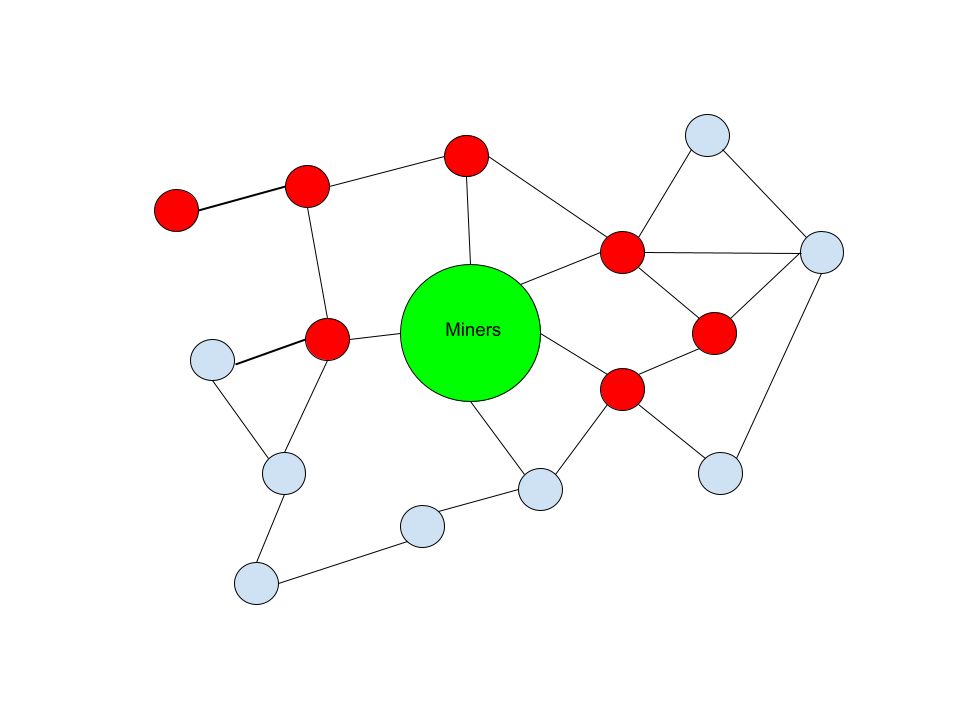
In this diagram, you can see that almost half of the example network is instituting filtering policies for this class of transactions. Despite this, only part of the network that propagates these transactions is cut off from a path to miners. The rest of the nodes not filtering still have a clear path to miners. This has introduced some degree of friction for a subset of users, but the others can still freely engage in propagating these transactions.

Even for the users that are affected by filtering nodes, only a single connection to the rest of the network nodes that are not cut off from miners (or a direct connection to a miner) is necessary in order for that friction to be removed. If the real relay network were to have a similar composition to this example, all it would take is a single new connection to alleviate the problem.
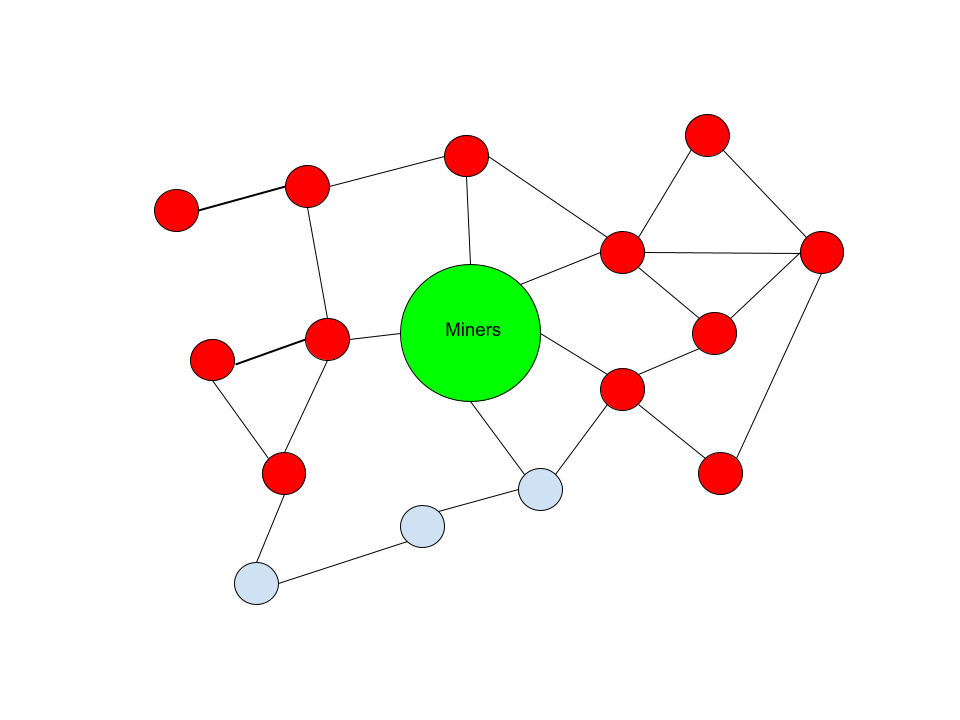
In this scenario, only a tiny minority of the network is actually propagating these transactions. The rest of the network is engaging in filtering policies to prevent their propagation. Even in this case however, those nodes that are not filtering still have a clear path to propagate them to miners.

Only this tiny minority of non-filtering nodes is necessary in order to ensure their eventual propagation to miners. Preferential peering logic, i.e. functionality to ensure that your node prefers peers who implement the same software version or relay policies. These types of solutions can guarantee that peers who will propagate something to others won’t find each other and maintain connections amongst themselves across the network.

The Tolerant Minority

As you can see looking at these different examples, even in the face of an overwhelming majority of the public network engaging in filtering of a specific class of transactions, all that is necessary for them to successfully propagate across the network to miners is a small minority of the network to propagate and relay them.

These nodes will essentially, through whatever technical mechanism, create a “sub-network” within the larger public relay network in order to guarantee that there are viable paths from users engaging in these types of transactions to the miners willing to include them in their blocks.

There is essentially nothing that can be done to counter this dynamic except to engage in a sybil attack against all of these nodes, and sybil attacks only need a single honest connection in order to be completely defeated. As well, an honest node creating a very large number of connections with other nodes on the network can raise the cost of such a sybil attack exorbitantly. The more connections it creates, the more sybil nodes must be spun up in order to consume all of its connection slots.

What If There Is No Minority?

So what if there is no Tolerant Minority? What will happen to this class of transactions in that case?
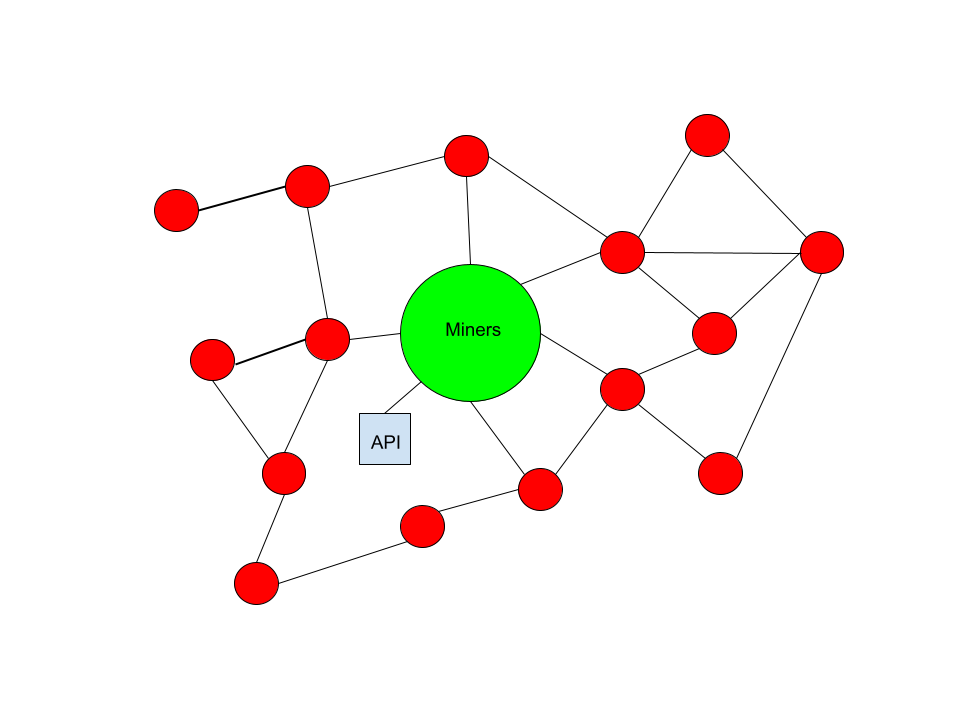
If users still want to make them and pay fees to miners for them, they will be confirmed. Miners will simply set up an API. The role of miners is to confirm transactions, and the reason they do so is to maximize profit. Miners are not selfless entities, or morally or ideologically motivated, they are a business. They exist to make money.

If users exist that are willing to pay them money for a certain type of transaction, and the entirety of the public relay network is refusing to propagate those transactions to miners in order to include them in blocks, miners will create another way for users to submit those transactions to them.

It is simply the rational move to make as a profit motivated actor when customers exist that wish to pay you money.

Relay Policy Is Not A Replacement For Consensus

At the end of the day, relay policy cannot successfully censor transactions if they are consensus valid, users are willing to pay for them, and miners do not have some extenuating circumstances to turn down the fees users are willing to pay (such as causing material damage or harm to nodes on the network, i.e. crashing nodes, propagating blocks that take hours to verify on a consumer PC, etc.).

If some class of transactions is truly seen as undesirable by Bitcoin users and node operators, there is no solution to stopping them from being confirmed in the blockchain short of enacting a consensus change to make them invalid.

If it were possible to simply prevent transactions from being confirmed by filtering policies implemented on the relay network, then Bitcoin would not be censorship resistant.

This post The Bitcoin Mempool: Relay Network Dynamics first appeared on Bitcoin Magazine and is written by Shinobi.

Share. Facebook Twitter Pinterest LinkedIn Tumblr Email
NBTC

NBTC is the editorial account for NBTC News, covering Bitcoin, Ethereum, DeFi, blockchain infrastructure, exchanges, mining, regulation and digital asset markets. The editorial team focuses on clear sourcing, timely updates and practical context for crypto readers.

Related Posts

Is the Four-Year Cycle Dead, or Just Running Late?

28/06/2026

$14B loss raises fears of a deeper BTC fall

28/06/2026

What’s the Latest on Bitcoin? What Can We Expect Next? An Analysis Firm Explains

28/06/2026

Bitcoin Hits New Cycle Low After Bull Trap Plays Out, but Breakdown Is Not Over

28/06/2026
Add A Comment

Comments are closed.

Top Posts
Get Informed

Subscribe to Updates

Get the latest news from NBTC regarding crypto, blockchains and web3 related topics.

Your source for the serious news. This website is crafted specifically to for crazy and hot cryptonews. Visit our main page for more tons of news.

We're social. Connect with us:

Facebook X (Twitter) LinkedIn RSS
Top Insights

HSBC Expands Orion Network to UAE, Enabling Real-Time Dirham Liquidity Flows

28/06/2026

Is the Four-Year Cycle Dead, or Just Running Late?

28/06/2026

Tokenization’s Next Phase Is Lending, Says RedStone Co-Founder

28/06/2026
Get Informed

Subscribe to Updates

Get the latest news from NBTC regarding crypto, blockchains and web3 related topics.

Type above and press Enter to search. Press Esc to cancel.