

Robinhood Chain kept producing blocks through the outage reported on Friday. What stopped was its transaction data reaching Ethereum, for 14 minutes across two gaps.
Posting those batches is what puts Robinhood Chain’s data where anyone can reconstruct the chain and check it, and what allows funds to leave for Ethereum. Robinhood Chain posts more of that data than any other network, so a delay in its batches is the largest single interruption the blob market can produce.
Arbitrum said Ethereum’s blob market caused the delay. That fits the second gap, which began after the blob price rose past the ceiling Robinhood Chain’s poster was bidding. It does not fit the first and longer one, which ran 8 minutes and 36 seconds while Ethereum blocks carried 263 unused blob slots and priced them at 0.0086 gwei against the poster’s standing bid of 0.0616.
“Robinhood Chain experienced no downtime,” Arbitrum posted at 2:19 p.m. New York time, after posts on X and two crypto outlets reported that the network had stopped producing blocks for around 14 minutes. “Earlier today, Robinhood Chain experienced batch posting delays due to L1 market blob behavior. Direct user transactions experienced no delays. Some infrastructure providers that rely on Robinhood Chain’s data stream experienced a brief performance impact due to a high number of feed subscribers. Robinhood Chain remains operational.” The post had drawn about 24,500 views, 314 likes and 40 replies within an hour.
Robinhood has published no technical account of the incident and its chain documentation lists no status page.
Blocks Never Stopped
Robinhood Chain produced 106,756 blocks between 12:00 and 15:00 UTC, an average of one every 101 milliseconds, according to blocks read from the chain’s Blockscout explorer. Block 54,248,341 carries a 12:00:00 timestamp and block 54,355,097 carries 15:00:00, a count consistent with uninterrupted production at that pace.
Blocks inside the window that traders flagged were full of activity. Block 54,266,500 at 12:30:37 UTC carried 19 transactions, block 54,270,000 at 12:36:34 carried 14, and block 54,274,000 at 12:43:21 carried 22. Every block sampled between 12:28 and 12:50 UTC held between 14 and 22 transactions.
Fourteen Minutes Of Missing Data
The delay sits on Ethereum. Robinhood Chain’s batch poster, the address 0xDaa5…87F4 identified by L2BEAT, submits blob transactions to the chain’s sequencer inbox contract at a median interval of 12 seconds. It went 8 minutes and 36 seconds without posting, from 12:29:47 to 12:38:23 UTC, then went another 5 minutes and 24 seconds silent from 12:42:47 to 12:48:11.
Those two gaps total 840 seconds, or exactly 14 minutes, matching the figure that circulated on Friday as the length of a block-production halt. Across the 18 minutes and 24 seconds between the start of the first gap and the end of the second, the poster landed batches at nine separate moments against the roughly 92 its median cadence implies. Software tracking the chain through its Ethereum batch data rather than its blocks would have seen 14 minutes of nothing arriving.
Across the nine hours from 11:00 to 20:00 UTC, 26 intervals ran 60 seconds or longer, and 19 of them fell between 12:10 and 14:51. The figures come from 2,279 consecutive blob transactions sent by that address, read from Blobscan.
Room Going Spare
A Robinhood Chain batch carries three blobs. Ethereum blocks held 21 at most on Friday and no block in a sample of 600 exceeded that, so the test of whether the chain was competing for space is how many blocks had three slots free while its batches were missing.
Through the first gap, 21 of the 29 Ethereum blocks that carried any blobs had at least three slots free, and the window held 263 unused slots in total. The blob base fee averaged 0.0086 gwei and peaked at 0.0152, against the 0.0616 gwei the poster had bid on its last transaction before the gap began.
The second gap reads differently. The blob base fee averaged 0.0625 gwei through it, above the standing bid, and the batch that ended the gap raised its ceiling to 0.8187 gwei.
Blob price is not the only condition on inclusion. A blob transaction also competes on its execution-layer fee, and block builders sometimes carry fewer blobs than the limit allows to keep blocks propagating quickly. Neither accounts for 8 minutes and 36 seconds of absence across 263 open slots at a twelfth of the price the sender had already offered.
Bidding Its Way Back
The poster’s fee ceiling shows what it did once batches began landing again. It bid 0.0616 gwei per unit of blob gas going into the first gap and 0.2463 gwei on the batch that ended it, four times higher, at a moment when the base fee had reached 0.0434. It bid 0.8187 gwei on the batch that ended the second gap and reached 1.4239 gwei at 12:53:59, roughly 10 times the prevailing base fee.
Whether that escalation was the poster responding to a rising market or recovering from a fault of its own is not established by the public record. Robinhood has not said which, and the mempool data that would show whether its batches were broadcast and waiting during the first gap is not publicly retained.
The 21-Blob Ceiling
Blob space did tighten on Friday, later than the first gap. The blob base fee averaged 0.0055 gwei across the 85 minutes to 12:25 UTC, then climbed to 0.1473 gwei by 12:53:23, 27 times the earlier level.
Ethereum blocks carried an average of 6.92 blobs in the calm period and 11.99 between 12:25 and 13:00 UTC. Eight percent of blocks in that window carried 21 blobs, the most any block held.
At the peak fee, a three-blob Robinhood Chain batch cost about 14 cents to post.
Base Filled The Blocks
The demand that moved the price came from Base. Robinhood Chain’s own posting rate held steady: its batch poster sent 476 blobs in the 35 minutes to 11:35 UTC and 477 in the 35 minutes to 13:00 UTC, according to Blobscan.
Base nearly tripled its usage over the same comparison, from 222 blobs to 593, Blobscan data shows. Arbitrum One went from 48 to 135, and total blob supply across all senders rose 59%, from 1,058 blobs to 1,678. Robinhood Chain still accounted for 28% of every blob posted to Ethereum during the crunch and 45% in the calm window before it, more than any other single sender in either sample.
Base’s batcher posts six blobs at a time, so it buys more space by posting more often. It submitted a batch every 55 seconds through the morning, then 45 batches in the 10 minutes from 12:30 UTC, one every 13 seconds and four times its morning rate, before settling near one every 30 seconds for the rest of the afternoon.
Traffic on Base is what changed. Its blocks carried an average of 1,428 transactions in those 10 minutes against 174 at 12:20, measured from blocks read through Base’s public RPC endpoint. One block held 2,031 transactions; another burned 360 million gas against Base’s 400 million gas limit. Base’s own base fee left the 0.005 gwei floor it had held all morning, reaching 0.0193 gwei by 12:40.
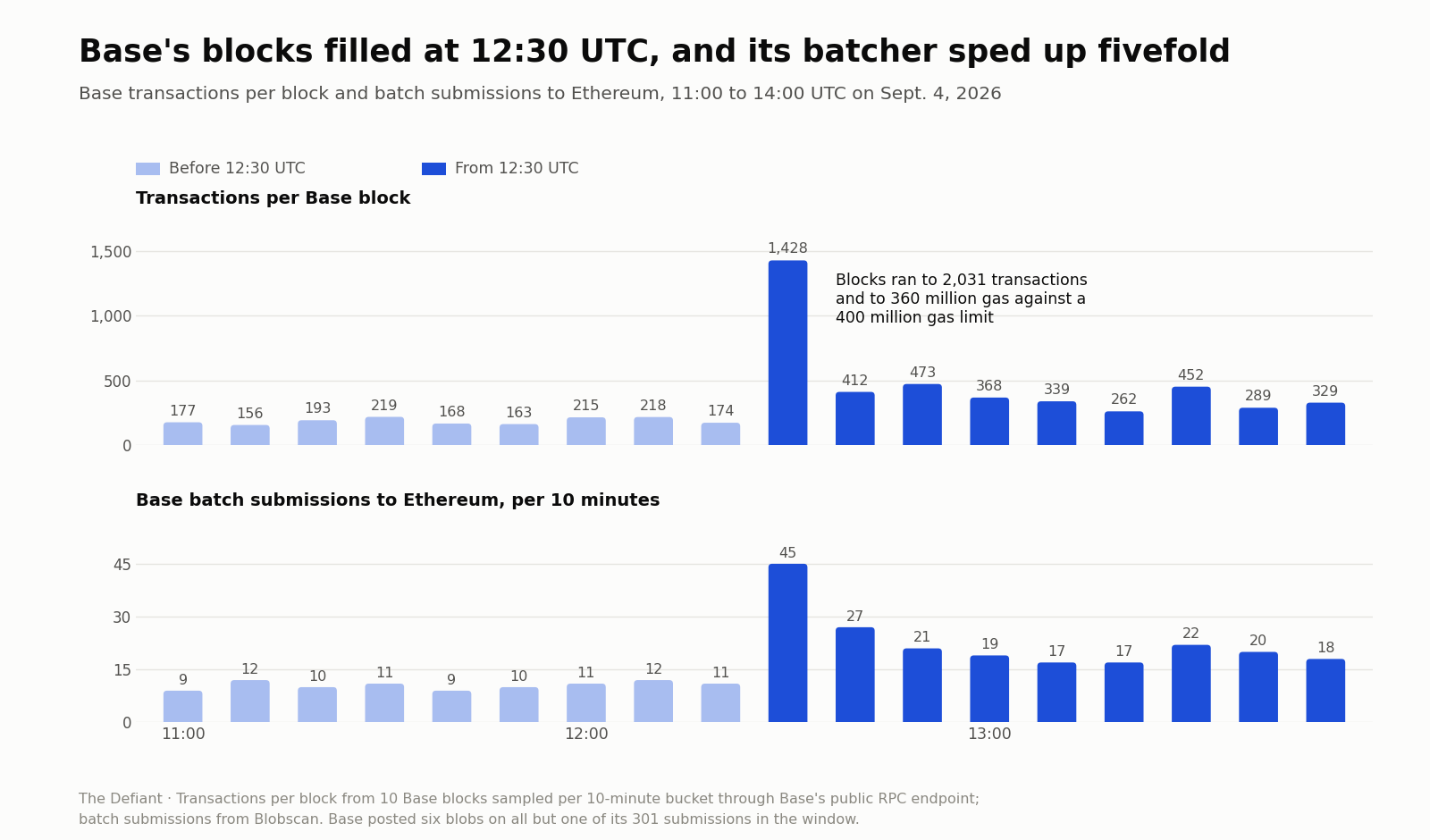
About 31% of the Base transactions sampled in the 12:40 UTC window went to four unverified contracts that emit no event logs and move no tokens, burning between 54,000 and 144,000 gas each. None carries a public label. One has processed 4.43 million transactions since deployment and recorded a single token transfer, according to Base’s Blockscout explorer.
Robinhood and Base did not reply to a request for comment by press time.
What Batches Buy
Robinhood Chain’s sequencer confirms transactions for users on its own; posting the batches to Ethereum is what puts the data where anyone can reconstruct the chain and challenge it, and what allows funds to leave for Ethereum.
Robinhood operates the chain’s only sequencer, and L2BEAT flags a precompile, ArbFilteredTransactionsManager, that lets an authorized filterer register a transaction hash and cause the state transition to fail it, including transactions that were force-included. There is no delay on code upgrades. Users had no alternative route while batches queued.
Software that reads the chain’s sequencer feed rather than its blocks, the route Chainstack’s open-source decoder takes to see transactions before they execute, saw the degradation, which is consistent with monitoring tools reporting a halt that block data does not show.
Fees Keep Climbing
Robinhood Chain took $4.59 million in chain fees over 24 hours, up 3.1%, according to DefiLlama. Total value locked reached $839.7 million, from $783.1 million a day earlier. DEX volume was $1.69 billion, up 8.6% on the day and 98.2% over seven days.
The chain launched its mainnet on July 1 as infrastructure for tokenized securities, then leaned into memecoins as launch platforms paired them against stock tokens. It passed Solana on tokenized stock volume in late July, overtook Base on daily active users three weeks after launch and topped Ethereum on daily application revenue on Aug. 29.
Arbitrum collects 10% of the chain’s fees under its Expansion Program license, split 8% to the DAO treasury and 2% to development funding.
ARB traded at $0.1327, down 5.7% over 24 hours, for a market capitalization of $886.2 million, according to CoinGecko. PONS, the launchpad token native to the chain, was at $0.6903, up 12.8%. ETH traded at $2,457.42, down 2.2%.
Robinhood Chain block data read from the chain’s Blockscout explorer; batch posting, blob capacity and blob market data from Blobscan, covering 2,279 blob transactions from the chain’s batch poster and 786 Ethereum blocks between 11:00 and 14:00 UTC on Sept. 4. Free-slot counts assume the 21-blob maximum observed across that window and a separate sample of 600 blocks. Base transaction, gas and base fee figures from 10 blocks sampled per 10-minute bucket through Base’s public RPC endpoint, with destination contracts counted across 2,899 transactions in the 12:40 UTC window. Fee, TVL and volume figures via DefiLlama and prices via CoinGecko at 19:30 UTC on Sept. 4.
