

DefiLlama shows Pump.fun generated $108.3 million in gross revenue during the first quarter and $69.2 million in the second quarter to date, marking a 36.1% decline from the prior quarter’s pace.
The broader Pump stack, which includes PumpSwap and Terminal alongside Pump.fun, shows Q2-to-date gross protocol revenue of $179.3 million, 37.5% below the first quarter’s $287.1 million, while earnings fell from $120.9 million to $79.1 million over the same period.
Pump.fun’s scale ranks among the most profitable consumer applications ever built on Solana. Its cumulative revenue exceeds $1 billion, and the broader Pump stack has generated $1.18 billion since launch.
Its bonding-curve mechanism, which bootstraps initial liquidity for new token issuances and collects fees on trades, graduations, and Mayhem-mode activity, still processes hundreds of millions in DEX volume monthly.
The quarterly comparison shows a deceleration, with cumulative revenue and volume reflecting one of crypto’s most productive consumer loops.
The revenue conversation on Solana has widened as Collector Crypt’s quarterly numbers run in the opposite direction.
A different curve
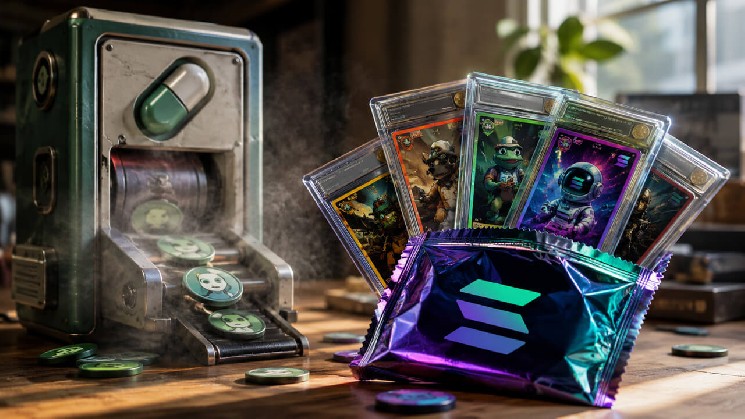
Collector Crypt is a Solana protocol built around tokenized physical trading cards: users buy randomized digital packs tied to real, graded cards, trade tokenized cards on-chain, sell them back through the platform, or redeem the physical versions.
DefiLlama describes it as a protocol to sell RWA Pokémon cards on Solana, with revenue from gacha pack sales, marketplace fees, and royalties, net of gacha pack buybacks.
Collector Crypt opened over 215,000 tokenized TCG packs in a single week and crossed $50 million in cumulative revenue, with more than 30% of users redeeming physical cards.
DefiLlama shows Collector Crypt generated $12.3 million in the first quarter and $25.8 million in the second quarter to date, a 108.8% acceleration.
Its 7-day revenue of $5.1 million represents about 38% of its nearly $13.5 million 30-day total, a sharper recent concentration than Pump.fun’s 22.8% ratio.
Collector Crypt’s last 30 days also account for 88.3% of its approximately $123.5 million in cumulative DEX volume, compared with 1.4% for Pump.fun, which reflects a protocol whose measurable activity is recent and compressing upward rather than spread across years of cumulative issuance.
Collector Crypt’s 2026 revenue of $38.1 million is about 21.5% of Pump.fun’s $177.5 million, and 8.2% of the broader Pump stack’s $466.5 million.
The data show that a protocol generates its strongest activity precisely as the larger platform decelerates.
$CARDS as the market’s attention proxy
$CARDS, Collector Crypt’s token, has moved in tandem with the protocol’s revenue acceleration.
CoinGecko shows the token around $0.259, up 47% over seven days, with approximately $10.4 million in 24-hour trading volume, a market cap of around $66.83 million, and an all-time high of $0.38.
$CARDS has become the liquid instrument traders use to express a view on Collector Crypt’s acceleration, but token holders should not assume revenue capture from that price action.
DefiLlama currently lists Collector Crypt holders’ revenue as zero and notes that tracking is disabled until the protocol’s buyback hub wallet receives official confirmation.
The broader tokenized trading card market provides context for why Collector Crypt’s activity curve looks the way it does.
The top seven tokenized trading-card platforms generated $230 million in gacha sales in May 2026, up sevenfold year over year, with Solana accounting for 64% of that volume.
That expansion points to a specific aspect of what Solana’s consumer app economy can now monetize.
Pump.fun’s model depends on a speculative issuance loop: new tokens launch, trade on bonding curves, graduate to open markets, and generate fees at each stage.
Collector Crypt’s model depends on a consumer loop different from Pump.fun’s, based on randomized pack openings tied to recognizable physical collectibles, on-chain secondary trading, and real-world redemption.
Both loops generate fees, volume, and token-market activity, but they draw on different user motivations and different definitions of what makes an on-chain asset worth holding.
Where the numbers go next
If Collector Crypt sustains its current revenue pace and the broader tokenized trading-card category continues to expand, the protocol becomes a durable fixture in Solana’s app-revenue rankings.
$CARDS continues to serve as the liquid proxy for that acceleration, gacha pack demand remains elevated, and the 30-day revenue gap between Collector Crypt and Pump.fun narrows further.
The sevenfold year-over-year figure for the broader TCG gacha category supports this trajectory if user demand holds.
If gacha demand fades, $CARDS volume drops, or multiple jurisdictions apply loot-box frameworks to scrutinize randomized-pack mechanics, Collector Crypt’s recent concentration of activity becomes a liability rather than proof of acceleration.
The protocol’s cumulative revenue base of $58.4 million is thin relative to Pump.fun’s $1 billion, which means a demand pullback would show up quickly in the weekly ratios that currently make Collector Crypt’s trajectory legible.
Collector Crypt is building on the premise that users will pay for, trade, and return digital assets anchored to physical objects they recognize.
The second-quarter data show that this model and Pump.fun’s can both generate real fees on the same chain at the same time, and that Solana’s consumer revenue base is wider than it was at the start of the year.
