


The exploit of Polkadot’s bridge protocol Hyperbridge last month is a symbol of deeper dysfunction within one of crypto’s most ambitious ecosystems, a former insider says.
Jaskirat Singh, co-founder and former CEO of Polkassembly, which served as the primary governance interface for Polkadot and Kusama for over five years before quietly shutting down last month, told The Defiant the exploit reflects a pattern of costly missteps at Polkadot.
The issues, Singh said, span from lack of direction from ecosystem leadership, to DAO overspending, and even failure to pay ecosystem participants for their contributions, including Polkassembly itself.
A spokesman for Parity, the company behind the development of the Polkadot blockchain, denied those claims.
Bridge Chaos
The Polkadot bridge situation has been expensive and chaotic.
“Hyperbridge, sadly, was the bridge that Polkadot had labeled as the official bridge a while back after having spent millions of dollars on building their own bridge and funding other bridges,” Singh told The Defiant.
A 2024 Polkadot governance vote approved nearly $6 million in combined USDC and $DOT for Snowbridge — a Polkadot/Kusama-Ethereum bridge — which launched in 2024 after years of delays, then arrived with what Singh describes as “insane fees.” A subsequent Snowbridge funding request for $3.4 million was rejected by governance last August.
Meanwhile, Polytope Labs, the team behind Hyperbridge, raised $2.5 million in a September 2024 seed round led by Web3 Foundation (W3F), the nonprofit entity behind the Polkadot ecosystem, and VC firm Scytale, which Polkadot founder Gavin Wood advises.
Hyperbridge was elevated to native bridge status a year ago, per a press release from the protocol, with Polkadot governance allocating 795,000 $DOT — worth about $3.8 million at the time and just under $1 million today — from the protocol’s treasury for a liquidity campaign.
Stuart Macdonald, chief of staff at Parity, pushed back on Hyperbridge’s and Singh’s framing.
He told The Defiant that Hyperbridge is not in fact Polkadot’s native bridge, and that while it was used for the liquidity campaign, it was “not an ‘official’, Polkadot-endorsed bridge.”
Parity and W3F are now distancing themselves from the protocol entirely.
“Hyperbridge is an independent project deployed as a permissionless parachain in the Polkadot network,” Macdonald told The Defiant.
Who’s Actually Running Polkadot?
To understand why this matters, it helps to understand how Polkadot’s institutional structure works.
Polkadot operates with two key entities: Web3 Foundation (W3F), a Swiss non-profit founded by Wood that currently leads advocacy and education with a focus on promoting web3 values; and Parity Technologies, the private company that leads protocol development and engineering.
Wood — who was also one of the co-founders of Ethereum before building Polkadot — currently serves as CEO of Parity, which he also founded, and President of the W3F Council.
This structure is a common one in DeFi, with protocols often opting for a non-profit foundation and a separate Labs company (centralized development company), often also coordinating with a decentralized autonomous organization, aka DAO, which is a community governance body of token holders.
OpenGov – which is Polkadot’s on-chain governance system, where $DOT holders vote on decisions, like treasury spending and protocol change – has handled decision-making at Polkadot since 2023.
Polkadot’s origins trace to a 2016 whitepaper, authored by Wood, proposing a “heterogeneous multi-chain framework.” The original framework positions Polkadot explicitly as a Layer 0 chain, the foundational infrastructure on which other chains would run, rather than an application platform in its own right.
It also lays out the architecture and terminology Polkadot would go on to realize in production: a relay chain providing shared security to a network of specialized blockchains called parachains, enabling them to communicate without trusted intermediaries.
W3F raised approximately $145 million in a public ICO in October 2017, followed by multiple private sales in 2019. In Polkadot’s year-end report for that year, Wood said Polkadot conducted a “number of private sales,” selling over 5% of the genesis $DOT supply. Wood noted that venture capital firm Placeholder Capital was among the participants, but didn’t reveal much else about the sales.
Finally, a 2020 private sale that raised just under $43 million, also with VC participation, brought total token sale fundraising to an estimated $247.7 million. The mainnet launched in May 2020, with the first parachains going live in late 2021.
W3F Sunsets Initiatives, Including Official Support
While W3F was an active participant in the development of the Polkadot and Kusama ecosystems since the foundation’s inception, Polkassembly’s co-founder argues that it has largely retreated from that role — a take the foundation itself didn’t deny.
This February, the foundation wound down its official Polkadot Support channels. Earlier, in December, it sunset its general grants program, as well as Decentralized Voices and Decentralized Nodes initiatives.
Leadership instability compounds the picture. Fabian Gompf, appointed W3F CEO in September 2023, stepped down in February 2025 after roughly 16 months. The foundation is now led by managing director Thomas Fecker Boxler, who joined W3F as CFO in March 2023.
Macdonald, who also currently provides official comms for W3F, said the shift was strategic:
“W3F is stepping back from operational roles to concentrate on global advocacy and long-term stewardship. On-chain treasury funding remains fully open and new programmes and initiatives will be rolled out by other entities as needs emerge.”
Indeed, W3F announced in March that it was narrowing its scope toward “championing the long-term vision of Web3 while ensuring that resources entrusted to the Foundation are deployed responsibly.”
Singh was less charitable.
“When the foundation was established, over $200 million went to the foundation — so to four years later come and say like oh now we’re only doing conferences and treasury management…” he said, evidently referring to W3F’s 30% allocation of Polkadot’s initial token supply, which was increased to 1 billion $DOT in 2020.
Treasury Payment Issues
Singh told The Defiant that Polkassembly operated for over five years, tracking more than 1,700 Polkadot referenda and serving over 250K participants. He also said that the governance platform kept running for roughly eight months without payment.
After an initial attempt at retroactive compensation was denied, the team submitted a narrower final request for 62,700 USDT this February — $50K of which was to “settle a discounted portion of outstanding contributor compensation for already-delivered OpenGov infrastructure work.” The proposal excluded founder compensation and reflected a “45% reduction following internal discussions.”
It was overwhelmingly rejected, with over 99% of votes against. Anonymous commenters on the proposal said the platform had already “drained” and “milked” millions from the treasury.
While Polkassembly remains referenced and linked on Parity’s official website, as well as the official Polkadot Wiki’s OpenGov guides, such as here and here, Macdonald told The Defiant that Web3 Foundation “has never mandated Polkassembly to perform any work for us,” adding:
“Polkassembly was funded through OpenGov. Their most recent referendum sought retroactive payment for work the community had not approved in advance. The community voted against it decisively, with roughly 0.2% in favour – W3F abstained on that vote.”
Macdonald was also careful to note that W3F votes on decisions alongside other $DOT holders and “is an independent entity that is one of many stakeholders in the Polkadot ecosystem.”
Meanwhile, Singh says Polkassembly isn’t alone.
“Everyone has faced the same problem with the foundation not giving any direction for the longest time and then coming in just basically closing all the doors on everyone and not paying them for their work.”
Just last month, a former Parity employee who went on to lead an ambassador program at Polkadot publicly alleged that she had not been paid for agreed-upon work and expenses totaling over $200,000.
Lucy Coulden, who has launched a crowdfunding campaign to cover legal costs, wrote that the uncompensated work for the Polkadot ecosystem spanned eight months and that there was a “clear and reasonable expectation that the work would be supported financially.”
The broader issue, Coulden writes, is that in the case of decentralized ecosystems, accountability can be blurred and individual contributors bear the risk that their work won’t be funded, even retroactively.
“Contributors are encouraged to deliver real work – partnerships, coordination, events and public engagement – often in reliance on governance systems that promise fair funding,” Coulden writes.
Singh said the problem with decentralized entities is that “there’s nobody really driving things. More importantly, there’s no accountability.”
Macdonald tole The Defiant that neither Parity nor W3F owes contractors money.
“To the extent any suggestion is being made that Parity or W3F owes unpaid sums in connection with the matters referenced, we do not accept that any sums are due or that Parity or W3F has any liability in relation to them.”
Referring to Singh’s claims of a broader pattern of not paying ecosystem contributors for their work, Macdonald shifted responsibility to collective $DOT token holders, stating, “OpenGov funding decisions rest with $DOT holders, and teams whose proposals are not approved are sometimes disappointed,” adding:
“W3F follows rigorous procedures for all its contractual commitments, and we are not aware of any outstanding disputes.”
Treasury Spending
Singh also raised the question of accountability around Polkadot’s treasury spending — including the reported $180K Polkadot spent on private jet branding in May 2024.
Polkadot spent a total of $133 million in 2024 — $48 million on outreach, $32 million on development, $19 million on business development — drawing community criticism, particularly around the $37 million allocated to marketing, advertising, and events in the first half of that year alone.
Spend dropped sharply to $70.6 million for full-year 2025, with Q4 coming in at $7.4 million, the lowest spending quarter since the introduction of OpenGov. But treasury spending for each of the remaining quarters last year was in the double-digit millions of dollars, according to Polkadot’s own reports.
Projects Voting with Their Feet: What Do Parachain Teams Have to Say?
The reported governance dysfunction has a parallel in project departures. Centrifuge, the real-world asset protocol that was among the ecosystem’s flagship parachains, announced last July that it was migrating to Ethereum, citing broader reach and liquidity.
Another project, Manta, announced last January that it was shutting down its Polkadot parachain, Manta Atlantic. Manta had first expanded to Ethereum as an L2 in 2023 and was running the two chains in parallel. In its announcement that it was deprecating its parachain entirely, the team underlined, by way of contrast, the “remarkable growth and adoption” on its L2 versus the parachain.
In November of last year, former parachain Phala, which launched in 2022, officially departed from the ecosystem as well, also migrating to an L2. The project’s DAO had first proposed sunsetting the Phala parachain in September, and later said the move was strategic: “It marks a new era for Phala — a deliberate choice of scalability and future-proofing over legacy infrastructure.”
The original governance proposal to sunset the parachain noted that its so-called slot on the Polkadot relay chain was expiring in November and “[k]eeping it alive would consume significant resources while locking us into an infrastructure with limited scalability.”
In Manta’s case, the official parachain sunsetting announcement was succinct and only indirectly cited lack of adoption in the Polkadot ecosystem as the project’s reason for leaving. But more than six months prior to that official announcement, Manta’s co-founder was explicit about the team’s critiques of the Polkadot ecosystem.
In a July 2, 2024 X post, Victor Ji wrote, “we do not want to engage with the Polkadot ecosystem and team at all.” He continued, echoing similar critiques from Singh:
“It is a highly toxic ecosystem that lacks any real value for web3, and it does not focus on users or adoption at all.”
Notably, Ji’s X post was a response to a post from April of that year criticizing Polkadot treasury spending from none other than the cofounder of Polytope Labs, the firm behind Hyperbridge.
In the scathing X thread, Ji also called the team behind Polkadot “incapable and not truly decentralized,” alleging that Wood and the team, presumably referring to Parity and W3F, had failed to support Polkadot builders.
“[T]he entire Polkadot ecosystem is essentially dead,” Ji wrote.
Commenting on projects leaving the Polkadot ecosystem, Macdonald said, “independent teams make their own strategic decisions.” He also noted that new projects have joined since, and that “using the Polkadot SDK allows for teams to easily join or leave the Polkadot ecosystem.”
In the same X thread, the Manta co-founder also accused the ecosystem and “Polkadot team” of discrimination against Asian founders and developers.
Ecosystem Update: What Do the Numbers Say?
Polkadot parachains collectively hold ~$81 million in DeFi TVL as of May 7, per DefiLlama data — with the bulk, over $75.7 million, sitting on the Hydration protocol.
But in September 2025, Hydration’s TVL reached as high as $376.5 million; it has since fallen more than 80%. For comparison, DeFi TVL on Ethereum currently sits at $48 billion, followed by Solana with $6.8 billion.
Hydration’s parachain, formerly known as HydraX, launched in 2022, but its TVL only began notably growing in 2024, eventually overtaking Moonbeam to become the ecosystem’s dominant DEX and lending protocol by value locked.
Other parachains, however, have seen their TVL share shrink, especially over the past year. One of them, Astar Network — which was among the five original parachain slot auction winners in 2021, and secured over 10 million $DOT via a crowdloan — represented between 60-70% of total value locked across Polkadot parachains from March-June 2022, per DefiLlama data. That share shrank to ~25% for the next two years and it’s now sitting at just over 2.5% of parachain TVL, as of May 6.
While Astar remains a parachain, the TVL shift reflects the project’s expansion beyond Polkadot to Ethereum and Soneium, Sony’s L2.
Acala, another of the original 2021 parachain cohort, suffered a different fate. Just after its TVL peaked above $110 million in mid-August 2022, a liquidity pool bug caused the erroneous minting over 1.2 billion of the protocol’s native stablecoin, aUSD. As a result, aUSD depegged and Acala’s TVL plummeted to below $50 million in a matter of days. It never recovered and in 2024 began drifting lower, reaching around $122,400 in TVL as of today.
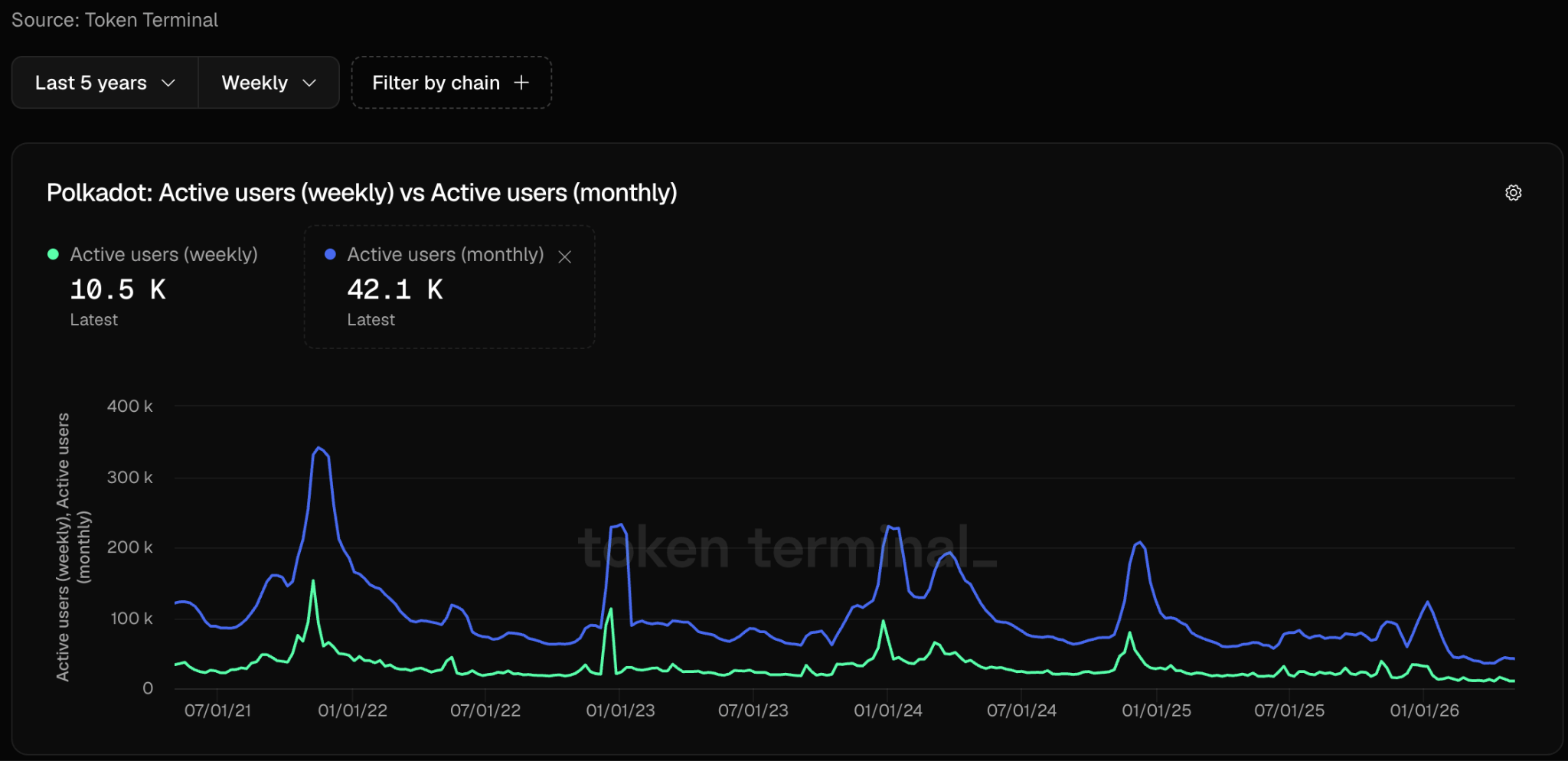
Meanwhile, more broadly, monthly active users across the Polkadot ecosystem currently stands at around 43,000, per data from TokenTerminal, down from ~200,000 in December 2024, and an all-time high of 230,000 in January 2024.
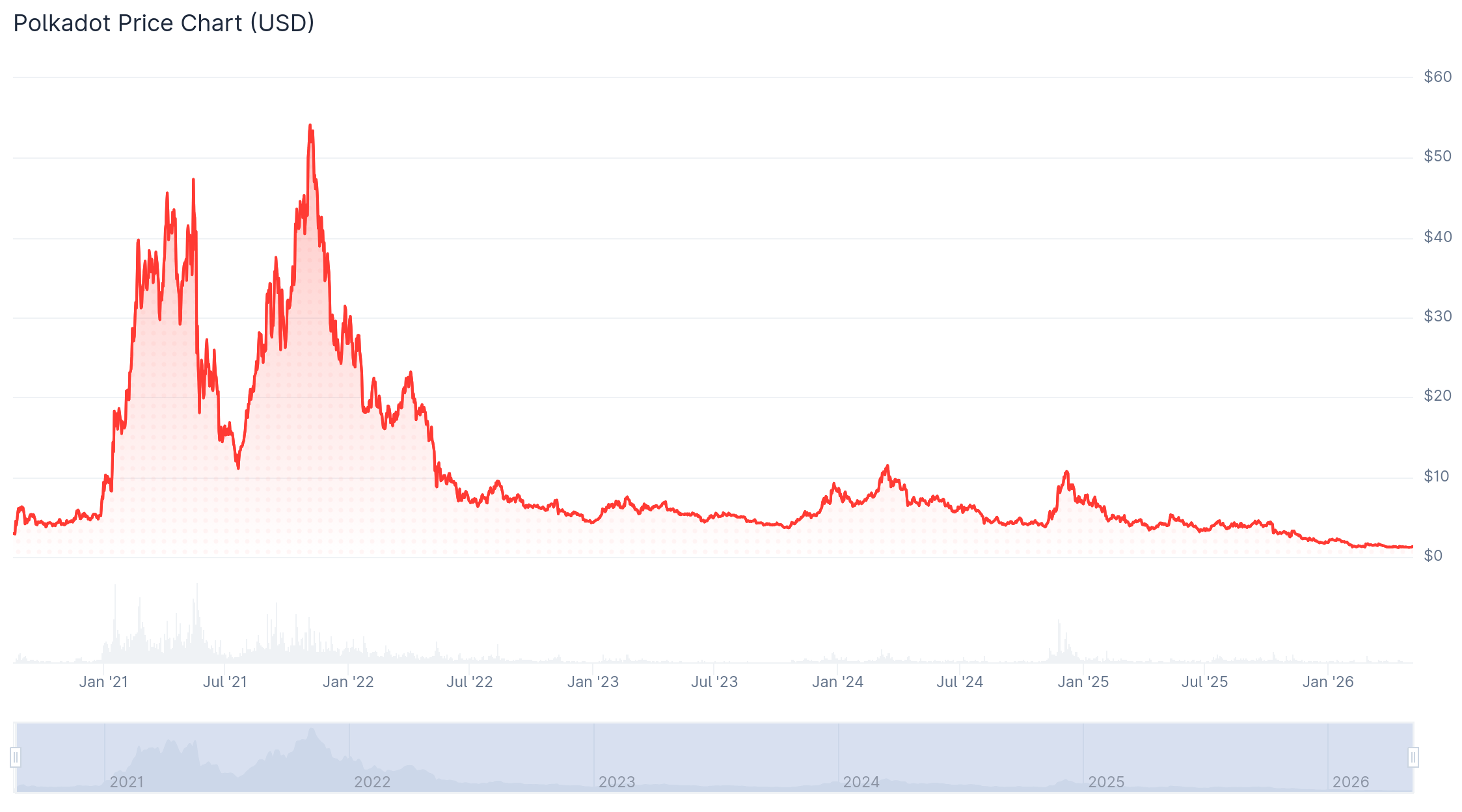
Polkadot’s native token, $DOT, is down about 98% from its November 2021 all-time high. Its market cap sits around $2 billion — still a top-50 asset by market cap, but a shadow of its 2021 peak. The native tokens of the original parachain cohort that secured the biggest crowdloans — Astar, Acala, and Moonbeam — are also all down over 98% from their respective highs, which they all reached in January 2022.
“The interesting story for me […] was that this model [decentralized governance] has failed broadly and even like Polkadot is kind of done. I mean they haven’t delivered anything for a while. The foundation is also kind of done,” Singh said.
In pushing back against Singh’s claim that Polkadot has slowed down on its technical deliverables recently, Macdonald referred to Polkadot’s Asset Hub migration in November of last year, telling The Defiant: “Polkadot completed what may be the largest ever live-to-live blockchain migration […] Transaction fees dropped 100-fold.”
Indeed, average transaction fees across the ecosystem have dropped from $0.007 the week of Dec. 1, 2025 to $0.00028 this week. But the lower fees haven’t led to increased usage, Token Terminal data shows.
Active users on the monthly and weekly timeframes have mostly trended downward since the start of the year. Since late March, weekly active users have spent three weeks below 10,500 — the lowest weekly levels in the past five years.
Since February, MAU has seen its lowest levels in five years as well, though April saw an uptick to 39,700 from 38,800 active users in March.
Macdonald said the Polkadot ecosystem’s focus is to continue building.
“We are focused on delivering product-grade infra for a new generation of Web3 applications. In the near term, our goal is to present a set of integrated capabilities that demonstrate what Web3 products can feel like.
The system evolves, our community governs, our engineers deliver. This is a maturing ecosystem,” he told The Defiant.
Indeed, just this week, Polkadot announced a new data storage model for decentralized applications, Bulletin Chain. The model introduces a time limit to improve scalability so that “everyday apps can run on decentralized infrastructure.”
Also this week, $DOT staking service Polkadot Cloud announced that the Polkadot ecosystem now lets DApps cover fees for new users, addressing the friction of requiring users to have $DOT to pay fees. However, The Defiant was unable to verify the development via Polkadot’s official channels and documentation.
Meanwhile, Polkadot’s $DOT is the largest Layer 0 asset by market cap, per CoinGecko data. But the ecosystem’s TVL remains lower than other meta-networks, like Avalanche and Cosmos. The largest Cosmos chain has a TVL of $1.3 billion, while Avalanche’s TVL is over $660 million, compared with Polkadot’s approximately $81 million total, per DefiLlama.
With a recently launched $DOT ETF, Polkadot is poised for increased mainstream and institutional attention, and possibly capital. But it remains to be seen where Wood’s “scalable multi-chain” will go from here, and if it can deliver on its ambitious goals — building the infrastructure “for a new generation of Web3” apps.
This article was written with the assistance of AI workflows. All our stories are curated, edited and fact-checked by a human.
