


On March 14, 2026, Polkadot made its first big supply change. Many users now call it the Polkadot halving or $DOT halving because new $DOT issuance dropped by more than half, from about 120 million $DOT per year to about 55 million.
Polkadot’s issuance model upgrade is scheduled to coincide with Pi Day on March 14.
This protocol change introduces, among others:
‣ A maximum supply of 2.1B $DOT, of which ~80% has already been issued.
‣ A $DOT emission rate reduction by ~53% on March 14, and further…— Polkadot (@Polkadot) March 13, 2026
That label is useful, but it can also mislead. This was not a Bitcoin-style halving with an automatic 50 percent cut to block rewards. Instead, Polkadot adopted a new tokenomics model through governance, with a hard cap and a schedule of step-by-step issuance cuts over time.
So, what changed essentially? New $DOT now enters the system more slowly, the network has a long-term supply cap of 2.1 billion $DOT, and rewards plus fees now flow through a new shared pool.
In this guide, I’ll explain how the change works, why people call it a halving, and what it may mean for staking, sell pressure, and $DOT‘s long-term supply story.
What the Polkadot halving actually is, and why the name can be confusing
At its core, Polkadot’s March 2026 event was a major issuance cut. The network stopped following its old open-ended inflation path and moved to a capped supply model. Because annual new $DOT fell by more than 50%, many investors naturally reached for the word “$DOT halving.”
That makes sense at a glance. Still, the mechanics are different.
Bitcoin halving reduces miner rewards by half on a fixed schedule written into the protocol. Polkadot, in comparison, changed its token model through governance. The result is similar in spirit, less new supply over time, but not in form.
Under the old setup, Polkadot inflation on an annual level was running near 10%, or about 120 million new $DOT a year in later practice. After the March 2026 change, inflation moved into the low-single digits. Some summaries cite roughly 3.1%, although current reporting is more solid on the issuance cut itself than on one exact inflation number, because inflation changes with total supply.
How Polkadot’s halving is different from Bitcoin’s halving
Bitcoin and Polkadot are solving a similar problem, how to slow new supply, but they do it in very different ways.
Bitcoin cuts miner rewards by 50% about every four years. It’s a sharp drop. Everyone can point to the date, watch the reward change, and update their supply charts.
Polkadot now follows a smoother path. After the March 14, 2026 cut, issuance steps down every two years based on the remaining amount still allowed before the 2.1 billion $DOT cap. That means supply reduction is less abrupt. As a result, the long-term path is easier to model.
For regular investors, that’s a pretty big deal. Sudden reward cuts can create dramatic headlines. A stepped model feels more like walking down a staircase than falling off one. It gives the network more room to balance staking rewards, treasury needs, and long-term scarcity.
The key numbers behind the March 2026 $DOT inflation reduction
Here’s the simplest way to view the shift:
The headline is easy to remember: 55 million replaced 120 million. That’s why the “halving” label stuck, even though the design is different from Bitcoin’s.
How $DOT‘s new inflation model works after the 2026 change
The new $DOT issuance model is simpler than it first sounds. It’s like filling a tank with a marked limit. Under the old system, the faucet kept running. Under the new one, Polkadot now knows the tank’s top line, 2.1 billion $DOT, and slows the flow as it gets closer.
The first major cut happened on March 14, 2026, when annual issuance dropped to about 55 million $DOT. After that, issuance is set to fall every two years by 13.14% of the remaining amount still to be minted before the cap.
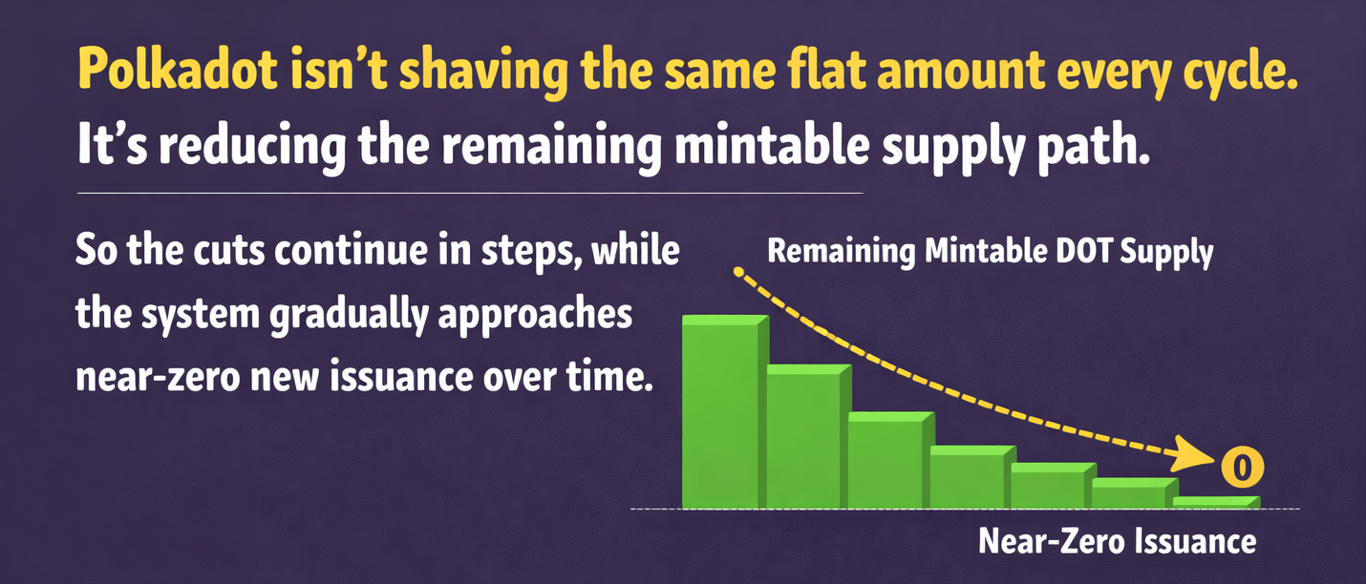
Current reporting points to the next scheduled reduction landing around March 14, 2028, following the same two-year cadence. Some community posts have cited a different April 2028 date, but the schedule tied to the March 2026 start points back to March.
This design was approved in 2025 and began going live in March 2026. In short, Polkadot moved from an inflation-heavy model to a cap-based model with planned reductions.
Why issuance now falls in steps instead of staying near 10% forever
Under the old model, $DOT had no hard supply ceiling. Inflation stayed active, and later issuance sat around 120 million $DOT per year, with most of that going to stakers and part going to the treasury.
That approach helped pay for security, but it also meant ongoing dilution. If you held $DOT and didn’t stake, your share of the network shrank faster over time. Even if you did stake, a high-issuance system can still add steady sell pressure when rewards hit the market.
The new model changes that story. Instead of keeping issuance near the same level year after year, Polkadot now reduces future supply in steps. As those cuts stack up, inflation should keep trending down through the 2030s.
That doesn’t mean price must rise. Markets don’t work that cleanly. Yet it does mean the supply side becomes easier to understand, and that helps investors judge risk with fewer moving targets.
What the Dynamic Allocation Pool changes for rewards, fees, and treasury funds
At the same time, Polkadot changed how money moves through the network. Since March 12, 2026, the Dynamic Allocation Pool, or DAP, acts like a shared on-chain funding pool.
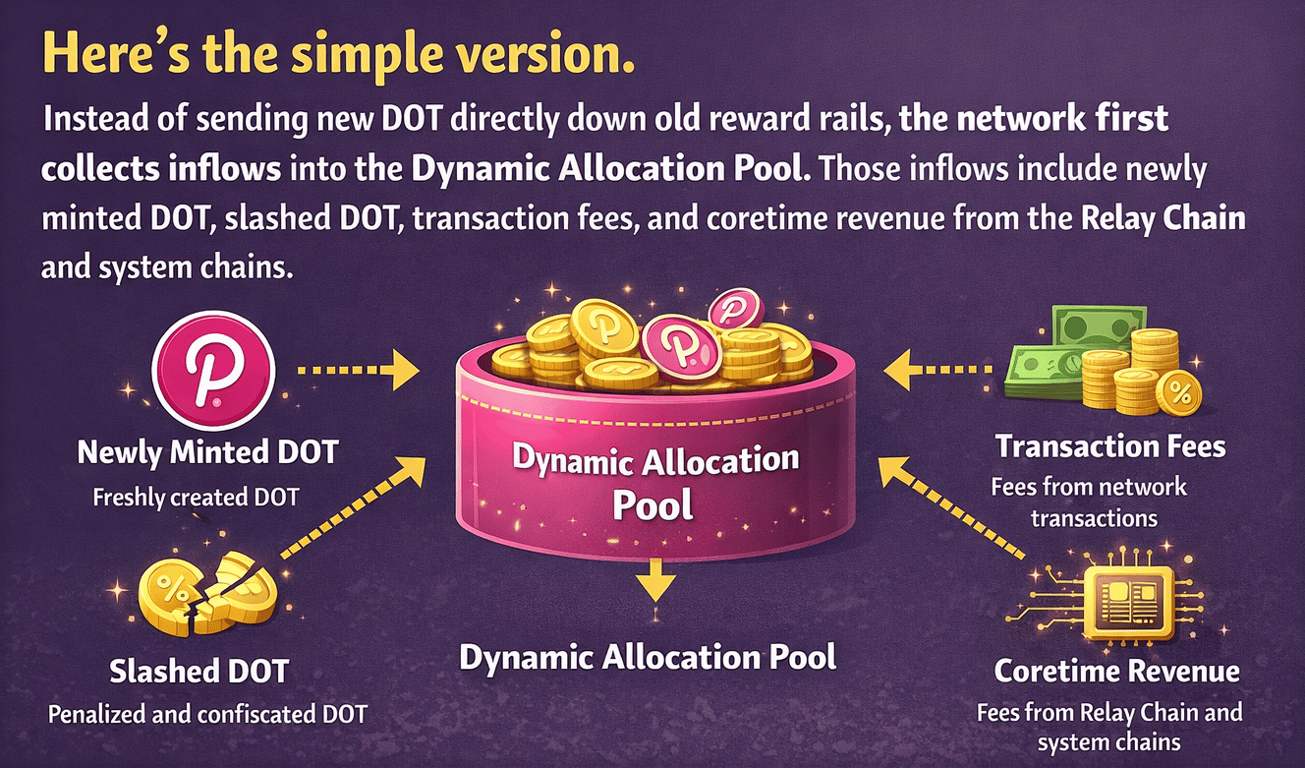
From there, governance decides the budget split. Funds can go to staking rewards, the treasury, and a reserve. That reserve gives Polkadot more room to smooth payouts and plan ahead.
This also replaces the older burn-based design. Treasury burn is gone, slashed $DOT no longer disappears, and fee revenue now plays a bigger role in funding the system.
If network income grows enough, fees and related revenue can offset more of the token issuance. Over time, that opens the door to deflationary periods instead of constant net supply growth. That’s a big shift in how $DOT‘s economics work.
What the Polkadot crypto halving could mean for investors, stakers, and the network
This is where the headlines usually get loud. Lower inflation sounds bullish. Sometimes it is. Still, tokenomics is only one part of the picture.
A supply cut can reduce pressure from new coins entering circulation. It can also make a network look more disciplined, which matters for long-term holders. On the other hand, price still lives in the real world, where adoption, usage, sentiment, and macro conditions all matter.
So it’s better to view Polkadot’s 2026 change as a structural upgrade, not a magic switch.
Lower inflation can reduce dilution, but price still depends on demand
Dilution is simple. If a network keeps printing lots of new tokens, each token can represent a smaller slice of the pie unless demand grows with it.
Polkadot’s new model slows that dilution. Fewer fresh $DOT should mean less automatic supply pressure than before. That’s good for holders, at least on paper.
But paper isn’t the market. Lower inflation can help the supply side, but it can’t create demand on its own.
$DOT‘s price still depends on whether people use the network, pay for blockspace, buy coretime, stake, build apps, and stick around during rough market cycles. Crypto sentiment also matters. If the whole market turns risk-off, a better issuance schedule won’t stop that wave.
So, keep the right frame. Lower inflation improves the setup. It does not guarantee a price outcome.
Why staking may look more attractive under the updated tokenomics
Staking is where the 2026 changes get more practical. Lower issuance changes the reward environment, but the DAP also changes how those rewards are funded and distributed.
For nominators, the user experience looks better than before. Around late March and April 2026, Polkadot’s staking updates are expected to reduce or remove nominator slashing risk and cut unbonding time from 28 days to roughly 24 to 48 hours in many cases. That’s a real quality-of-life upgrade.
Why does that matter? Because long lockups and slashing fears keep plenty of users on the sidelines. Shorter exit windows make staked capital feel less trapped. Lower risk also makes participation easier to stomach, especially for smaller holders.
For the network, that can help keep staking healthy even as issuance trends lower. And for investors comparing $DOT with other assets, it means the story is no longer just “high inflation, high rewards.” It becomes a more balanced trade-off between security, flexibility, and slower supply growth.
What happens next in Polkadot’s supply schedule
The big picture is now much clearer than it used to be. $DOT has a cap, a schedule, and a funding pool that can adapt as network revenue changes.
The next reduction is expected around March 14, 2028, with similar cuts continuing every two years after that. As those steps continue, annual inflation should keep falling. Current reporting supports a path toward very low issuance in the 2030s, with sub-1 percent rates later on as supply nears the cap.
That’s a major break from Polkadot’s earlier model, which had no hard limit and relied on ongoing inflation.
The bottom line
If you want the short version, keep this timeline in mind:
- Before March 2026: Polkadot followed an open-ended inflation model, often described near 10 percent, with about 120 million new $DOT a year in later practice.
- March 14, 2026: Annual issuance dropped to about 55 million $DOT, and the capped supply path began.
- Around March 14, 2028: The next scheduled reduction is expected to hit, following the two-year cycle.
- Through the 2030s: Issuance keeps stepping down as $DOT moves toward its 2.1 billion cap.
That’s the map. Much less guesswork, much more structure.
Polkadot’s 2026 halving wasn’t a Bitcoin-style halving, but it was still a major tokenomics reset. New $DOT issuance fell from about 120 million a year to about 55 million, the network shifted toward lower inflation, and $DOT now has a path toward a 2.1 billion supply cap.
Just as important, the Dynamic Allocation Pool gives Polkadot a more flexible way to fund staking, treasury needs, and reserves. If you’re judging $DOT‘s long-term setup, watch both sides of the story: tokenomics and actual network use. Scarcity helps, but usage is what gives it weight.
If you’d like to participate in the Polkadot ecosystem yourself, make sure to check out our selection of the best Polkadot wallets.
FAQ
Will Polkadot reach $10 again?
Polkadot could reach $10 again, but lower issuance by itself will not be enough to make that move happen. $DOT would also need stronger demand, more activity across the ecosystem, and a broader bullish crypto market to support a return to that price level.
Where will Polkadot be in 5 years?
In five years, Polkadot will likely be much further along its lower-issuance path, with inflation reduced compared to the old model. Still, its long-term market position will depend less on tokenomics and more on adoption, developer activity, and real network usage.
Is Polkadot a good investment?
Polkadot could be a good long-term investment for people who believe in the project’s ecosystem, technology, and future growth. At the same time, $DOT is still a volatile crypto asset, so it makes more sense as a higher-risk investment than a safe one.
