


Europe’s MiCA deadline is turning access and infrastructure into the same question: which crypto apps remain available, and who controls the rails underneath them?
BitGo Europe GmbH announced a partnership with Bielik.io, a Warsaw-based crypto trading platform, to support regulated trading access across the EEA by integrating BitGo Europe’s Crypto-as-a-Service infrastructure.
Through that integration, eligible Bielik.io users are expected to access deposits, supported digital asset trading, and custody via Bielik’s mobile app, while BitGo Europe provides the regulated infrastructure beneath.
The deal is small enough to look like a normal platform partnership. It is also specific enough to show one route smaller European platforms may take as MiCA deadlines replace old national regimes.
If those platforms cannot build a full regulated operating stack before national permissions expire, the survival path may be to keep the customer-facing app and move the regulated core to a licensed provider.
That makes the BitGo-Bielik announcement different from standard MiCA access issues. Many platforms are being asked whether users will still be able to open their app after July 1. They may not be asking who holds custody, onboarding, transfer, trading, settlement, and policy controls once the app keeps working.
MiCA deadline turns compliance into an operating model
ESMA has said the MiCA transitional period expires across the EU on July 1, 2026. After that date, entities providing crypto-asset services to EU clients without a MiCA license are in breach of EU law and must stop offering those services, according to the regulator’s April statement.
That moves MiCA out of the realm of policy design and into the operating model of every exchange, broker, wallet, and app serving the bloc. A platform can seek its own MiCA CASP authorization, wind down, transfer users, withdraw from Europe, or find a licensed infrastructure partner that can lawfully provide the relevant services.
ESMA’s statement sets a boundary for outsourcing. It says CASPs cannot outsource or delegate custody to entities that are not themselves authorized CASPs, and it warns against arrangements that route EU clients through unauthorized third-country entities.
In practice, crypto custody outsourcing and routing must remain within the regulatory perimeter for the services being performed.
BitGo Europe is positioning itself directly in that gap. A day before the Bielik partnership announcement, the company described MiCAR-compliant CaaS infrastructure for eligible VASPs, fintechs, and digital asset platforms as they navigate the transition from national registration regimes to MiCA.
The product set includes custody, wallet APIs, onboarding and KYC, trading and settlement, transfer services, SEPA on- and off-ramps where available, policy controls, implementation support, and insurance for BitGo custodial wallets subject to terms.
The offer combines technology with a regulated operating path: a platform can preserve its front-end relationship with users while moving regulated functions into another company’s stack.
For a smaller platform, the appeal is clear. Building the full set of regulated capabilities alone means carrying the burden behind custody, wallets, onboarding, trading, settlement, transfers, and policy controls.
Embedding a licensed provider may allow the platform to retain its brand, user experience, and customer relationships while the provider handles the infrastructure for those functions.
For users, the change can be harder to see. The same app may offer deposits and trades, but the entity providing custody or transfer services may be different from the brand on the home screen.
Where the provider is authorized for the relevant services, that model can support compliance while preserving access through a familiar interface.
Still, a customer-facing platform that depends on another company for custody, wallets, trading, settlement, and onboarding has less operational independence than a platform that runs those functions itself.
Its continuity depends on the provider’s license scope, service availability, supported assets, and policy controls for the functions it provides.
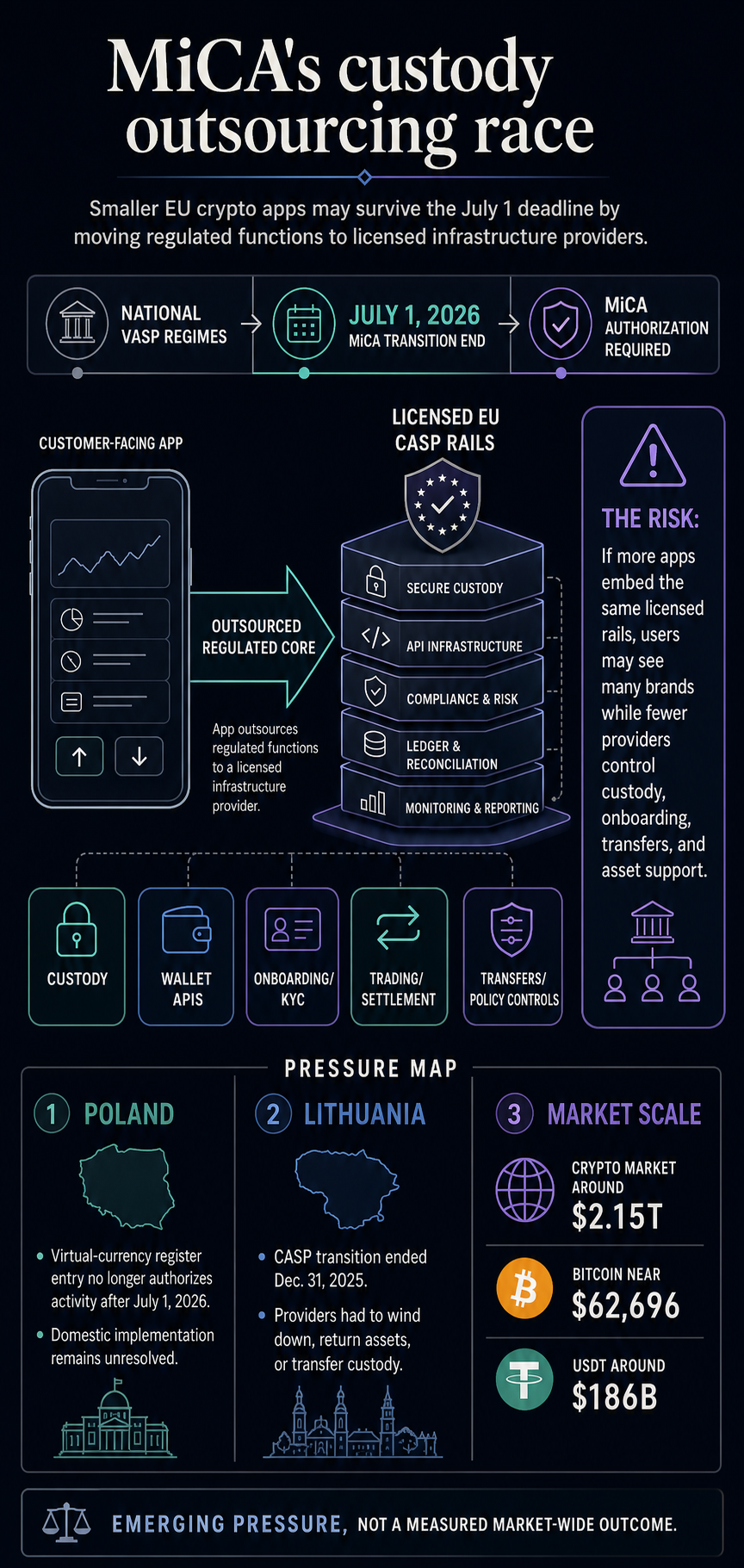
That is the concentration issue MiCA may be creating beneath the market. The regulation may also keep some smaller platforms alive by shifting their operational core toward larger regulated providers.
BitGo Europe’s own regulatory position helps explain why it can play that role. France’s AMF lists BitGo Europe GmbH as a Germany-licensed MiCA CASP authorized in France under free provision of services.
The listed services include custody and administration; exchange of crypto-assets for funds; exchange of crypto-assets for other crypto-assets; order execution and transmission; and transfer services.

In a single-market framework, that passporting logic is valuable. It lets a provider authorized in one member state become part of the infrastructure answer in another, subject to the service scope and notification process.
For smaller platforms in markets where the domestic path is messy or late, that can become more than a convenience.
Poland and Lithuania show the pressure points
Poland is the clearest immediate pressure point in this story because the BitGo-Bielik partnership is tied to a Warsaw-based platform and the July 1 deadline is arriving with unresolved national implementation questions.
The Polish government’s Katowice notice for clients of entities on the virtual-currency activity register states that, after July 1, 2026, a Polish register entry will not authorize virtual-currency activity in Poland or abroad.
It said crypto-asset services after that date require valid MiCA authorization, and it directed clients to check ESMA’s public list.
Poland’s legislative backdrop adds to that pressure. The Polish president’s refusal to sign the May 15, 2026 crypto-assets market act left implementation unresolved.
UKNF has separately said that because the relevant national act had not entered into force, no Polish competent authority had been formally designated for certain MiCA functions relating to crypto-asset service providers.
Poland remains inside MiCA, but its domestic transition is awkward. UKNF said MiCA-authorized CASPs from other member states may provide services in Poland under cross-border rules after notifying their home authority, and they do not need a physical presence in the host state.
Lithuania gives an earlier view of the same kind of pressure. Its CASP transition period ended on Dec. 31, 2025, and the Bank of Lithuania said providers that did not plan to continue needed to wind down smoothly, return client assets, or transfer custody to client-designated custodians or self-hosted wallets.
It said that about 30 companies had applied for a CASP license at the time, while more than 370 had declared crypto-asset services, and only 120 were actually operating based on revenue and financial statement activity.
The pattern is consistent: national VASP regimes created large populations of registered or declared providers, but MiCA authorization is a higher bar.
As that bar bites, platforms have to decide whether they are regulated operators, wind-down candidates, or front-end brands relying on someone else’s regulated infrastructure.

How the MiCA deadline may concentrate crypto infrastructure
The most visible MiCA pressure remains user access. Recent CryptoSlate coverage on Binance access, $USDT liquidity, and possible exchange cutoffs shows how quickly compliance decisions can reach users.
The infrastructure issue sits one layer below that. If more platforms preserve access by embedding licensed CaaS providers, Europe’s crypto market could maintain a diverse app layer while more of the custody and compliance layers are handled by fewer providers.
A tradeoff can still support the regulation’s compliance goals. MiCA raises authorization requirements across the bloc, and a platform that uses an authorized custody and onboarding provider may be better positioned to continue serving users lawfully than one that relies on an expiring national registration.
But what control does the market give up in exchange?
If integrations concentrate among fewer providers, those providers could gain more influence over which assets are supported, how quickly platforms can onboard users, how transfers are monitored, which jurisdictions receive service first, and how quickly a platform can recover if its provider changes terms or exits a line of business.
Market scale explains why the issue extends beyond one Polish app. On June 22, CryptoSlate’s market pages showed total crypto market capitalization around $2.15 trillion, Bitcoin near $63,500, and $USDT still a roughly $186 billion liquidity rail.
MiCA’s infrastructure choices sit beneath a market large enough to make custody, onboarding, and transfer control strategically important operational functions.
At this stage, the concentration thesis is an emerging pressure awaiting market-wide measurement. The BitGo-Bielik deal shows one concrete route: a local platform preserving access through regulated infrastructure from a larger licensed provider.
ESMA’s deadline and outsourcing rules show why that route is consequential. Poland and Lithuania show why the timeline is urgent.
The next signal is whether more European platforms announce similar CaaS integrations before and after July 1. If they do, MiCA’s first visible result may be a cleaner, more compliant market.
Its second result may be that fewer companies control the rails beneath it.
