Central banks are continuing to buy gold at one of the fastest rates in recent years, even as prices remain historically high.
The trend continued beyond the third quarter of 2026, reinforcing the view that sovereign institutions still overwhelmingly favor the traditional safe-haven asset when diversifying their reserves.
Still Buying Gold
Data shared by analysts at the Kobeissi Letter show that central banks worldwide bought 321 tonnes of gold in Q3 2026, the largest quarterly total in almost two years and the fifth-largest on record. Purchases rose 8% from 296 tonnes in Q2 and climbed sharply from just 58 tonnes in Q1. By comparison, the five-year quarterly average is around 227 tonnes. Year-to-date demand reached 675 tonnes, 6% above the same period in 2025.
China and Poland were the biggest buyers, adding 63 tonnes and 40 tonnes, respectively. Kazakhstan and Uzbekistan each purchased another 14 tonnes. The Czech Republic also continued its multi-year buying spree.
Reports indicate that purchases continued after September. Reuters, for instance, reported that the People’s Bank of China added 25.8 tonnes in October, its largest monthly purchase in three years. Poland bought a further 27 tonnes that month, bringing its reserves to the previously announced target of 700 tonnes. Governor Adam Glapinski later said he saw no reason for the country to stop accumulating the precious metal.
The World Gold Council said that diversifying reserves and managing risk remain key reasons for central banks to buy gold. Demand for gold ETFs also rebounded strongly in Q3, adding 211 tonnes.
Gold Beats Bitcoin Again
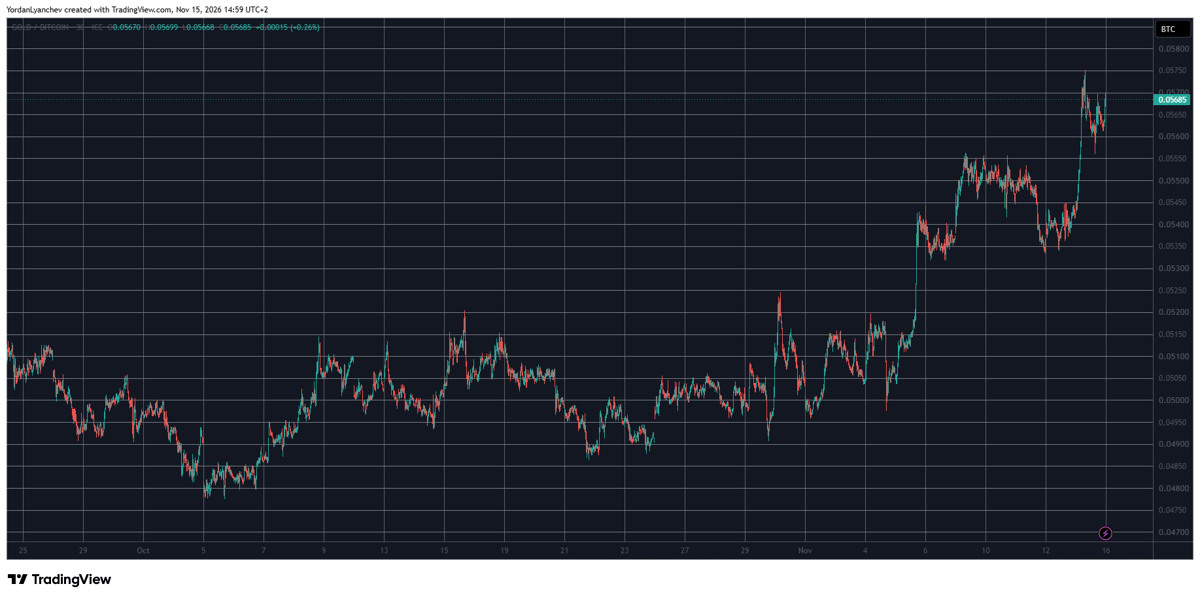
The trend is especially notable when gold is compared with bitcoin rather than the dollar. The XAU/$BTC ratio has risen from roughly 0.047 in early October to nearly 0.057 now, a gain of about 20%. In other words, an ounce of gold now buys considerably more $BTC than it did just over a month ago.
You may also like:
- Strategy Officially Exits MSCI: What It Could Mean for MSTR and Bitcoin
- Nakamoto Extends $60M Kraken Loan and Adds Bitcoin Derivatives as Collateral
- TSMC Confirms Employee Data Leak as Hackers Try to Sell 46,000 Records for Bitcoin
This highlights the sharp divergence between the two assets often described as “hard money”. $BTC traded well above $80,000 for much of October, but has since fallen sharply to $65,000. Gold has also lost some ground against the dollar, closing Friday at around $3,900/oz. However, its losses have been far less severe than bitcoin’s.
This comparison does not necessarily weaken $BTC’s long-term scarcity thesis. Central banks face very different constraints from private investors, and gold has centuries of history behind its narrative.
Bitcoin has faced pressure from deleveraging, ETF outflows, and broader risk-off sentiment, while central banks have been buying aggressively its oldest and perhaps closest rival. The current XAU/$BTC chart, viewed from below, suggests that the traditional safe-haven asset is winning this round.