Boris Johnson entered a London hall packed with blockchain developers and told them, in effect, that he still does not trust the asset that launched their industry.
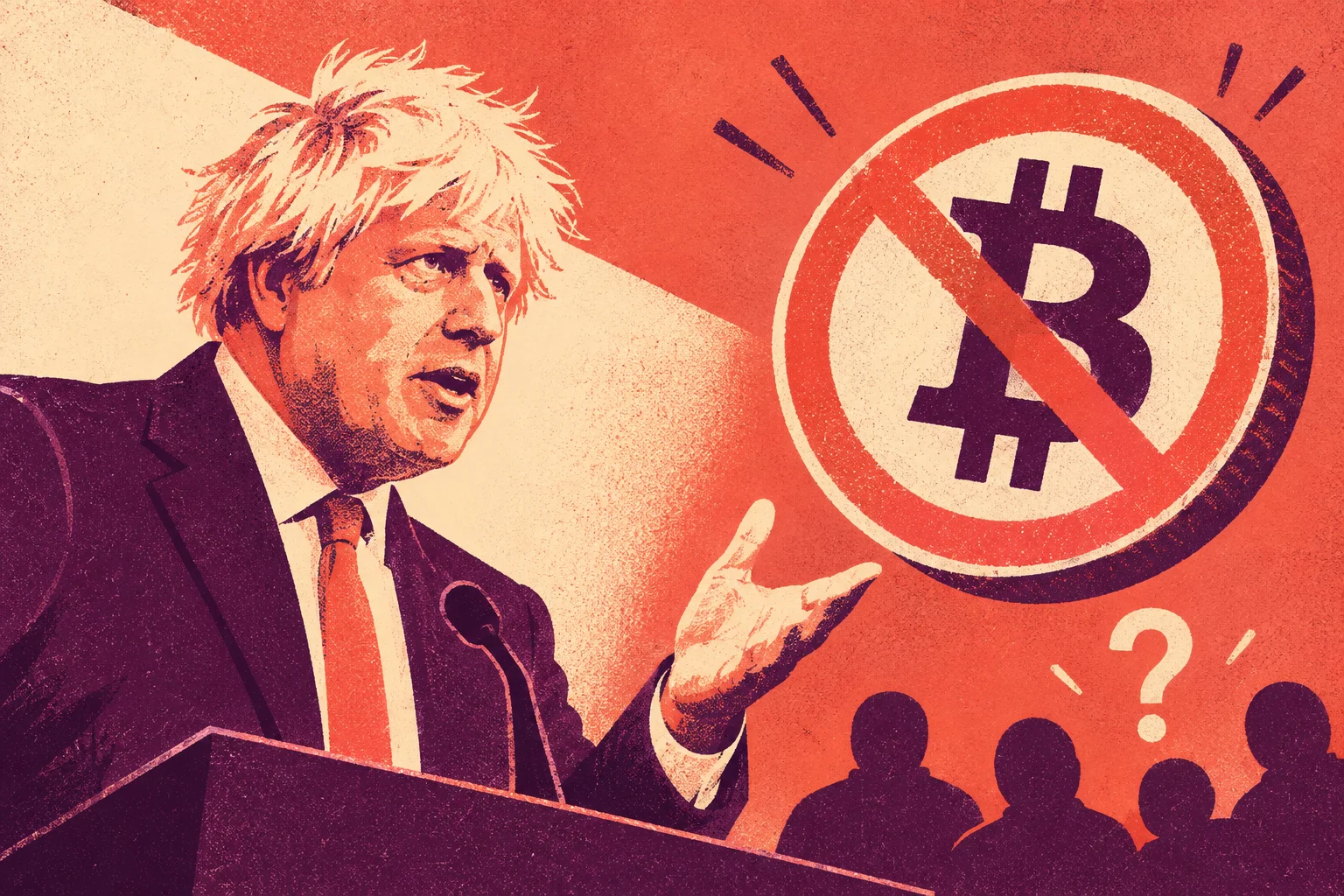
The former UK prime minister used a main-stage session at Solana’s Breakpoint conference to repeat his doubts about Bitcoin, focusing on two concerns: no one appears to be in charge, and no one seems accountable when things go wrong.
A name he couldn’t quite remember
Johnson’s main complaint was about leadership, or the absence of it. He argued that no identifiable person or body is accountable for Bitcoin.
To make his point, he deliberately mispronounced the name of Satoshi Nakamoto, Bitcoin’s pseudonymous creator, mangling it several times during the session.
“As far as I can see, nobody knows who’s in charge, apart from Yakimoto Nakasori, and I don’t know where to find him,” Johnson said.
He then turned from governance to consumer protection. He told the audience that if six billion were stolen from a cryptocurrency, he would have no idea whom to contact or how to recover the funds.
Not a new position
In a March 2026 column for the Daily Mail, Johnson called Bitcoin a “giant Ponzi scheme.” The opinion piece also questioned accountability in decentralized financial systems. His Breakpoint remarks, delivered on November 16, 2026, essentially repeated the same argument before a live audience that was far less sympathetic.
Johnson appeared on a panel titled “Crypto is Key to the UK’s Economic Future,”, alongside Lord Ross Kempsell.
The conference he was speaking at
Breakpoint 2026 took place at Olympia London from November 15 to 17. Expected attendance exceeded 8,000 participants.
The event’s theme was the “Token Supercycle,”, a framing intended to connect traditional finance with the blockchain sector. Sessions focused on stablecoins, tokenized assets and AI-enhanced activity on blockchains.
Executives from Revolut, Mastercard and DTCC were among the people on the program.
What this means
His remarks may resonate with institutional investors concerned about regulatory uncertainty and could reflect a broader public perception that affects how quickly mainstream investors adopt digital assets.
His two complaints align closely with the regulatory debate. The “who’s in charge” question concerns governance. The “who do I call” question concerns consumer recourse. Regulators routinely raise both issues when considering how to treat decentralized systems.
A divide between Bitcoin and the tokenization push is also worth watching. Much of Breakpoint’s agenda focused on stablecoins and tokenized assets, products that typically involve identifiable issuers and institutions. Johnson’s criticism is aimed at the opposite model: a system with no named operator. The participation of companies such as Revolut, Mastercard and DTCC suggests that the industry is embracing that version of the story.