In the 8-K filed on November 9, BitMine Immersion Technologies valued its 6,070,092 ether at $2,234 per token. At the price of $1,821.97 per ether at 03:52 UTC on November 16, the same holdings are worth $11.06 billion, about $2.50 billion less than the company’s carrying value.
The difference is a matter of arithmetic, not an accusation. BitMine values its treasury using Coinbase’s ether price on the measurement date, making the $2,234 entry accurate at 2:00 p.m. ET on November 8. The market has since changed. Ether closed at $1,768.45 on November 15, its lowest daily close since July 10, and has since gained about 3% to reach $1,822. Each dollar lost by ether now reduces the value of a treasury that the company says accounts for 4.97% of the total supply of 122.2 million tokens.
Eight Days Between the Valuation and the Market
The filing provides unusually detailed information for a corporate treasury, making it easy to follow the repricing line by line. As of November 8, BitMine reported 6,070,092 $ETH valued at $2,234 each, 216 bitcoin, a $180 million stake in Beast Industries, $75 million in Eightco Holdings (NASDAQ: ORBS), and $475 million in cash and marketable securities. The company valued the total at $14.3 billion.
Recalculating the ledger using the November 16 ether price and a bitcoin price of $64,944 gives $11.06 billion in ether, $14.03 million in bitcoin, and the same $730 million in moonshots and cash. The total comes to $11.80 billion, 17.5% below the figure reported eight days earlier. Ether accounts for almost all of the difference. The other assets are too small and too stable to change the total by more than a few tens of millions.
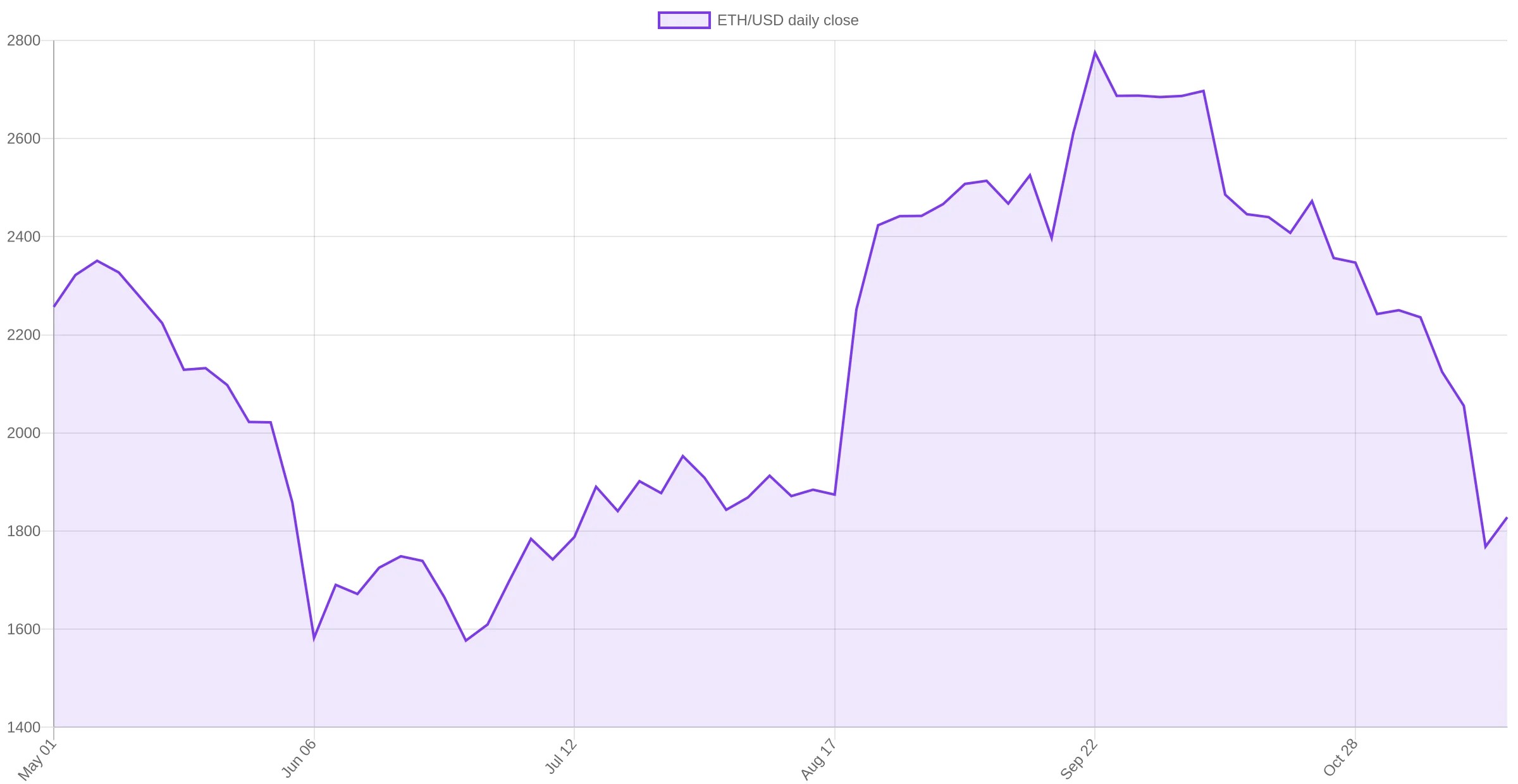
The chart above shows the ether price series against which the valuation is being measured. It records a September 22 peak of $2,775.17, a decline through October, and the November 15 close, which fell below the August support level near $1,912. BitMine’s $2,234 carrying value is above every daily close since November 9, leaving the discount in the billions rather than the millions.
Restoring the Mark Requires a 22% Move
For the treasury to be worth the amount stated in the filing, ether would have to return to $2,234, or rise 22.61% from its current price. That is the break-even point, not a forecast. The same arithmetic applies in reverse to any future BitMine purchases: buying at $1,822 would lower the position’s blended cost but would not restore the carrying value of tokens bought at higher prices.
In the November 9 release, BitMine chairman Thomas “Tom” Lee focused on ether’s role rather than its price. “Vitalik Buterin, founder of Ethereum, declared at Devcon 8 in Mumbai, ‘I’ve finally made up my mind, $ETH is a store of value, $ETH is money.’ This declaration by the founder of Ethereum, in my view, is a seismic shift, clarifying how $ETH will capture value in this coming supercycle of tokenization and AI,” Lee said.
He made the same case twice more in the same document. “In my opinion, $ETH was not a ‘cash flow’ token model, like HYPE or LIT, but rather pristine and trusted collateral, and reflective of how Ethereum is the Layer 1 chosen by the vast majority of financial institutions moving assets onto the blockchain,” he wrote, later adding that “$ETH as a Store of Value is most consistent with the future roadmap of $ETH and also the role $ETH will play in the coming super tokenization supercycle.”
These are the company’s own descriptions of its thesis. They do not show that the thesis is working, and they do not address the mark-to-market difference. The store-of-value argument does not reduce the 22% rise needed to return to the figure in the filing.
Staking Earns 2.65% in Ether, Not Dollars
BitMine’s hedge against a falling price is yield, which the filing quantifies precisely. Of the 6,070,092 ether on its books, 5,227,037 were staked as of November 8, or 86% of the position. The company reported a trailing seven-day staking yield of 2.65%, which would generate roughly 138,516 ether annually on the staked balance.
At the $2,234 valuation, that yield is worth $309.4 million a year, the amount BitMine disclosed. At $1,822, the same 138,516 ether is worth $252.4 million. The ether-denominated yield is unchanged, but its dollar value falls 18.4% with the price. That is the difference between earning a return in tokens and earning one in dollars. Staking does not offset a fall in the principal’s value, but it does soften the rate at which the treasury loses value.
Lee directly addressed the question of scale. “Bitmine has staked more $ETH than other entities in the world. At scale (when Bitmine’s $ETH is fully staked by MAVAN and its staking partners), the projected $ETH staking rewards would be $359 million on an annualized basis, using BMNR’s trailing 7-day staking yield of 2.65% as of November 8, 2026. This compares to annualized staking rewards of $309 million based upon 5.2 million staked $ETH (86% of the 6.07 million $ETH held by Bitmine),” he said. Both figures assume a price of $2,234 and a yield of 2.65%; neither holds if either input changes.
Thirty-Nine Thousand Ether Short of the 5% Threshold
The acquisition programme is the other part of the strategy, and it is now working toward a moving target. Five percent of 122.2 million ether equals 6,110,000 tokens. BitMine holds 6,070,092, leaving a gap of 39,908 ether, which would cost about $72.7 million to fill at $1,822.
At the rate of 9,587 ether that the company said it bought in the week before filing, filling the gap would take a little over four weeks, assuming the weekly pace continues and the supply estimate remains unchanged. Lee described the buying pattern as mechanical: “Over the past week, we acquired 9,587 $ETH. Bitmine’s track record of consistent buying of crypto is unmatched by any public company in the world. Bitmine has bought $ETH each week since the inception of the $ETH Treasury Strategy on June 30, 2025,” he said in the release.
A four-week timeline to the stated goal is short enough for the market to see how it unfolds. It also means BitMine’s remaining buying power matters more than its holdings: 39,908 ether is small compared with ether’s $12.7 billion in daily volume, so the programme’s final stage will not move the price. But the financing behind it will determine whether the buying pace can continue if ether trades at $1,700.
Strategy Faces the Same Issue With Bitcoin
BitMine’s own filing offers a comparison that makes the point. The company ranks itself second among corporate treasuries, behind Strategy Inc. (NASDAQ: MSTR), which it says “reportedly owns 849,327 BTC valued at approximately $69 billion.” At $64,944 per bitcoin, those coins are worth $55.16 billion, or $13.84 billion less than the figure cited by BitMine.
The two treasuries therefore have unrealised losses of similar size as a percentage of their carrying values, but one difference matters for BitMine’s ether holdings. Strategy’s bitcoin is not staked and generates no yield, leaving price appreciation as its only way back to the carrying value. BitMine’s staked ether earns roughly 138,516 tokens a year, gradually lowering the effective break-even point: at a yield of 2.65%, the position earns about 2.3% of its value annually, so the price needed to recover the mark declines over time rather than remaining fixed at $2,234.
That calculation is the most favourable way to frame the company’s position, and it still leaves a double-digit gap. It also assumes the validators continue to perform. Slashing, downtime or a change in staking yield would reduce the offset.
What Would Change the Arithmetic
Three developments could change the numbers rather than the narrative. The first is a new measurement date. BitMine publishes weekly, so its next filing will revalue the treasury at the prevailing price. If the filing uses a price near $1,800, the carrying value would be reset lower, replacing the current gap with a smaller one and a lower reported total.
The second is the pace of purchases. A pause in weekly buying would suggest the company is managing the valuation rather than pursuing its goal, leaving the 5% target short of 6.11 million tokens. The third is completion of staking. Moving the remaining 843,055 unstaked ether onto MAVAN would raise annual rewards toward $359 million at the current price, though the dollar value of those rewards would still depend on ether’s market price.
None of this means BitMine has to sell, and the company has not said that it will. The arithmetic points to a narrower and more useful picture: the treasury is valued at a price 22.6% above the market, its yield is paid in the asset whose price is falling, and its buying programme is close enough to its stated goal that the next four weekly filings will show whether the pace continues. For readers following the largest corporate ether position, the key figure is not the 6.07 million tokens already purchased. It is the $2,234 level and how far the market remains below it.
Data: CoinGecko, SEC EDGAR, CoinGecko bitcoin.
BitMine’s ether position was last covered here when its treasury held 6.06 million tokens, valued at $14.5 billion, ranking second only to Strategy. The ether price backdrop is the same one in which ether closed below its 200-day average for the first time since August, on November 9.
Disclosure: This article is not investment advice. The content and materials on this page are for educational purposes only.