
Bitcoin ($BTC) extended its fall below $70,000 on Friday as persistent selling pressure threatened to push the cryptocurrency into a sixth straight week of losses.
The world's largest cryptocurrency has dropped more than 9% over the past seven days, bringing its cumulative losses over the last six weeks to roughly 20%.
Weak institutional demand, uncertainty over US monetary policy, and falling technology stock valuations have weighed on market sentiment.
Bitcoin's technical indicators also remain bearish, with its major moving averages nearing a possible death cross and momentum readings showing sustained selling pressure.
Although the daily RSI has entered oversold territory, which could signal a temporary rebound, sellers continue to dominate the market.
Bitcoin faces a sixth straight weekly loss as selling pressure intensifies
Bitcoin's latest decline extends a prolonged correction that began in early October. The cryptocurrency has lost roughly 20% over the past six weeks, reflecting a sustained weakening in buying demand.
Friday's drop of around 6% followed Thursday's decline of more than 3%, pushing $BTC below the psychologically important $70,000 level.
If Bitcoin closes the week in negative territory, it would mark its sixth consecutive weekly loss.
A losing streak of this length suggests that sellers have kept control despite several attempts by buyers to stabilize prices.
However, Bitcoin's deeply oversold momentum readings suggest the decline may be becoming stretched.
Institutional demand remains a key concern as Bitcoin struggles to attract sustained buying interest.
US spot Bitcoin exchange-traded funds (ETFs) have recorded six consecutive trading days of net outflows. The funds saw an outflow of $47.61 million on Thursday, after $300 million left the previous day.
Persistent ETF redemptions can add to selling pressure because these products give traditional market participants a major channel for gaining Bitcoin exposure.
The withdrawals have coincided with renewed uncertainty about US inflation and the Federal Reserve's interest rate outlook.
Expectations of tighter monetary policy can discourage investment in risk-sensitive assets, particularly when investors anticipate higher borrowing costs and reduced market liquidity.
Bitcoin has also shown sensitivity to developments in the technology sector, particularly shares tied to artificial intelligence.
Nvidia confirmed on Thursday that Jensen Huang had resigned as president, chief executive officer and board member, effective immediately. The company named Chief Financial Officer Colette Kress interim CEO while it searches for a permanent successor.
His departure followed reports concerning personal relationships and national security allegations. Nvidia has said its internal investigation found no evidence that company secrets or national security were compromised.
Bitcoin technical forecast: $BTC risks falling toward $67,292
Bitcoin's daily technical structure remains bearish following its breakdown below $70,000.
$BTC's 50-day exponential moving average (EMA) sits at $78,272, while its 200-day EMA is at $76,898. Both moving averages are trending downward, reinforcing weakness in Bitcoin's broader price structure.
The 50-day EMA is also approaching a possible bearish crossover below the 200-day EMA, commonly known as a death cross.
Momentum indicators also suggest sellers remain in control. The daily Relative Strength Index (RSI) has fallen to about 25, placing Bitcoin firmly in oversold territory.
Meanwhile, the Moving Average Convergence Divergence (MACD) remains negative, indicating bearish momentum continues to dominate.
The immediate technical level to watch is $70,505, which previously acted as support. With Bitcoin now trading below that area, a sustained breakdown could expose the cryptocurrency to the next significant downside target at $67,292.
If selling pressure intensifies and buyers fail to defend that level, $BTC could extend its correction toward $62,345.
Despite the bearish outlook, Bitcoin's deeply oversold RSI suggests a temporary recovery remains possible.
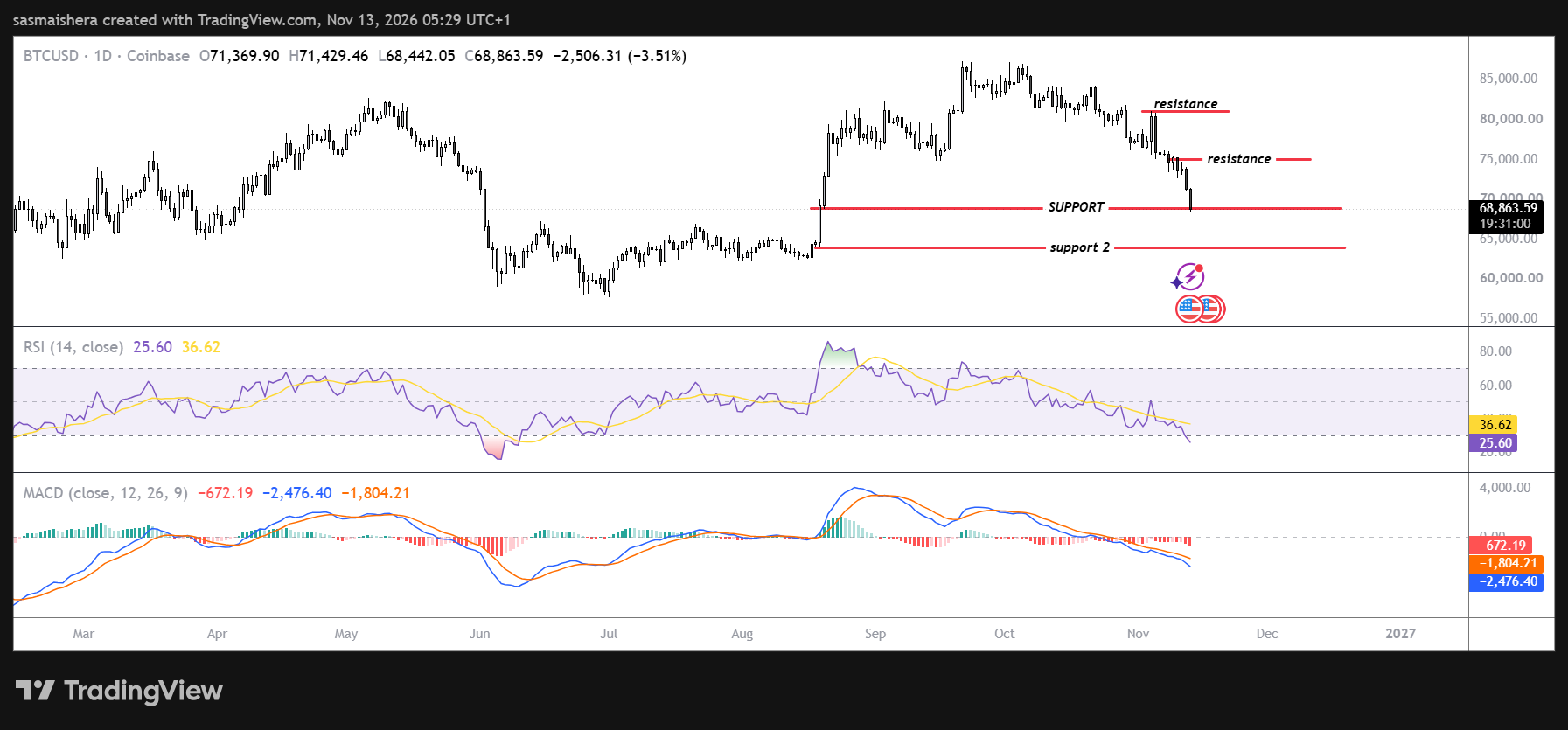
However, buyers face several important resistance levels before they can establish a convincing reversal.
The first significant barrier is $70,505, which Bitcoin would need to reclaim to ease immediate selling pressure. Beyond that, the next major resistance stands at $75,545.
A sustained recovery above $75,545 could encourage buyers to target the 200-day EMA near $76,898.
The 50-day EMA at $78,272 represents another substantial barrier that could limit any recovery attempt.
Reclaiming these moving averages would improve Bitcoin's technical structure and provide stronger evidence that buying momentum is returning.
AI disclosure: AI tools assisted with research and drafting of this piece. An Invezz editor reviewed the facts, sources and wording before publication. Any opinions or analysis are Invezz’s, not those of an automated system.