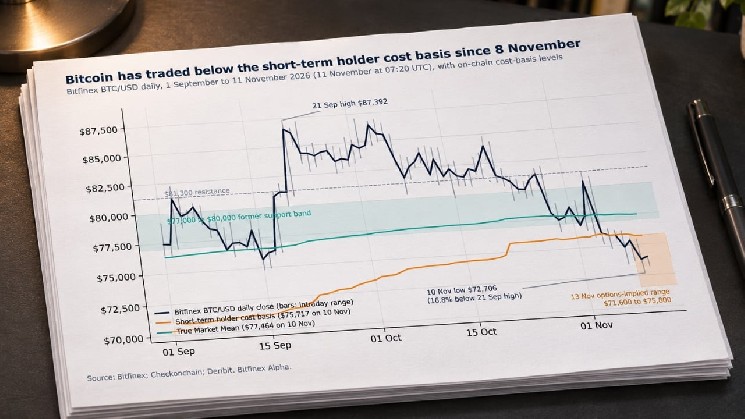
Bitcoin Faces a $75,717 Recovery Test
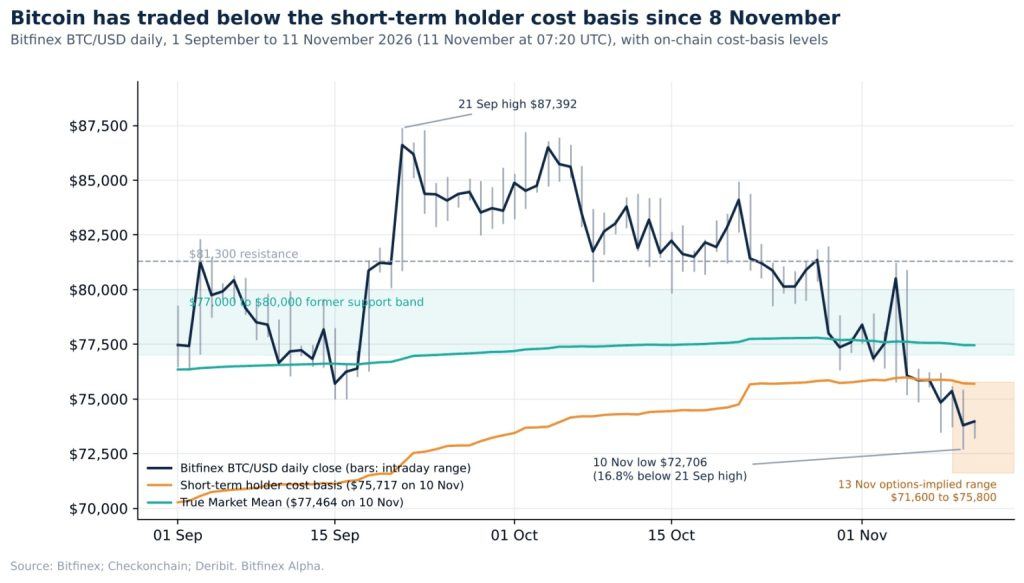
On Nov. 11, crypto exchange Bitfinex warned that bitcoin could face a deeper reset—a prolonged decline—after spending four days below its $75,717 short-term holder cost basis. The level reflects the estimated average purchase price of coins held for less than 155 days. Bitfinex said reclaiming it was central to its assessment of a recovery.
In 14 comparable episodes since 2016, bitcoin regained the level within two weeks in 11 instances, while three recoveries took 57 to 114 days. The current break began Nov. 8, so Nov. 22 marks the two-week point. Bitfinex stated:
“Rallies towards the short-term holder cost basis at $75,717 are likely to be sold until spot demand returns.”
Bitcoin rebounded above $74,600 at about 12:25 p.m. EST on Nov. 11, but remained below that level. It later edged down to $74,157 by 5:35 p.m. EST. The price was up 0.68% over 24 hours, but down 7.15% for the week, 10.42% for the month and 27.68% for the year.
Futures Positions Climb as Buyers Realize Losses
Total futures open interest—the exposure represented by contracts that remain open and unsettled—reached 701,900 $BTC around the Nov. 11 daily open. Exposure had increased 3.3% since Nov. 8, even as prices fell 2.6%, adding to pressure on bitcoin derivatives. Bitfinex cautioned that continued bullish positioning raised the risk of forced selling.
A metric comparing recent holders’ sale proceeds with their acquisition costs reached 0.989 on Nov. 10, meaning they received the equivalent of 98.9 cents for every dollar spent. Separately, 1.6 million $BTC purchased for between $75,000 and $80,000 was underwater—worth less than its purchase price. These holdings could add selling pressure during rebounds.
U.S. spot bitcoin exchange-traded funds (ETFs) saw approximately $399 million in outflows on Nov. 2. Corporate activity was mixed: Strategy Inc. (Nasdaq: MSTR) purchased 1,036 $BTC from Nov. 2-8, while MARA Holdings Inc. (Nasdaq: MARA) disclosed that it had sold 13,597 $BTC over the past six weeks. Bitfinex said corporate purchases were not enough to offset ETF selling.
Fund Flows and Broader Markets Influence the Outlook
Outflows later eased. U.S. bitcoin ETF flows showed $201 million leaving on Nov. 9 and $95 million on Nov. 10. Bitfinex calculated net outflows of $2.22 billion over eight sessions starting Oct. 30. In its correction scenario, reclaiming $75,717 together with three consecutive sessions of inflows would be supportive.
Martin Lee, market insights lead at DWF Labs, cautioned against relying too heavily on fund flows. He argued that withdrawals and deposits tended to follow price movements, limiting their usefulness as predictors.
Bitfinex also pointed to an imbalance between bitcoin and equities. In the 25 sessions after the Nasdaq 100 set a record on Oct. 6, bitcoin captured 91% of the index’s losses on down days, but only 58% of its gains on up days. The index tracks 100 of the largest nonfinancial companies listed on Nasdaq.
Weakness in altcoins added to the pressure on bitcoin. Among 12 large altcoins on Bitfinex, the median decline from the Sept. 21 close was 27.8%, compared with 14.8% for bitcoin. Bitfinex attributed the difference to concentrated leverage and speculative capital shifting elsewhere.
For the Nov. 13 options expiration, Bitfinex expected a range of $71,600 to $75,800. A 10-year real Treasury yield—measured after accounting for expected inflation—above 2.8%, or a Nasdaq 100 decline below 26,606, could trigger long liquidations. Under that conditional scenario, prices could move toward $70,000-$71,200.