

Close Menu
  • Coins
    • Bitcoin
    • Ethereum
    • Altcoins
    • NFT
  • Blockchain
  • DeFi
  • Metaverse
  • Regulation
  • Other
    • Exchanges
    • ICO
    • GameFi
    • Mining
    • Legal
  • MarketCap
What's Hot

62.6K Unique Addresses Hold Robinhood’s Stock and ETF Tokens — What This Means

04/08/2026

Chainlink whales add $22M LINK, but institutions are quiet: Is $20 still possible?

04/08/2026

CLARITY Act odds fall to 34% as Senate delays vote

04/08/2026
Facebook X (Twitter) Instagram
  • Back to NBTC homepage
  • Privacy Policy
  • Contact
X (Twitter) Telegram Facebook LinkedIn RSS
NBTC News
  • Coins
    1. Bitcoin
    2. Ethereum
    3. Altcoins
    4. NFT
    5. View All

    Galaxy Says $43K Bottom While Standard Chartered Calls $59K the Low

    04/08/2026

    Bitcoin CVDD Model Shows Price Likely to Bottom Near $48K

    04/08/2026

    After 107 Liquidations, Andrew Tate Is Back With Big Bitcoin Bet

    04/08/2026

    BTC Bulls Face $72K Breakout Test

    04/08/2026

    Ethereum Miners Are Selling Less Than Ever — Could Institutional Demand Trigger the Next Major Rally?

    02/08/2026

    Ethereum gains 100+ institutional backers to boost enterprise adoption

    02/08/2026

    Where are the Ethereum founders 11 years after the genesis block?

    02/08/2026

    Ethereum price tumbles below $1,900, will $1,850 hold?

    02/08/2026

    Chainlink whales add $22M LINK, but institutions are quiet: Is $20 still possible?

    04/08/2026

    Evernorth COO Says Japan’s XRP Future Hinges on Solving a Chicken-and-Egg Dilemma

    04/08/2026

    Solana Trust ETP Debuts on NYSE, Bolstering Institutional Interest

    04/08/2026

    NEAR Protocol Launches Nearcore 2.13 with Quantum-Safe Enhancements

    04/08/2026

    What Happens to Your Attendance NFTs?

    04/08/2026

    StonkBrokers NFT on Robinhood hits $12.6K in 2 weeks: Can momentum hold?

    04/08/2026

    Top NFT Sales of the Week, Ethereum Dominates with $52.2M Sale

    02/08/2026

    Are NFTs Dead in 2026? What Happened to the Market

    29/07/2026

    62.6K Unique Addresses Hold Robinhood’s Stock and ETF Tokens — What This Means

    04/08/2026

    Chainlink whales add $22M LINK, but institutions are quiet: Is $20 still possible?

    04/08/2026

    CLARITY Act odds fall to 34% as Senate delays vote

    04/08/2026

    Cross River to enable P2P payments, banking services for X Money

    04/08/2026
  • Blockchain

    What is a zero-knowledge proof? Privacy and scaling explained

    03/08/2026

    Why 110 corporate blockchains are headed for a massive shakeout – and Coinbase’s secret plan to absorb them

    03/08/2026

    UBS and Euroclear Collaborate with Chainlink to Tackle $58B Issue

    03/08/2026

    Astarter Joins BitBall to Accelerate AI-Driven Sports Intelligence on BNB Chain

    03/08/2026

    Astarter and MelosBoom Accelerate AI and Web3 Innovation for Creators

    03/08/2026
  • DeFi

    ValueQube Taps X-Agent to Build AI-Readable DeFi Asset Infrastructure

    04/08/2026

    Orbs kicks off community vote to shape its DAO framework

    03/08/2026

    Why a DeFi platform ditched its consumer app to become the secret backend for tech giants

    03/08/2026

    NEAR Protocol Highlights Need for Onchain Euro Solutions in MiCA Era

    02/08/2026

    DeFi Kingdoms to Shut Down DFK Chain on Aug. 28, Prioritizing Asset Migration

    02/08/2026
  • Metaverse

    Is Solana Gaming Back? Kintara Activity Fuels Renewed Optimism in Onchain MMOs

    24/06/2026

    The Sandbox launches AI game engine ‘The Sandbox Studio’ for next-generation creators

    10/06/2026

    Meta commits $13M in funding for Oversight Board through 2028

    29/05/2026

    Why Animoca’s Yat Siu says the future is 100 billion AI agents

    07/05/2026

    ‘8,000 Jobs’—Polymarket Sees Tech Layoff Surge As Meta AI Push Bites

    18/04/2026
  • Regulation

    62.6K Unique Addresses Hold Robinhood’s Stock and ETF Tokens — What This Means

    04/08/2026

    How SBI Built Japan’s Largest Crypto Business

    04/08/2026

    Bitcoin Blasts Past $65K as Soft Inflation Ignites Stocks, Gold and Crypto

    04/08/2026

    Startale Group Joins SBI and DigiFT to Tokenize a $1.3 Billion Equity Fund With JPYSC Stablecoin

    04/08/2026

    Tim Draper Admits ‘Ouch’ Moment After Passing on Coinbase — His Son Saw a Crypto Fortune in the Making

    04/08/2026
  • Other
    1. Exchanges
    2. ICO
    3. GameFi
    4. Mining
    5. Legal
    6. View All

    Cross River to enable P2P payments, banking services for X Money

    04/08/2026

    The Engine Behind Crypto’s Derivatives Dominance

    04/08/2026

    X Money launches US payments with yields up to 6%

    04/08/2026

    Kakao Pay Taps Nasdaq’s Siebert to Bring Tokenized Korean Stocks to Wall Street

    04/08/2026

    ICO market slows sharply with only six completions in 2026

    30/04/2026

    South Korea Poised to Lift Ban on Domestic ICOs After 7 Years

    19/12/2025

    Why 2025’s Token Boom Looks Both Familiar and Dangerous

    31/10/2025

    ICO for bitcoin yield farming chain Corn screams we’re so back

    22/01/2025

    YGG Play Shuts Down Services as Yield Guild Pivots to AI Data

    01/08/2026

    why gameplay now beats crypto rewards

    29/07/2026

    From NFT gaming to mining simulators

    29/07/2026

    Top 11 NFT games to play in July 2026

    16/07/2026

    Trump-linked American Bitcoin president Matt Prusak departs for Giga Energy

    04/08/2026

    Solo Bitcoin Miner Hits Jackpot, Scoring $200K BTC Reward

    04/08/2026

    Bitcoin miner gambles on a 4-day bridge loan equal to 97% of its BTC treasury value – the deadline passed without in total silence

    03/08/2026

    Bitcoin Miners Face August Showdown After Revenue Rebound

    03/08/2026

    CLARITY Act odds fall to 34% as Senate delays vote

    04/08/2026

    U.S. SEC Prepared to Draft Own Crypto Rules if CLARITY Bill Stalls in Congress

    04/08/2026

    South Korea advances crypto bill as 22% tax nears

    04/08/2026

    Ripple Lawsuit Architect Confirmed as Director of National Intelligence

    04/08/2026

    62.6K Unique Addresses Hold Robinhood’s Stock and ETF Tokens — What This Means

    04/08/2026

    Chainlink whales add $22M LINK, but institutions are quiet: Is $20 still possible?

    04/08/2026

    CLARITY Act odds fall to 34% as Senate delays vote

    04/08/2026

    Cross River to enable P2P payments, banking services for X Money

    04/08/2026
  • MarketCap
NBTC News
Home»Mining»84% of BTC hashrate secured Bitcoin DeFi in Q1, but miners saw little fee upside
Mining

84% of BTC hashrate secured Bitcoin DeFi in Q1, but miners saw little fee upside

NBTCBy NBTC21/05/2026No Comments6 Mins Read
Share
Facebook Twitter LinkedIn Pinterest Email


Bitcoin miners are already doing more than securing Bitcoin’s base chain. According to Rootstock’s Q1 2026 merged-mining report, 84.01% of Bitcoin’s total hashrate contributed to securing Rootstock during the quarter, giving Bitcoin DeFi a hashrate-backed security claim.

The network averaged 833.92 EH/s of Rootstock hashrate.

The number is striking because Rootstock sits beside Bitcoin rather than competing for a separate set of machines. It is a Bitcoin sidechain that uses merged mining, allowing Bitcoin mining pools to submit work to Rootstock while continuing to mine Bitcoin.

In Rootstock’s framing, miners can earn additional $BTC-denominated rewards from Rootstock network fees without adding hardware or interrupting their Bitcoin operations.

Precision matters. The metric tracks hashrate contributed through mining pools rather than individual miners’ intent, leaving DeFi demand unanswered.

It shows that a large share of Bitcoin’s hashpower, as measured by Rootstock’s Q1 methodology, was also being used to secure a Bitcoin smart-contract layer.

That turns the report into a signal for mining and Bitcoin DeFi infrastructure. Bitcoin DeFi, often called BTCFi, is the broader category that Rootstock is trying to secure through merged mining.

The next signal is whether that security becomes meaningful fee revenue, liquidity, and user activity.

What the hashrate number means for Bitcoin DeFi

Merged mining allows a miner to mine more than one compatible proof-of-work chain at the same time. CryptoSlate’s own glossary defines merged mining as mining more than one cryptocurrency without sacrificing hash rate.

In Rootstock’s case, the practical claim is that Bitcoin miners can reuse their existing infrastructure to secure Rootstock while remaining focused on Bitcoin.

Rootstock said 93.10% of observed mining-pool hashrate participated in merged mining during Q1. Its full report lists Foundry USA, AntPool, F2Pool, ViaBTC, and SecPool among the largest contributors to Rootstock’s securing hashrate.

Foundry USA accounted for 36.62% of Rootstock’s reported distribution, followed by AntPool at 19.92%, F2Pool at 12.79%, ViaBTC at 11.79%, and SecPool at 4.98%.

Mining-pool participation determines whether merged mining remains a niche technical option or becomes a security layer backed by major Bitcoin infrastructure.

A chain secured by a small pool of marginal hashpower carries a different risk profile from one receiving work from pools that already sit near the center of Bitcoin mining.

Rootstock’s Bitcoin hashrate data uses blockchain.com seven-day averages, and that Rootstock hashrate is extrapolated from the share of Bitcoin blocks also used to mine Rootstock blocks.

That methodology makes the number a security-participation metric. Wallet usage, lending activity, trading volume, and protocol revenue require separate measures.

Hashrate explains the security floor, while fees and usage explain whether that floor becomes valuable for the broader Bitcoin economy.

Pool distribution also belongs near the top of the discussion. A high headline ratio can conceal concentration, and Rootstock’s own table shows the security base depends heavily on a small group of large pools.

Why miners may care now

Bitcoin mining margins have come under pressure. CoinShares’ Q1 2026 Bitcoin mining report described Q4 2025 as the toughest quarter for miners since the April 2024 halving.

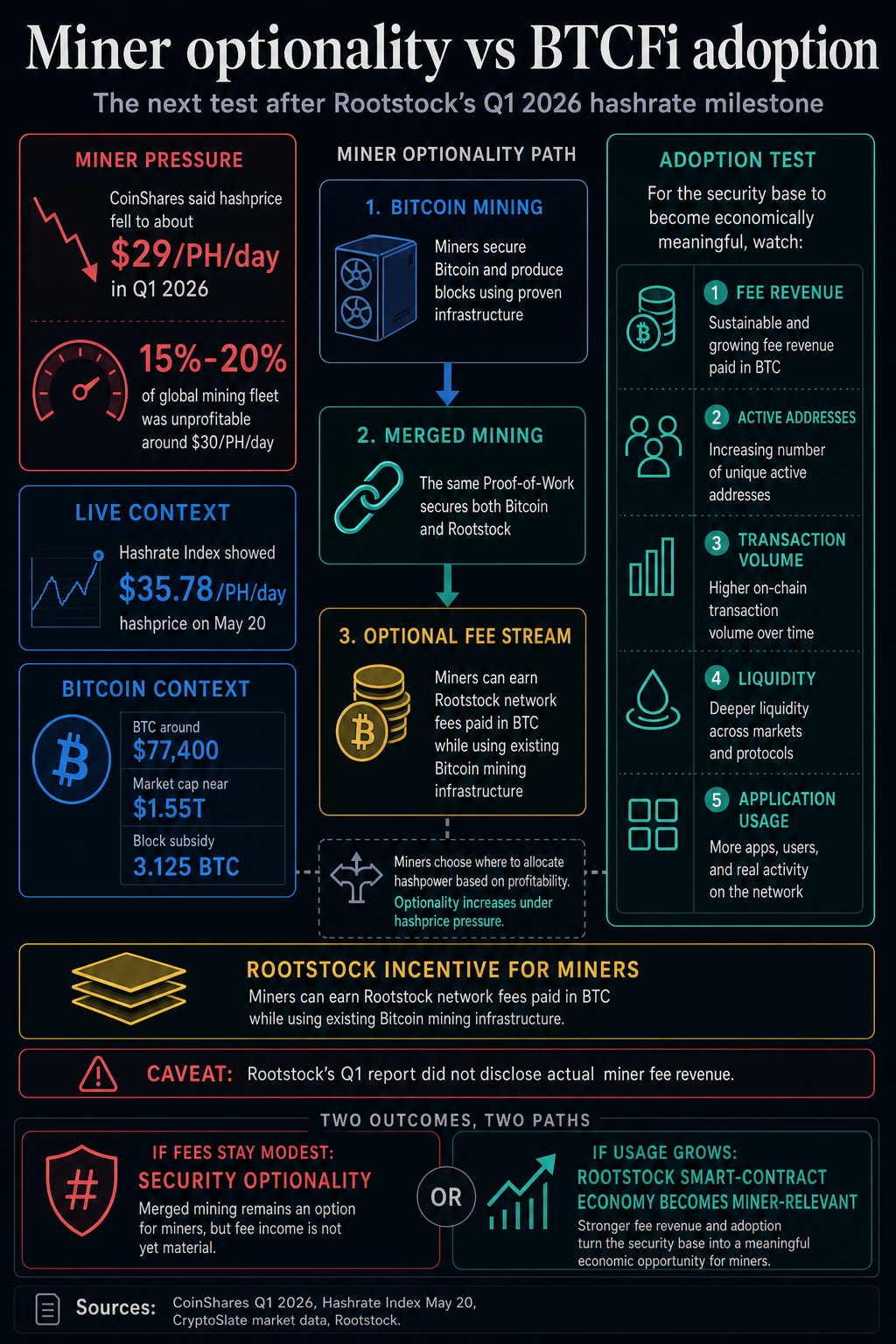
The firm said hashprice was compressed by Bitcoin’s late-2025 price decline and high network competition. It fell further to about $29 per PH/day in Q1, and CoinShares estimated that 15% to 20% of the global mining fleet was unprofitable at around $30 per PH/day.

Hashrate Index has hashprice at $35.78 per PH/day, and Bitcoin network hashrate at 984.34 EH/s.

CryptoSlate market data shows $BTC trading around $77,300 with a market cap near $1.55 trillion, while its market rankings placed Bitcoin dominance at 60.1%.

At that price, the 3.125 $BTC block subsidy remains the core mining reward. Additional fee streams become easier to understand in business terms when miners are managing hardware refreshes, power costs, treasury sales, and AI or high-performance computing opportunities.

Rootstock’s pitch to miners is that a pool can add another fee source while using the same proof-of-work. That is a modest claim, but it is also why the Q1 hashrate figure is more broadly relevant.

Merged mining gives Bitcoin miners an option on BTCFi fee growth while keeping their main operation anchored to Bitcoin.

For $BTC holders, the implication is different. If miners can secure Bitcoin-native smart-contract infrastructure without redirecting hashpower away from Bitcoin, then part of the BTCFi stack is already attached to Bitcoin’s economic engine.

The security base exists before the market has settled on how valuable that infrastructure will become.

The Q1 number lands first as optionality for miners, then as a challenge for builders: convert a strong security base into regular economic activity.

The income effect remains unquantified. Merged mining can make sense even when fees are small because the incremental operational burden is limited, according to Rootstock’s mechanics, but materiality still depends on actual fee flow.
Where security has to turn into usage

Hashrate can rise faster than usage. Messari’s State of Rootstock Q1 2025 report showed that Rootstock’s merged-mining participation averaged 81% in that quarter after the integration of Foundry and SpiderPool.

In the same report, Messari recorded weaker user metrics, including lower active addresses, lower new addresses, and a decline in DeFi TVL.

That earlier split is the key caveat for the new Q1 2026 figure. High participation in merged mining can make a network harder to attack, while borrowers, traders, stablecoin liquidity, and developers determine whether the secured network becomes economically active.

Security is a prerequisite for financial activity, while fee revenue and usage show whether people are using the rails.

The available Q1 2026 mining report leaves the most important miner-economics number outside the table: actual Rootstock fee revenue to miners.

Rootstock says rewards are paid in Bitcoin from network fees, but the Q1 mining report focuses on hashrate participation and pool distribution rather than a miner revenue breakdown.

The small scale of Rootstock’s token economy reinforces that caveat. CryptoSlate market data shows rBTC, the Bitcoin-pegged asset used on Rootstock, with a market capitalization of about $19.9 million. RIF, the Rootstock Infrastructure Framework token, is larger at about $74.4 million, but still modest by crypto-sector standards.

Together, those figures show that Rootstock’s security footprint is much larger than the market value currently attached to its core ecosystem assets.

Rootstock has shown that most Bitcoin hashrate can secure BTCFi infrastructure through merged mining. But it still needs activity and fee data to show that the infrastructure is becoming economically important for miners and $BTC holders.

The next test is economic. If Rootstock fee revenue, active addresses, transaction volume, liquidity, and application usage remain modest, merged mining will look like valuable optionality for miners and a security feature for users.

If those metrics grow alongside sustained mining-pool participation, the argument changes: Bitcoin’s hashrate would be helping miners earn from a real Rootstock smart-contract economy secured through merged mining.

For now, Rootstock’s 84.01% figure gives Bitcoin DeFi a stronger infrastructure claim. It shows that a Bitcoin smart-contract layer can sit on top of a large share of Bitcoin’s mining work while miners continue their main business.

The harder part is converting that security headline into enough activity and fees for miners and $BTC holders to care beyond the hashrate number.

Share. Facebook Twitter Pinterest LinkedIn Tumblr Email
NBTC

NBTC is the editorial account for NBTC News, covering Bitcoin, Ethereum, DeFi, blockchain infrastructure, exchanges, mining, regulation and digital asset markets. The editorial team focuses on clear sourcing, timely updates and practical context for crypto readers.

Related Posts

Trump-linked American Bitcoin president Matt Prusak departs for Giga Energy

04/08/2026

Solo Bitcoin Miner Hits Jackpot, Scoring $200K BTC Reward

04/08/2026

Bitcoin miner gambles on a 4-day bridge loan equal to 97% of its BTC treasury value – the deadline passed without in total silence

03/08/2026

Bitcoin Miners Face August Showdown After Revenue Rebound

03/08/2026
Add A Comment

Comments are closed.

Top Posts
Get Informed

Subscribe to Updates

Get the latest news from NBTC regarding crypto, blockchains and web3 related topics.

Your source for the serious news. This website is crafted specifically to for crazy and hot cryptonews. Visit our main page for more tons of news.

We're social. Connect with us:

Facebook X (Twitter) LinkedIn RSS
Top Insights

62.6K Unique Addresses Hold Robinhood’s Stock and ETF Tokens — What This Means

04/08/2026

Chainlink whales add $22M LINK, but institutions are quiet: Is $20 still possible?

04/08/2026

CLARITY Act odds fall to 34% as Senate delays vote

04/08/2026
Get Informed

Subscribe to Updates

Get the latest news from NBTC regarding crypto, blockchains and web3 related topics.

Type above and press Enter to search. Press Esc to cancel.